Rivian R2 Owners Crack the Code to Ultra-Cheap Charging via Smart Automation
With public fast-charging prices continuing to climb, the true economic promise of electric vehicle ownership lies squarely in the garage. A Rivian R2...
Editorial Team
World Of EV
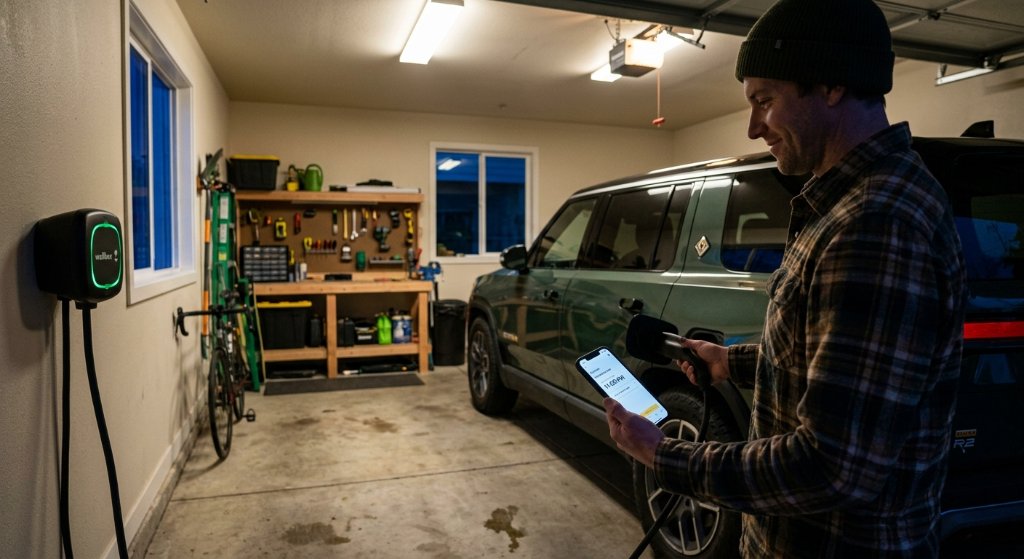
With public fast-charging prices continuing to climb, the true economic promise of electric vehicle ownership lies squarely in the garage. A Rivian R2 owner recently demonstrated how easily savvy buyers can exploit this advantage, revealing that they slashed their home-charging costs to roughly one-third of the standard daytime rate. By utilizing the Rivian app to automate and delay their vehicle's charging cycle to start at exactly 11:05 PM, the owner successfully bypassed peak utility rates, tapping exclusively into their energy provider's 'super off-peak' window.
This real-world hack comes at a critical juncture for Rivian. The California-based automaker recently began public deliveries of the mid-size R2 SUV—starting with the $57,990 Performance trim, with a standard $45,000 model expected next year. Unlike the premium R1T and R1S that established the brand as a rugged luxury icon, the R2 is Rivian's make-or-break bid for the mass market. To succeed against established segment leaders like the Tesla Model Y, the R2 cannot just be an adventure vehicle; it must be an economical, seamless daily driver.
The Power of 11:05 PM: Automating the Savings
While hardware often dominates EV headlines, software is increasingly dictating the ownership experience. The R2 owner's ability to minimize utility bills points to the sophistication of Rivian's companion app. By taking less than a minute to configure a delayed charging schedule, the owner ensured their R2 drew power only when the grid was underutilized and electricity was cheapest.
This simple adjustment highlights how modern EV software is dismantling the 'range anxiety' narrative and replacing it with 'cost optimization.' Rather than requiring an expensive, third-party smart wall charger, the R2's onboard software handles the scheduling natively. Key software and hardware features driving this optimization include:
- Granular Time-of-Use (TOU) Scheduling: The Rivian app allows owners to set precise, minute-by-minute charging windows to match local utility structures.
- Next-Gen Cell Efficiency: The R2's structural battery pack utilizes massive 4695-type cylindrical cells (46 mm wide, 95 mm tall), which offer a larger form factor and better energy density than Tesla's 4680 cells, facilitating steady home charging without overheating.
- Native NACS Integration: Combined with a native North American Charging Standard (NACS) port, the R2 is designed to adapt to any environment, from a 240V home outlet to Tesla's Supercharger network.
Why This Matters:
This grassroots case study signals a vital transition for the EV industry: the democratization of energy management. Early adopters of the premium R1 platform (frequently priced near or above six figures) rarely concerned themselves with minor fluctuations in their utility bills. However, the R2 target demographic is highly cost-conscious. For these buyers, cross-shopping against the Model Y or Hyundai Ioniq 5, the true cost of ownership is a deciding factor. By making smart-charging automation brainless, Rivian is addressing a primary friction point for mainstream buyers.
Furthermore, this capability represents a massive win for utility grid operators. As millions of new EVs plug in over the coming years, uncontrolled peak-hour charging could overwhelm local grids. Native, automated vehicle-side scheduling aligns consumer savings with grid stability. For Rivian, delivering robust, intuitive software that saves owners thousands of dollars annually isn't just a neat feature—it is a critical moat in the brutal mass-market price wars.
Ultimately, as Rivian ramps R2 production at its Normal, Illinois factory, success will not just be measured by horsepower or off-road wading depth. It will be measured in the cents-per-kilowatt-hour saved by regular drivers. This simple scheduling trick proves that Rivian's software stack is fully prepared to deliver on the economic promise of the electric transition.