Real-World Data Proves Heavy Electric Trucks Are Ready For Primetime—But Charging Bottlenecks Threaten Rollout
A groundbreaking new survey by Germany’s renowned Öko-Institut offers an unfiltered, real-world look at heavy electric truck operations. Moving beyond...
Editorial Team
World Of EV
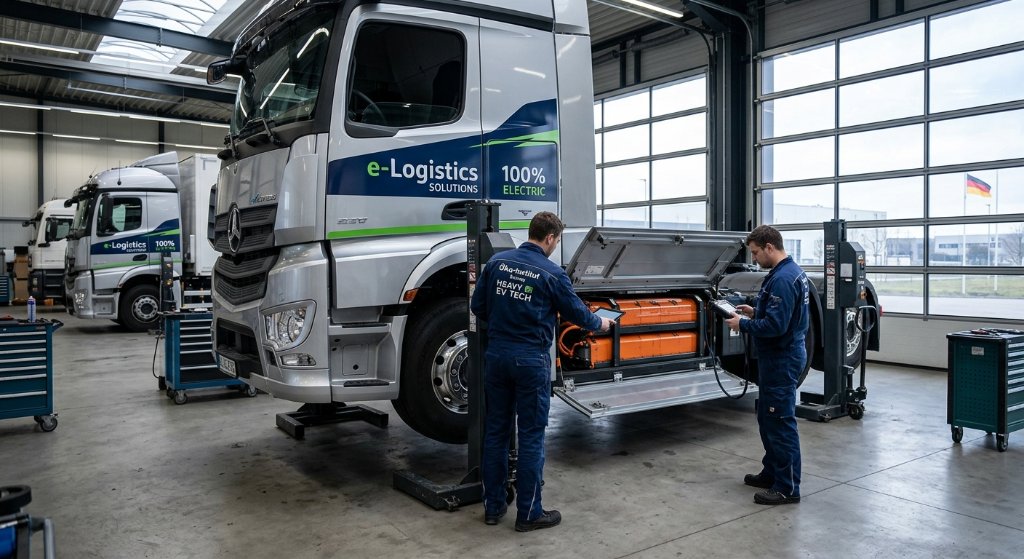
A groundbreaking new survey by Germany’s renowned Öko-Institut offers an unfiltered, real-world look at heavy electric truck operations. Moving beyond theoretical projections and pilot-phase optimism, the study surveyed 57 German companies running heavy battery-electric trucks—ranging from 3.5-metric-ton vans to massive 18-ton long-haul rigs—for over a year. The verdict is highly encouraging for proponents of electrification, but it serves as a stark warning to grid operators and policy makers.
For decades, diesel has been the undisputed king of freight transport, with logistics fleets operating under the assumption that battery-electric drivetrains could never endure the grueling duty cycles of long-haul logistics. However, with the European Union mandating an aggressive 45% reduction in heavy-duty CO2 emissions by 2030 (scaling to 90% by 2040), the pressure to transition is immense. While legacy truck manufacturers have historically lobbied to weaken these targets, this new real-world data demonstrates that the technology itself is ready to perform, even if the surrounding infrastructure is not.
The Verdict: Drivers Love Them, Operators Save Money
Fleet operators who have made the leap are overwhelmingly satisfied with their transition away from diesel. The survey results shatter the myth that electric trucks are a compromise, proving that they deliver immediate, tangible benefits in daily operations:
- High Operator Satisfaction: An impressive 93% of surveyed fleet operators expressed high overall satisfaction, citing exceptional driver comfort and substantial fuel and energy savings.
- Reliability on Par with Diesel: Critics of early adoption have long predicted that complex high-voltage systems would lead to frequent breakdowns. Instead, 71% of operators reported that their electric heavy-duty vehicles performed on par with or better than traditional diesel rigs.
- The Dominance Timeline: Despite the hurdles, the industry is looking forward with immense confidence. More than 90% of the pioneering operators surveyed expect battery-electric trucks to dominate their fleets by 2030.
The Growing Pains: Maintenance and Infrastructure Hurdles
Despite the overwhelming positivity, the transition from diesel to electric is not without friction. Fleet operators identified key operational bottlenecks that continue to slow down full-scale adoption:
- Early Maintenance Bugs: Approximately 25% of operators reported more frequent maintenance or mechanical issues compared to diesel. This points to the reality that heavy EV trucks are still in their early-generation optimization phase, requiring manufacturers to refine component durability.
- Depot Power Bottlenecks: While depots carried a respectable average grid connection of 1,115 kW, the average installed charging capacity sat at just 629 kW—revealing that many operators are hitting physical and regulatory grid limits when trying to upgrade their facilities.
- The Public Charging Desert: Public charging accounted for a mere 8% of energy consumed across all surveyed fleets. Existing highway infrastructure remains fundamentally hostile to commercial rigs, and operators frequently cited highly volatile pricing and opaque billing structures at public stations as major pain points.
Why This Matters:
The Öko-Institut survey delivers a critical proof-of-concept: battery-electric trucks are not a future pipe dream; they are a viable business solution today.
The Big Winners: Battery-electric truck manufacturers (like Daimler Truck, Volvo Group, and Traton) are the big winners here. The data proves a massive 'perception gap' exists in the industry—while 71% of active users find e-trucks highly reliable, logistics firms without EV experience remain highly skeptical. This study gives manufacturers the ammunition they need to convince hesitant fleet buyers to convert. Furthermore, truck drivers win big, benefiting from reduced noise, zero vibrations, and significantly lower physical fatigue.
The Big Losers: The hydrogen fuel-cell lobby is the clear loser of this transition. While hydrogen was previously hyped as the only viable solution for long-haul shipping, the Öko-Institut's wider research shows interest has plummeted. In 2021, 80% of logistics companies expected hydrogen to play a major role; today, that figure has fallen below half, as battery technology rapidly advances.
The Market Signal: This is a loud wake-up call to utility companies, grid operators, and governments. The vehicles are ready, and the fleets are willing, but the infrastructure is lagging. If European governments do not rapidly accelerate depot grid connection approvals and invest heavily in high-power Megawatt Charging Systems (MCS) along major highways, they will artificially bottleneck the EV transition. This isn't a vehicle problem anymore—it’s an infrastructure emergency.
Conclusion
The transition of road freight transport is no longer a question of 'if,' but 'how fast.' German fleet operators have proven that heavy electric trucks can go toe-to-toe with diesel in reliability, driver satisfaction, and operating costs. However, until public charging networks are tailored to heavy-duty logistics and grid connections are simplified, fleets will remain anchored to their depots. The ball is now firmly in the court of grid operators and policymakers to unlock the grid and power the future of zero-emission freight.