Power Move: Hyundai and SK On Fire Up $5 Billion Georgia Battery Plant to Unlock Massive US EV Tax Credits
Mass production of advanced battery cells has officially commenced at the $5 billion Hyundai SK Battery Manufacturing America (HSBMA) facility in Bart...
Editorial Team
World Of EV
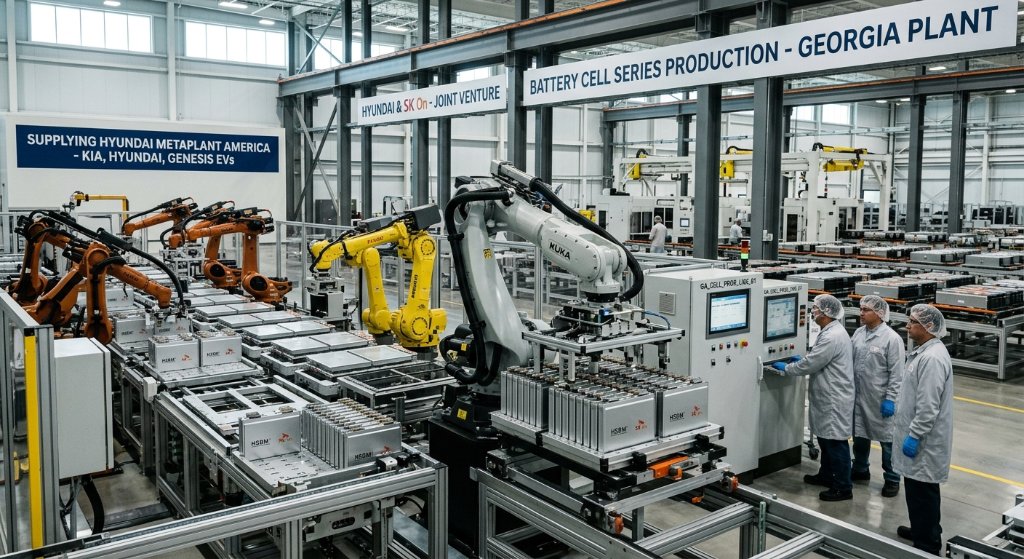
Mass production of advanced battery cells has officially commenced at the $5 billion Hyundai SK Battery Manufacturing America (HSBMA) facility in Bartow County, Georgia. For years, Hyundai Motor Group—encompassing the Hyundai, Kia, and Genesis brands—has designed some of the world’s most compelling, critically acclaimed electric vehicles. Yet, the South Korean automotive giant faced an uphill battle in the United States. Deprived of the federal $7,500 EV consumer tax credit under the strict localization rules of the Inflation Reduction Act (IRA), Hyundai had to rely on creative leasing loopholes to maintain its sales momentum.
That defensive strategy is officially a thing of the past. With the launch of the HSBMA joint venture, Hyundai is establishing a robust, localized supply chain directly in America's "battery belt". These domestic battery cells will soon find their way into the floors of U.S.-built EVs, unlocking the full, unqualified federal tax incentive for retail buyers and leveling the playing field against domestic heavyweights.
Inside the 35 GWh Georgia Powerhouse
The new facility in Bartow County represents a massive 50/50 joint venture between Hyundai Motor Group and SK On. Spanning a colossal 3.3 million square feet, the plant represents one of the largest economic development projects in Georgia’s history, backed by $641 million in state and local incentives.
Key specifications of the newly opened plant include:
- Annual Capacity: 35 GWh at full scale, which is enough to power approximately 300,000 high-performance electric vehicles annually.
- Workforce: Expected to employ over 3,500 workers when operations are fully ramped up.
- The Logistics Pipeline: Raw cells produced at the Bartow County plant will be shipped to Hyundai Mobis to be assembled into complete battery packs.
- The Destination: The finished packs will go directly to Hyundai’s nearby $12.6 billion "Metaplant America" (HMGMA) in Bryan County, Georgia, to power vehicles like the award-winning Ioniq 5 and the upcoming Ioniq 9 three-row SUV.
- The Technology: High-nickel NCM (nickel-cobalt-manganese) pouch cells designed to deliver exceptionally high energy density and support Hyundai’s ultra-fast 800V E-GMP charging architecture.
Fueling the Metaplant and Shaking Up the Competition
While SK On has been bridging the gap by supplying battery cells from its standalone Commerce, Georgia facility, the Bartow County joint venture serves as Hyundai's permanent, dedicated pipeline. This dedicated supply is crucial as Metaplant America ramps up production of the highly anticipated Ioniq 9 and the refreshed Ioniq 5.
From a technological standpoint, these high-nickel NCM cells are a direct challenge to the rest of the industry. Unlike Tesla's slower-ramping 4680 dry-electrode structural cells, or BYD’s safe but lower-voltage LFP (lithium iron phosphate) Blade batteries, SK On's cells are highly optimized for charging speed. Coupled with Hyundai's 800-volt architecture, these batteries can juice from 10% to 80% in a mere 18 minutes—a metric that remains a primary selling point for savvy EV buyers who refuse to spend their road trips waiting at chargers.
Why This Matters:
The Big Winners: Hyundai, Kia, and Genesis are the undisputed victors here. By localizing cell production in Georgia, they can bypass the complex leasing workaround and hand a clean, point-of-sale $7,500 discount directly to retail buyers of US-made EVs. Hyundai is already closing the gap on General Motors to secure the spot as the #2 EV brand in America; this plant is the turbocharger that could push them over the top.
The Losers: Legacy automakers who have dragged their feet on domestic battery localization—particularly Japanese brands like Toyota and Honda—will find themselves further outpaced. Furthermore, domestic rivals like Ford and GM will face a highly aggressive, price-competitive product line from Hyundai that no longer suffers from a tax-incentive disadvantage.
The Market Signal: This is a clear demonstration of Hyundai’s "do-or-die" commitment to the American market. Not only are they launching this massive plant with SK On, but they also have a second joint-venture battery plant with LG Energy Solution underway nearby. By building an ironclad, local supply chain, Hyundai is successfully insulating itself against future political swings, tariff threats, and foreign entity of concern (FEOC) rules. They aren't just trying to participate in the U.S. EV transition; they are building the infrastructure to dominate it.
The Bottom Line
The official start of mass production at the Bartow County battery plant is the final, crucial piece of the puzzle for Hyundai Motor Group's American ambitions. By linking a dedicated, state-of-the-art battery facility to its sprawling Metaplant, Hyundai has closed the loop on its localized supply chain. For the American consumer, this translates to faster-charging, highly advanced EVs that finally qualify for the full federal tax credit right off the dealership lot. The competition should be very worried.