Phantom Grime: Tesla's FSD v14.3.9 Bug Falsely Flags Clean Cameras, Forcing Proactive Service Cancellations
Tesla has once again illustrated the delicate high-wire act of its 'vision-only' autonomy philosophy. Following the deployment of its Full Self-Drivin...
Editorial Team
World Of EV
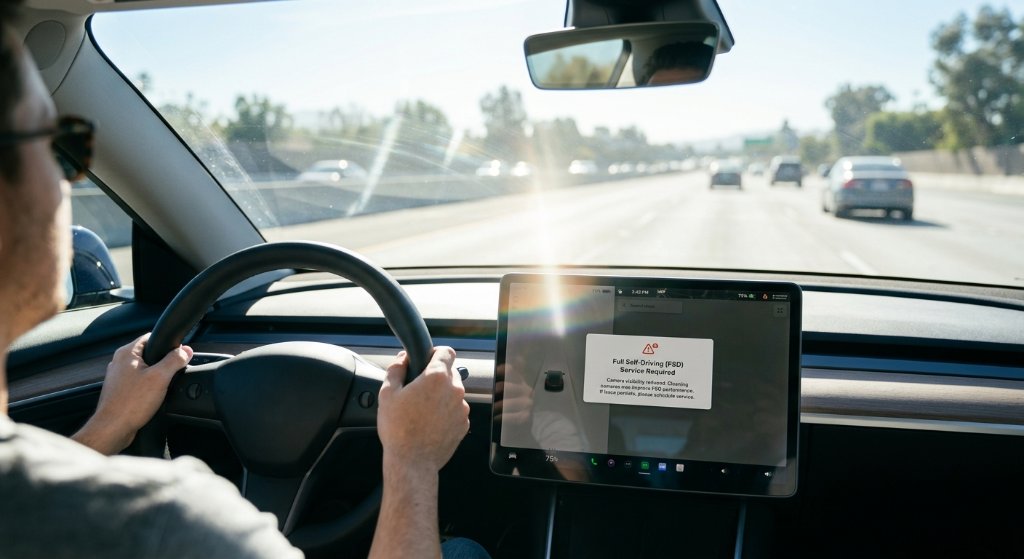
Tesla has once again illustrated the delicate high-wire act of its 'vision-only' autonomy philosophy. Following the deployment of its Full Self-Driving (FSD) Supervised v14.3.9 update, thousands of owners have watched their dashboards light up with urgent warnings demanding service for a 'dirty' front-facing camera. The reality? Their cameras are spotless. The culprit is a hyper-sensitive software bug that mistakes normal sunlight and glare for physical windshield debris.
This glitch hits just as Tesla is pushing its latest FSD v14 architecture to Hardware 4 (AI4) vehicles globally. While the update introduces advanced features like Automatic Collision Evasion, it has also triggered an unexpected logistics headache, forcing Tesla's service network to scramble and proactively cancel service appointments booked by confused owners.
Over-Sensitive Algorithms and the Off-Gassing Ghost
The warning itself reads, 'Poor camera visibility detected. Interior windshield residue cleaning is required.' This prompt is actually tied to a very real historical issue: interior cabin plastics 'off-gassing' over time, which coats the inside of the windshield with a hazy film directly in front of the forward-facing camera enclosure. To address this, Tesla introduced a dedicated residue detector in late 2025 under FSD v14.1.7, and even offered a free 15-minute service cleaning because camera clarity is so critical to the system.
However, in the v14.3.9 build (shipped via software updates 2026.27.5 and 2026.27.6), the vision encoder's threshold has been tuned far too aggressively. Normal, everyday driving conditions—such as heading directly into a low morning sun or encountering sudden lens glare—are being misclassified as an obstructed camera.
Key Takeaways of the FSD v14.3.9 Glitch:
- The Root Cause: A buggy vision-encoder threshold in v14.3.9 that misidentifies normal sun glare as plastic off-gassing film.
- The Symptoms: Spurious dashboard warnings demanding professional glass cleaning, often disabling FSD capabilities or prompting immediate driver intervention.
- Tesla's Reaction: Proactively messaging affected owners to cancel their service appointments, assuring them that their physical hardware is functioning normally.
- The Upcoming Fix: A software patch is promised in the FSD v14.3.10 build (firmware 2026.27.10), which has already begun early deployment.
- Financial Redress: Owners who have already paid out-of-pocket for diagnostic cleanings during this bug's window can contact Tesla Support for a refund.
Why This Matters:
This software glitch is far more than a minor annoyance; it exposes a structural vulnerability in Tesla's pure vision playbook. By completely abandoning radar and ultrasonic sensors in favor of cameras (Tesla Vision), Elon Musk’s engineering team has made FSD’s reliability entirely dependent on pristine optical inputs. When a basic coding error makes the car 'think' it is blind when it is simply facing the sun, it causes sudden, unpredictable disengagements. For drivers, this degrades trust in a system that is supposed to be moving closer to unsupervised, robotaxi-ready status.
Furthermore, this incident underscores the operational bottleneck of Tesla's service model. Tesla's physical service centers are already notoriously backlogged. A software update that inadvertently prompts thousands of drivers to book unnecessary appointments represents an operational failure. While Tesla's proactive system-wide cancellation of these service appointments shows agility, it also highlights how a single line of bad code in an over-the-air (OTA) update can immediately threaten to choke physical service infrastructure.
While Tesla's FSD v14-series represents a massive evolutionary leap in neural-network-driven driving, the v14.3.9 camera bug serves as a humbling reminder of the real-world friction of vision-only autonomous tech. As Tesla rolls out v14.3.10 to patch the issue, the company must realize that achieving true autonomy isn't just about training neural nets to drive—it is about ensuring the system doesn't panic when it looks at the sun.