Lucid Hit With Class-Action Lawsuit Over Hidden Gravity SUV Quality Issues and 29-Day Delivery Halt
Lucid Group, Inc. is facing a massive legal headache just as it attempts to scale its highly anticipated savior, the Gravity SUV. Nationally recognize...
Editorial Team
World Of EV
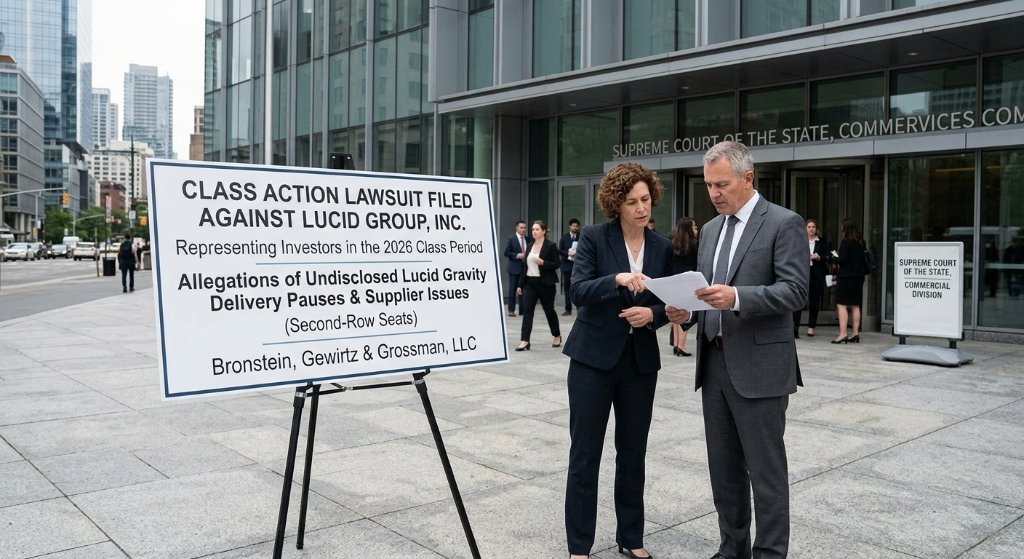
Lucid Group, Inc. is facing a massive legal headache just as it attempts to scale its highly anticipated savior, the Gravity SUV. Nationally recognized investor-rights law firm Bronstein, Gewirtz & Grossman, LLC has officially filed a securities class-action lawsuit against the luxury EV manufacturer and its top executives. The lawsuit alleges that Lucid actively concealed a critical supplier quality issue concerning the Gravity’s second-row seats—a defect that quietly halted deliveries of the flagship SUV for 29 days and put a serious dent in the company’s financial results.
This legal challenge comes at an incredibly delicate moment for the California-based automaker. Having spent years attempting to scale production of the ultra-efficient but slow-selling Air sedan, the three-row Gravity SUV was supposed to be Lucid’s breakout hit—the volume-driving vehicle designed to pull the company out of its deep cash-burn phase and appeal to the lucrative family SUV market. Instead, this lawsuit exposes the same supply-chain and manufacturing bottleneck ghosts that have haunted the automaker since its public debut.
The Alleged Secret Delivery Freeze
The complaint, which represents investors who acquired Lucid securities between February 25 and April 13, 2026, claims that Lucid’s management team deliberately misled the market. According to the lawsuit, the defendants failed to disclose that a major supplier quality issue involving the second-row seats had completely paralyzed Gravity deliveries.
By keeping this information under wraps, the lawsuit argues that Lucid's leadership overstated the brand's manufacturing efficiency, operational readiness, and near-term delivery capabilities. When the truth finally came to light, it became clear that the 29-day halt had severely compromised the company’s ability to meet eager customer demand, throwing a wrench into what was supposed to be a flawless product launch.
The Math Behind the Manufacturing Glitch
The real-world impact of the delivery halt was laid bare in Lucid's Q1 2026 production and delivery numbers, which highlighted a glaring mismatch between vehicles built and vehicles actually handed over to customers:
- Vehicles Produced (Q1 2026): 5,500 units
- Vehicles Delivered (Q1 2026): 3,093 units
- The Backlog Gap: 2,407 vehicles built but undelivered
- The Gravity Freeze: 29 days of zero Gravity deliveries due to the second-row seat supplier defect
While Lucid's production numbers showed healthy manufacturing activity, the delivery numbers disappointed Wall Street. The 29-day delivery freeze meant that a substantial portion of the quarter's built Gravity SUVs sat in holding lots rather than being converted into much-needed revenue.
Why This Matters:
This lawsuit is far more than a routine legal skirmish; it strikes at the core of Lucid's identity and its relationship with the market. Here is the expert breakdown of why this situation is critical:
- The Trust Deficit: Lucid has struggled for years to convince Wall Street that it can match its world-class engineering with world-class volume manufacturing. The Lucid Air is arguably the most efficient EV on the planet, yet delivery numbers have historically lagged far behind production capacity. By allegedly hiding a major supplier glitch, Lucid risks alienating the very investors who fund its high-burn operations.
- The Gravity is a 'Do-or-Die' Vehicle: Unlike established giants, Lucid does not have the luxury of a slow, troubled vehicle rollout. The Gravity, starting at $94,900 for the Grand Touring model, is the make-or-break product meant to bring Lucid to profitability. Any threat to its reputation or delivery momentum is an existential risk.
- Competitors are Ready to Pounce: Every day a Lucid Gravity sits undelivered is a win for rivals. The Rivian R1S continues to dominate the premium three-row EV space, while the aging Tesla Model X and various luxury European electric SUVs remain ready alternatives for frustrated buyers who don't want to wait on supply chain dramas.
- The PIF Safety Net Shielding the Brand: Lucid remains heavily backed by Saudi Arabia’s Public Investment Fund (PIF), which holds a majority stake. While this sovereign wealth backing ensures Lucid won’t go bankrupt tomorrow, the PIF’s patience is not infinite. To secure future tranches of capital, Lucid must prove it can execute flawlessly without hiding material operational struggles.
The Road Ahead
Lucid has since reassured the market that the second-row seat supplier issues have been fully resolved and has reaffirmed its full-year 2026 production guidance of 25,000 to 27,000 vehicles. However, a physical fix for a seat latch is much easier to implement than a repair to corporate credibility. As the lead plaintiff deadline of July 28, 2026, approaches, the court of public and investor opinion will be watching closely to see if Lucid can finally align its master-class engineering with transparent, dependable execution.