Locked Gates and 'Ransom' Demands: Tesla Files Emergency Lawsuit to Save Cybertruck Production
Tesla is facing an unprecedented supply chain crisis that threatens to grind Cybertruck production at Gigafactory Texas to a screeching halt. In an em...
Editorial Team
World Of EV
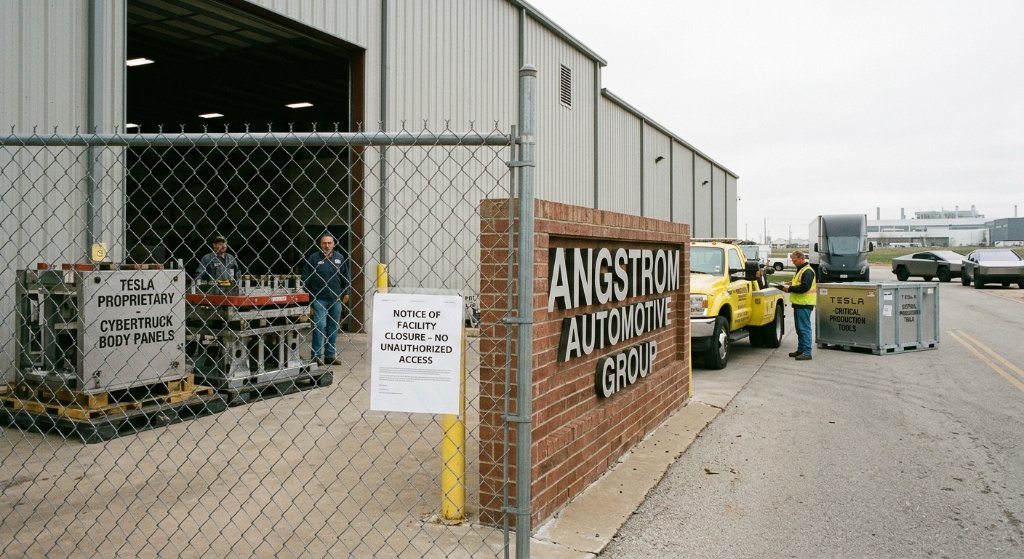
Tesla is facing an unprecedented supply chain crisis that threatens to grind Cybertruck production at Gigafactory Texas to a screeching halt. In an emergency lawsuit filed in the U.S. District Court for the Western District of Texas, the EV giant is seeking immediate federal intervention to retrieve its proprietary manufacturing tools from supplier Angstrom Automotive Group. The Troy, Texas facility is shutting down, and Angstrom has locked its gates—essentially holding the critical, multi-ton equipment "hostage" in a high-stakes commercial standoff.
This dramatic confrontation underscores the extreme fragility of the Cybertruck's highly customized supply chain. While Tesla’s high-volume vehicles like the Model Y have diversified component sourcing, the stainless-steel clad Cybertruck relies heavily on highly specialized, single-sourced manufacturing processes. Tesla warns that without immediate access to these proprietary dies and fixtures, Cybertruck production will run dry "in mere days," delaying the deliveries of several thousand electric pickups already committed to eager customers.
An Escalating Eight-Day Standoff
The relationship between Tesla and Angstrom—which acquired Tesla’s former supplier, Anderton Castings, in early 2025—deteriorated with staggering speed. According to the court filing, the entire crisis unfolded in just over a week:
- July 13: Angstrom abruptly notifies Tesla that it intends to shut down its Troy, Texas facility, failing to offer a cooperative exit strategy for Tesla's proprietary equipment.
- July 17: A scheduled shipment of 700 finished Cybertruck components fails to leave the factory, immediately choking the supply line.
- July 21: Tesla representatives, accompanied by local law enforcement, arrive at the Troy plant to retrieve their equipment, only to be turned away at the locked gates.
- The "Ransom" Demand: Angstrom allegedly demands compensation for previous tooling modifications and asks for an additional $250,000 per week to keep the facility running—a move Tesla characterizes as a blatant attempt to exert commercial pressure by holding its property hostage.
The Unreplaceable Tooling Behind the Dispute
Tesla's legal maneuver is highly targeted. The automaker is not seeking financial damages or a resolution to the broader commercial contract dispute. Instead, it is asking the court for one thing: immediate physical access to reclaim its proprietary machinery.
The equipment being withheld is not off-the-shelf hardware that Tesla can easily replace. It includes a massive suite of custom-engineered assets:
- Large die-cast machinery and trim dies specifically designed to stamp and shape unique Cybertruck components.
- Precision fixtures, cutting tools, and gauges required to maintain the vehicle’s strict, angular tolerances.
- X-ray inspection gear vital for quality control and structural integrity testing of cast components.
- 700 finished components that are already manufactured but trapped inside the shuttered facility.
Because these tools are custom-built, Tesla cannot simply order replacements. Rebuilding these complex dies and machinery from scratch would take months—a timeline that would completely derail Cybertruck momentum just as the automaker is ramping up deliveries.
Why This Matters:
This is more than a standard vendor dispute; it is a critical vulnerability test for Tesla's manufacturing philosophy.
The Vulnerability of Bespoke Architecture: The Cybertruck is a marvel of unconventional engineering, featuring an ultra-hard stainless-steel exoskeleton and massive, complex gigacastings. However, this unique design is a double-edged sword. Unlike the legacy Model 3 or Model Y, which benefit from highly mature, redundant global supply chains, the Cybertruck's bespoke architecture means Tesla is dangerously dependent on single-source suppliers like Angstrom. When a single node in that chain fails or goes rogue, the entire multi-billion-dollar assembly line at Giga Texas faces an immediate shutdown.
Who Wins and Who Loses? In the short term, nobody wins. If the court denies Tesla’s emergency request, the immediate loser is the consumer. Thousands of reservation holders who have waited years—and recently committed to higher-priced Foundation Series or newly released trims—will face indefinite delivery delays. Financially, Tesla loses massive momentum and revenue at a time when Wall Street is hyper-focused on its automotive margins and delivery numbers. Angstrom, while attempting to leverage the tooling for a quick payout, faces severe legal liabilities and reputational damage that could alienate other major automotive OEMs.
A Wake-Up Call for Just-in-Time Sourcing: This standoff signals a broader warning to the entire EV industry. The "just-in-time" manufacturing model, combined with highly customized vehicle platforms, leaves OEMs incredibly exposed to supplier insolvency or hostility. To secure its future, Tesla may be forced to aggressively bring more of its component manufacturing in-house or establish strict contractual safeguards that allow immediate, uncontested reclamation of proprietary tooling. It’s a "do-or-die" moment for Cybertruck's production stability, proving that even the world’s most valuable automaker can be brought to its knees by a locked gate in Troy, Texas.
Conclusion
As the Western District of Texas prepares to rule on Tesla’s emergency filing, the clock is ticking loudly for Gigafactory Texas. While Elon Musk’s manufacturing strategy has long favored vertical integration, this dispute reveals the lingering vulnerabilities in Tesla’s outer supply ring. If Tesla secures its tools, it will be a swift, albeit stressful, lesson in supply chain security. If it fails, the Cybertruck’s production halt will reverberate through Tesla's next quarterly earnings, highlighting the high cost of pioneering radical automotive design.