Lincoln Electric Strikes Gold: Velion Becomes the First EV Charger to Secure NEMA's Coveted 'Make It American' Certification
For years, the Achilles' heel of the American electric vehicle transition has been its deeply flawed, notoriously unreliable charging infrastructure. ...
Editorial Team
World Of EV
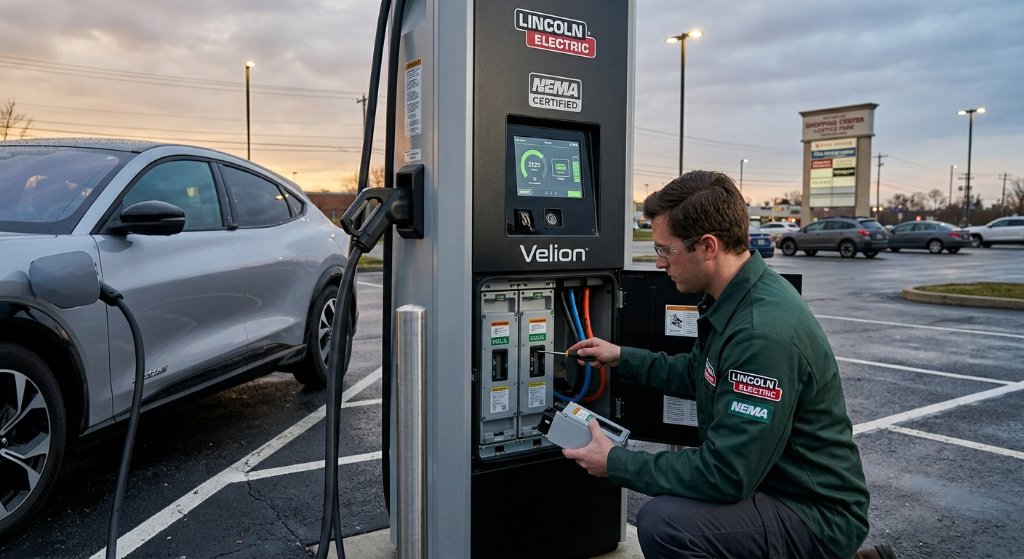
For years, the Achilles' heel of the American electric vehicle transition has been its deeply flawed, notoriously unreliable charging infrastructure. While flashy software and high-voltage promises capture headlines, the reality on the ground has been a frustrating maze of broken screens, faulty connectors, and slow maintenance turnarounds. State departments of transportation and private contractors, eager to deploy billions of dollars from the federal National Electric Vehicle Infrastructure (NEVI) formula program, have found themselves bottlenecked by rigid domestic sourcing mandates.
Now, a 130-year-old heavy-industry champion is stepping up to show the tech startups how it is done. Lincoln Electric—a global titan in welding and industrial power electronics—has captured the industry's first-ever product-level "Make It American" certification from the National Electrical Manufacturers Association (NEMA) for its Velion DC fast-charging equipment. This is not just a regulatory rubber stamp; it is a critical market-unlocking milestone that promises to rewrite the rules of the American EV charging landscape.
Solving the Downtime Disaster: Inside the Velion Architecture
The Velion DC Fast Charger is designed from the ground up to tackle the twin plagues of public charging: sluggish supply chains and excessive downtime. Utilizing Lincoln Electric's century-plus expertise in building rugged industrial equipment that survives the harshest environments, the Velion introduces a highly resilient, modular design.
Rather than requiring a specialized technician to disassemble a complex, bespoke cabinet when a single component fails—a process that currently leaves third-party chargers out of order for weeks—the Velion allows operators to swap modular power units quickly and easily on-site.
Key Specs and Features of the Velion DC Charging System:
- Power Delivery: 150 kW DC Fast Charging featuring a dual dispenser with an integrated cable management system.
- Modular Architecture: Designed to simplify on-site maintenance, enabling quick-swap repairs that dramatically lower the long-term cost of ownership.
- Deep Domestic Content: Engineered and manufactured in the U.S. with more than 70% domestic component sourcing.
- BABA Compliance: Independently validated under the stringent NEMA 70901-11 standard, making it fully eligible for federally funded infrastructure projects.
Navigating the BABA Minefield
The Build America, Buy America (BABA) Act, established under the 2021 Bipartisan Infrastructure Law, mandates that any federally funded EV charger must be manufactured in the United States and feature a high percentage of domestic parts. This requirement has triggered a mad scramble among EV equipment manufacturers, many of whom have struggled to untangle their supply chains from foreign manufacturing hubs.
NEMA's "Make It American" program, officially recognized as a vital industry resource by the Federal Highway Administration (FHWA), solves this headache. By subjecting the Velion chargers to rigorous, third-party audits of facilities, supply chains, and component percentages, Lincoln Electric has effectively removed the compliance risk for state DOTs, municipalities, and private developers. When contractors buy a Velion charger, they know they are legally cleared to unlock federal funds without fear of audit clawbacks.
Why This Matters:
The Big Winners:
- Lincoln Electric: By positioning itself as the first verified BABA-compliant player in the DC fast-charging space, the company has secured a massive head start in bidding for highly lucrative NEVI-funded highway corridor projects.
- State DOTs and Contractors: Procurement teams can now skip the tedious, risky process of auditing manufacturer supply chains. Lincoln Electric has handed them a pre-approved blueprint for federal compliance.
- The American EV Driver: The Velion’s modular build targets the agonizingly high downtime of public chargers. Faster repairs mean higher charger uptime along major highways, addressing a primary driver of EV range anxiety.
The Losers:
- Foreign-Sourced Legacy Players: Companies that relied on "assembled in USA" marketing tricks while secretly importing core power electronics from Asia are now exposed. They must either overhaul their supply chains at immense cost or forfeit federally backed contracts.
- Over-Engineered Tech Startups: Companies that focus strictly on software while treating the physical charger cabinet as an afterthought are being out-maneuvered by industrial-grade, heavy-duty manufacturers who understand thermal dynamics and electrical ruggedness.
The Market Signal:
This milestone signals a massive shift in the EV charging market from the "software-first" era of tech startups to the "industrial-first" era of heavy engineering. Designing a pretty user interface is easy; building a 150 kW power station that can survive a midwestern winter, use 70% American-made components, and be serviced by a local electrician in 20 minutes is incredibly hard. Lincoln Electric’s achievement proves that the old guard of American manufacturing holds the keys to building a truly reliable, continental EV charging network.
Conclusion
As the U.S. races to build out its EV corridor network, the success of the transition depends entirely on hardware reliability and domestic execution. By becoming the first manufacturer to achieve NEMA's "Make It American" certification, Lincoln Electric has effectively bridged the gap between federal mandates and real-world utility. The Velion charger isn't just a win for American factory workers—it is a blueprint for the rugged, modular, and highly reliable charging infrastructure that EV drivers have desperately been waiting for.