JLR Upgrades EV Software to Crush Range Anxiety with HERE Technologies Mapping Partnership
### Tackling the Premium EV Software Gap Jaguar Land Rover (JLR) is making a decisive move to address one of the most frustrating aspects of electric...
Editorial Team
World Of EV
Tackling the Premium EV Software Gap
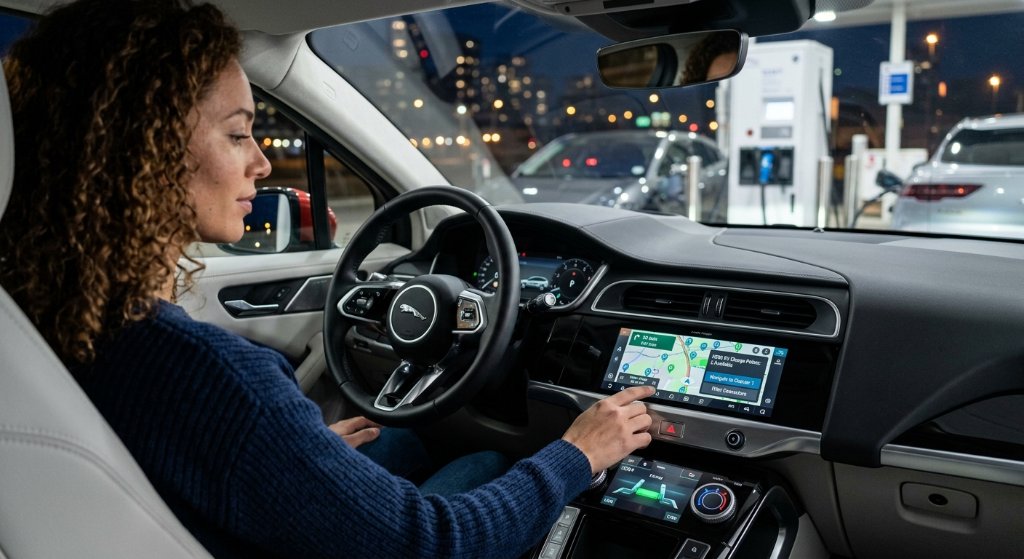
Jaguar Land Rover (JLR) is making a decisive move to address one of the most frustrating aspects of electric vehicle ownership: public charging chaos. In an expanded partnership with mapping giant HERE Technologies, JLR is integrating HERE’s advanced EV Charge Point feature directly into its vehicles' dashboard displays. Rather than merely showing where chargers are on a map, this upgrade leverages direct eMobility Service Provider (eMSP) data to feed real-time, predictive, and compatibility-filtered charger information right to the driver.
This move comes at a critical juncture for JLR. Under its revised "Reimagine" strategy, led by CEO PB Balaji, the British luxury house is navigating a delicate transition. While Jaguar prepares to morph into an ultra-luxury, pure-electric brand—kicked off by the upcoming Type 01 GT—and the heavily anticipated Range Rover Electric nears its market debut, JLR has faced historic hurdles with software integration and infotainment. By deepening its tie-up with HERE, JLR is attempting to leapfrog the typical clunky, third-party smartphone app workaround and deliver a truly native, luxury-grade navigation experience.
Real-Time Intelligence: What’s Under the Hood of the Update
Historically, EV navigation has been a guessing game of "plug and pray." Drivers route to a charger only to find it out of service, occupied, or incompatible with their vehicle's payment network. JLR’s new HERE integration aims to banish that anxiety by introducing a host of smart features directly into the digital cockpit.
Key features of the upgraded system include:
- Direct eMSP Integration: By linking directly with electric Mobility Service Providers, the system identifies which chargers are compatible with JLR’s native charging network accounts, eliminating payment and access confusion.
- Predictive AI Availability: Building on HERE's intelligent EV routing, the system uses machine learning to predict charger availability by the time the vehicle actually arrives at the station.
- Broad Backwards Compatibility: Unlike many legacy OEMs that lock new software features behind next-generation hardware, JLR is deploying this update to PHEV and BEV models built from 2020 onward—including the Jaguar I-PACE, Range Rover, Defender, and Discovery PHEVs—as well as the upcoming Range Rover Electric.
- Phased Global Rollout: The feature is launching immediately in the UK and Europe, with Australia and New Zealand scheduled to receive the update shortly after.
Why This Matters:
The software experience is the new horsepower. For legacy luxury brands like JLR, competing on leather quality and ride comfort is no longer enough to win over high-net-worth EV buyers. Tesla established the gold standard of painless road-tripping via its tightly integrated Supercharger network. Because JLR relies on a fragmented patchwork of public chargers, its vehicles must have superior onboard intelligence to replicate that seamless experience.
This is a critical trust-building exercise. JLR recently faced a wave of public skepticism after delaying several all-electric models in favor of a more flexible plug-in hybrid (PHEV) focus for North America. Furthermore, the Range Rover Electric’s prolonged, spec-deficient teaser campaign has tested consumer patience. Delivering a highly functional, backwards-compatible software update to existing owners shows that JLR is serious about its digital ecosystem. It rewards brand loyalty, placates frustrated early adopters, and builds the software foundation required for its upcoming next-gen premium EVs.
The Road Ahead
While software updates won't entirely solve the physical hurdles of public charging infrastructure, JLR's integration of HERE's real-time eMSP data is a massive step in the right direction. It proves that JLR understands a luxury EV is only as good as the software that powers its journey. As we edge closer to the official reveal of the Range Rover Electric and the rebirth of Jaguar, JLR is demonstrating that it is finally ready to treat software not as an afterthought, but as a core pillar of the modern luxury driving experience.