Inside Tesla’s Giga Texas Play: Why the New Cybercab Employee Rides Are More Than a Parking Lot Stunt
Tesla’s highly anticipated, steering-wheel-less Cybercab has officially crossed the threshold from high-tech prototype to a working employee shuttle. ...
Editorial Team
World Of EV
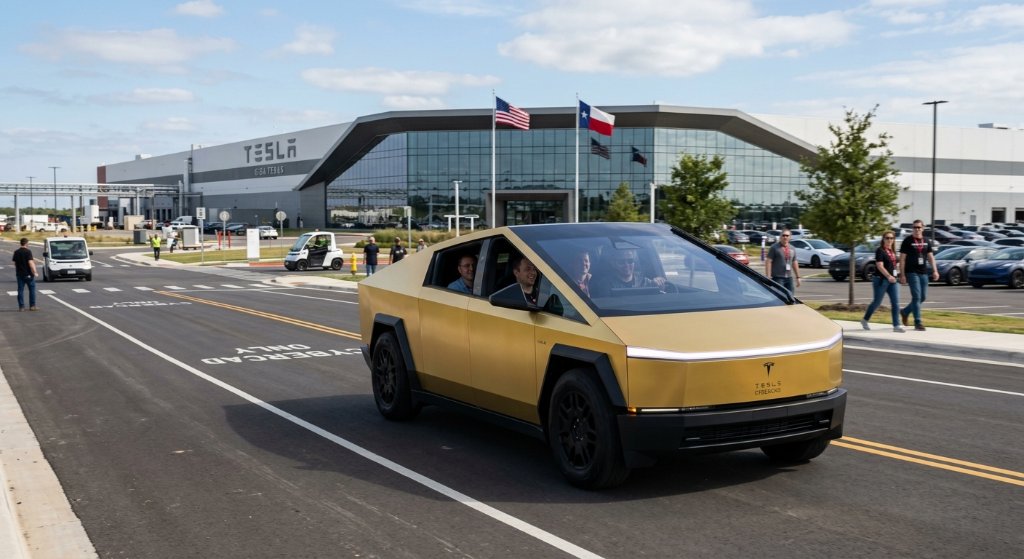
Tesla’s highly anticipated, steering-wheel-less Cybercab has officially crossed the threshold from high-tech prototype to a working employee shuttle. Following a teaser video posted on social media showcasing a gold Cybercab navigating the outbound lot at Gigafactory Texas, Tesla confirmed that employee rides are "starting soon". This closed-loop deployment is the most concrete step yet toward putting actual passengers inside a vehicle that lacks any traditional physical controls.
This milestone is not an isolated event, but rather the next logical step in Tesla's aggressive 2026 autonomous roadmap. After rolling the first production-ready Cybercab off the Giga Texas assembly line in February and ramping up to volume manufacturing in April, Tesla kicked off public-road engineering tests in Austin in late June. By transitioning now to employee rides on its own turf, Tesla is creating a critical feedback loop to stress-test both its hardware and passenger-facing software.
The Giga Texas Sandbox: More Than a Parking Lot
While skeptics might dismiss factory-ground testing as a glorified parking lot stunt, Giga Texas is actually a highly demanding environment. The facility operates as a massive, bustling industrial city-state, complete with heavy freight traffic, changing pedestrian patterns, and complex internal road networks. Using this space as a testbed offers several key operational advantages:
- Regulatory Loophole: By keeping the initial passenger rides restricted to private factory property, Tesla completely sidesteps the bureaucratic delays of waiting for DMV and NHTSA public-road driverless permits.
- Rapid Iteration: Tesla engineers can monitor, service, and update the vehicles in real-time, pulling immense amounts of local telemetry data.
- Practical Utility: The Giga Texas campus is massive, and these vehicles will serve a genuine purpose, shuttling employees across the site to reduce transport times.
A Closer Look at the Passenger Experience
This announcement also coincided with the leak of Tesla's dedicated Robotaxi app interface, giving us our first look at what riding in a Cybercab will actually feel like. Because the two-door, two-seat cabin is entirely devoid of a steering wheel or pedals, the vehicle relies heavily on digital interfaces to put passengers at ease.
- Pre-Boarding Cabin Climate: Leaked screenshots reveal that passengers can adjust the cabin temperature and even fine-tune the physical direction of the HVAC vents via the app before the vehicle even pulls up.
- A Massive 21-Inch Display: Once inside, passengers are greeted by a 21-inch center screen—the largest display ever fitted to a production Tesla—which acts as the central hub for route monitoring, trip details, and entertainment.
- Inductive Charging and Efficiency: Relying on a compact 35 kWh battery pack, the Cybercab is designed for hyper-efficiency, delivering roughly 200 miles of range and utilizing wireless inductive charging pads instead of standard plugs.
Why This Matters:
This deployment is a masterstroke in de-risking a product that many viewed as vaporware. For years, critics mocked Elon Musk's promises of a driverless future, but Tesla is now systematically checking off the engineering boxes.
By utilizing its own employees as real-world testers, Tesla wins on two fronts: it gathers priceless UX data to refine the passenger app experience, and it builds a mountain of statistical safety data. This safety data will be Tesla’s primary weapon when they eventually petition regulators for commercial, unsupervised public-road deployments.
For legacy autonomous vehicle (AV) players like Alphabet's Waymo, this is a clear warning shot. While Waymo has a functional, commercial robotaxi service in several major cities, their vehicles are expensive, heavily modified passenger SUVs packed with costly LiDAR sensors. Tesla is building a purpose-built, sub-$30,000 vehicle at scale using a pure-vision AI approach. If Tesla can prove that its vision-only system is reliable enough to safely navigate Giga Texas without human intervention, they will be positioned to undercut Waymo's per-mile cost drastically. The market signal is clear: the hardware and manufacturing capability are locked in. The only remaining hurdle to complete dominance is the final maturation of unsupervised FSD.
Looking Ahead
The launch of Cybercab employee rides at Giga Texas marks the transition from empty engineering test runs to a functioning, passenger-carrying ecosystem. By using its Austin factory as a living laboratory, Tesla is building the foundation for a commercial network. The steering-wheel-free future is no longer a distant projection; it is operating today, one factory shuttle run at a time.