Inside a 4,700-Mile Odyssey: How the Lucid Air Proved the Non-Tesla Charging Nightmare Is Over
For years, a single, agonizing specter dominated the narrative surrounding non-Tesla electric vehicles: charging anxiety. While Tesla drivers cruised ...
Editorial Team
World Of EV
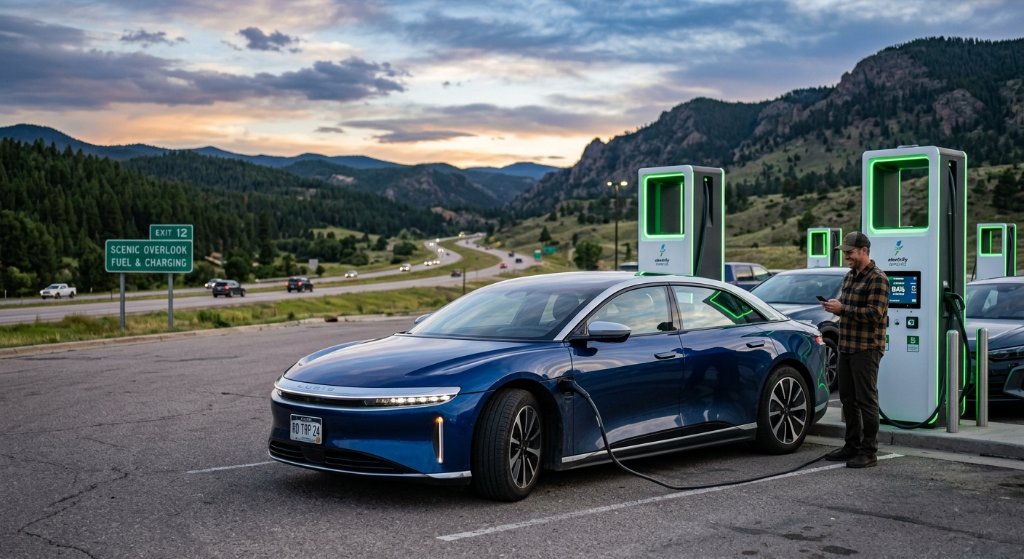
For years, a single, agonizing specter dominated the narrative surrounding non-Tesla electric vehicles: charging anxiety. While Tesla drivers cruised within the walled garden of the seamless Supercharger network, drivers of CCS-equipped EVs braved a fragmented wilderness of broken screens, handshaking errors, and unreliable third-party networks. But a massive, real-world stress test just threw cold water on that old trope, proving that the non-Tesla EV road trip is no longer a high-stakes gamble.
An owner of a 2025 Lucid Air Pure recently detailed their grueling, month-long, 4,709-mile journey spanning 11 states—stretching from the East Coast to Minnesota's remote Gunflint Trail and Michigan's Upper Peninsula. Over the course of 20 fast-charging stops on a patchwork of networks, the driver encountered exactly zero inoperable chargers. Leveraging Lucid's industry-leading engineering, this epic drive proves that EVs have officially transitioned from urban commuters to elite cross-country cruisers.
Conquering the Wilds: 4,700 Miles, 11 States, and Zero Dead Chargers
The sheer scale of this road trip put both the vehicle and the regional charging networks to the ultimate test. The route wound through some of the most isolated stretches of the American Midwest, proving that EV travel is no longer confined to major highway corridors.
Key takeaways from the month-long journey include:
- The Route: Spanning 4,709 miles across 11 states, including Michigan's Upper Peninsula and deep into Minnesota's wilderness on the Gunflint Trail, where the driver even topped off the battery using solar power.
- Seamless Reliability: Out of 20 DC fast-charging stops—utilizing Electrify America, Tesla Superchargers, Applegreen, GM, and Hyundai dealer networks—the driver encountered exactly zero dead chargers and had to wait only once (for 20 minutes).
- Simplified Payments: Every charger featured functional tap-to-pay card readers, completely bypassing the frustrating "app fatigue" that has plagued EV drivers for a decade.
- Superlative Efficiency: The Lucid Air Pure returned an astonishing real-world average of 4.01 miles per kWh, validating Lucid's relentless focus on aerodynamics and high-voltage efficiency.
The Price of Performance: Why Charging Isn’t Cheaper Than Gas Anymore
While the technical execution of the trip was flawless, the driver's meticulous data-tracking revealed a sobering truth about the economics of long-distance EV travel.
At public DC fast chargers, the driver paid an average of $0.47 per kWh. When factoring in a standard 12% charging loss—energy lost as heat during ultra-fast transfer—the "real" cost climbed to roughly $0.53 per kWh. Under these conditions, driving 32 miles in the Lucid cost $4.24. By comparison, a highly efficient hybrid like the Toyota Crown Platinum (rated at 32 mpg) would cost approximately $4.00 to cover the same distance with gas priced at $4.00 per gallon. While charging at home remains dirt-cheap, fast-charging on interstate highway networks has achieved cost parity with—or in some cases, surpassed—gasoline power.
Why This Matters:
This real-world test signals a massive shift in the EV landscape. First, it proves that the physical charging infrastructure is finally maturing. By executing 20 flawless fast-charging stops across multiple competing networks, this driver demonstrated that the industry's push for charger reliability is working. Tesla's moat is evaporating as public networks stabilize and adopt universal plug-and-charge and tap-to-pay standards.
Secondly, it highlights Lucid’s absolute masterclass in powertrain engineering. While a less efficient EV would struggle to hit 3 miles per kWh on highway speeds, the Lucid Air Pure’s 4.01 miles per kWh keeps road-trip costs manageable even in the face of skyrocketing public utility rates.
Ultimately, who wins here? The consumer. The fear of getting stranded in rural America is officially a legacy concern. Who loses? Legacy ICE automakers who rely on "range anxiety" as their final marketing shield against the inevitable EV transition. However, the economic reality means automakers can no longer sell EVs solely on the promise of "saving money on fuel" during road trips; instead, they must sell them on the superior driving experience—the silence, the effortless torque, and the luxury.
Conclusion
This 4,709-mile journey highlights that the EV transition has quietly moved past its awkward infancy. By proving that a non-Tesla EV can traverse remote corners of the Midwest without a single stranded moment, it signals to prospective buyers that the public infrastructure is finally ready for prime time. As Lucid continues to push the boundaries of physics—recently setting a Guinness World Record of 749 miles on a single charge in a Grand Touring model—it is clear that the future of long-distance luxury travel is electric, seamless, and finally, worry-free.