Home Charging Satisfaction Surges: Level 2 Chargers Cement Their Dominance as EV Adoption Accelerates
The electric vehicle (EV) revolution continues its accelerating pace, and a recent J.D. Power study confirms a critical pillar of its success: the ove...
Editorial Team
World Of EV
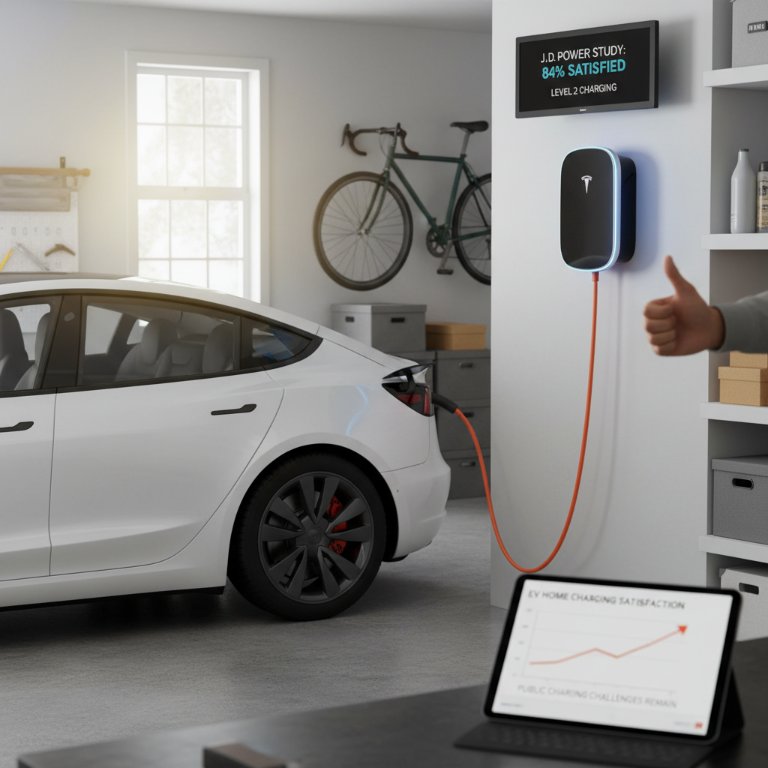
The electric vehicle (EV) revolution continues its accelerating pace, and a recent J.D. Power study confirms a critical pillar of its success: the overwhelming satisfaction of owners with their home charging experience. This news comes as a vital counterpoint to persistent concerns about public charging infrastructure, highlighting that for the vast majority, the EV lifestyle is proving to be remarkably convenient.
After years of navigating a nascent charging landscape, EV and plug-in hybrid (PHEV) owners are finding solace and efficiency in their own garages. The latest J.D. Power 2024 U.S. Electric Vehicle Experience (EVX) Home Charging Study, released in March 2024, paints a clear picture: home charging remains the cornerstone of the EV ownership experience, delivering a level of satisfaction that often eludes the public network.
The Power of the 240-Volt Outlet
Central to this surging satisfaction is the widespread adoption and superior performance of Level 2 chargers. These units, which leverage 240-volt outlets, deliver significantly faster charging times compared to the trickle charge offered by standard 120-volt Level 1 outlets. The study reveals that a staggering 84% of EV owners who charge at home utilize either portable or permanently mounted Level 2 chargers.
- Superior Charging Speed: Level 2 chargers drastically cut down charging durations, allowing owners to replenish a substantial portion of their battery overnight.
- Convenience and Reliability: Charging at home eliminates the uncertainty of finding an available and functional public charger, offering unparalleled ease of use.
- Higher Overall Satisfaction Scores: While Level 1 portable chargers saw some improvement in satisfaction (up 20 points in the 2024 study), the gap between them and Level 2 permanently mounted (744 on a 1,000-point scale) and portable (735) chargers remains significant.
A Sanctuary from Public Charging Headaches
This growing contentment with home charging provides a crucial buffer against the well-documented challenges plaguing the public charging infrastructure. While public charging availability and reliability continue to be major deterrents for prospective EV buyers and a source of frustration for existing owners, the home charging experience stands in stark contrast.
Indeed, J.D. Power's related studies have consistently highlighted public charging as a significant barrier to EV adoption, with issues ranging from low availability to broken stations and declining satisfaction with the cost of public charging. For many, the ability to reliably charge their vehicle overnight in their driveway mitigates the anxiety associated with venturing out to public stations, turning their home into a dependable energy hub.
Why This Matters:
This data is not merely a feel-good story for EV owners; it's a profound signal for the entire automotive industry and the future of electrification. The undeniable success of home charging is the silent hero, enabling mainstream EV adoption despite the public charging network's ongoing growing pains. This is critical context for understanding the market's trajectory.
- Who Wins? EV owners with access to home charging are clear winners, enjoying a seamless and satisfying experience that traditional gasoline vehicles simply cannot replicate. The EV market as a whole benefits, as this fundamental convenience de-risks ownership for potential buyers. Manufacturers of Level 2 home charging equipment, like perennial leader Tesla, along with Emporia and GRIZZL-E, are also seeing their investments validated.
- Who Loses? Public charging infrastructure providers, particularly those struggling with reliability and cost transparency, are at a disadvantage. While improvements in public charging reliability have been noted, satisfaction with the cost of public charging has declined. This study underscores the urgency for them to address their operational shortcomings or risk being relegated to a secondary, less satisfying role in the EV ecosystem.
- What This Signals to the Market: The study confirms that home charging is not just an option, but the primary charging solution for the vast majority of EV owners. This insight is paramount for automakers, policymakers, and utility companies. It means that efforts to accelerate EV adoption should heavily focus on enabling and incentivizing home charging solutions, especially for those in multi-unit dwellings or without dedicated off-street parking. While public charging needs improvement, its current state is not a complete roadblock to EV growth as long as home charging remains a strong, reliable alternative. Furthermore, the report emphasizes the need for better consumer education on optimizing home charging, such as scheduled charging to reduce costs, which currently too few owners utilize.
In conclusion, the J.D. Power study unequivocally positions home Level 2 charging as the bedrock of the modern EV ownership experience. It empowers owners with convenience and peace of mind, proving that despite external infrastructure challenges, the path to widespread EV adoption is being paved, quite literally, in our driveways and garages. The future of EV is bright, and it's largely powered from home.