Grid on Wheels: 2025 Hyundai Kona EV Powers Entire Live Concert—Using Just 3% of Its Battery
Imagine standing on a scenic lakefront, waiting to watch a live band power through a high-energy set, only to notice something missing: the relentless...
Editorial Team
World Of EV
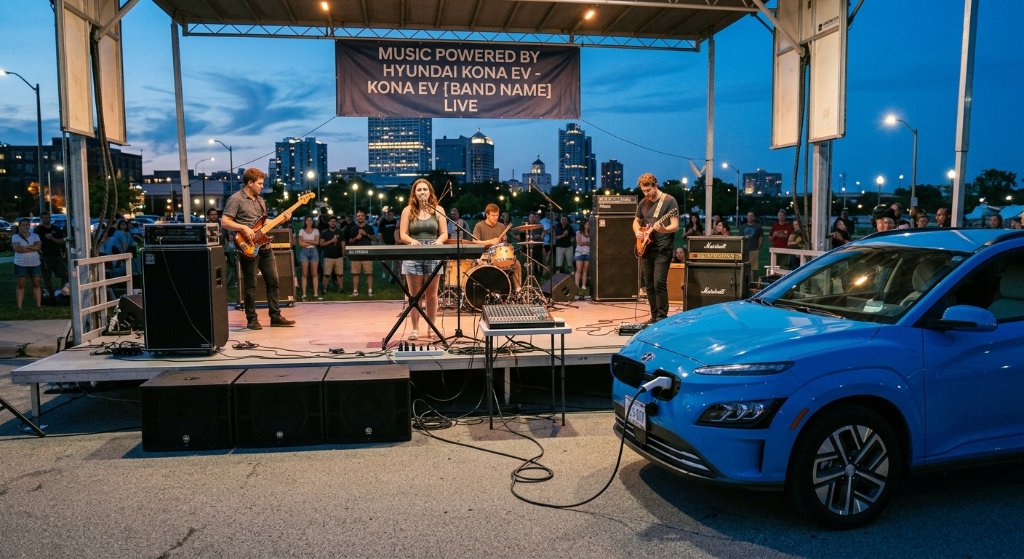
Imagine standing on a scenic lakefront, waiting to watch a live band power through a high-energy set, only to notice something missing: the relentless, deafening rumble and toxic exhaust fumes of a diesel generator. At a recent charity 5K walk/run in Milwaukee, Wisconsin, that clean, silent fantasy became a reality. Rather than relying on traditional fossil-fuel equipment, a local band successfully ran their entire stage rig—including subwoofers, mixers, and amplifiers—directly from the charging port of a member's 2025 Hyundai Kona EV.
This real-world feat shines a bright spotlight on Vehicle-to-Load (V2L) technology, proving that bi-directional charging is no longer just an expensive gimmick for flagship electric trucks or concept cars. For years, manufacturers treated V2L as a luxury add-on or restricted it to high-end dedicated electric architectures. By bringing this capability to the entry-level Kona EV, Hyundai is proving that the transition to electric transport isn’t just about replacing tailpipe emissions—it’s about completely redefining how we interact with mobile energy.
Underestimating the Load: What the Kona Powered
When organizing an outdoor set along the lakefront to benefit shelter animals, the band faced a common hurdle: there were no nearby electrical outlets in the park. While a nearby food truck ran a loud, smelly gas generator, the band decided to tap into the Kona EV's 64.8-kWh battery pack.
The stage setup was anything but lightweight. To deliver punchy live audio, the vehicle's V2L system powered a robust array of equipment:
- FOH & Monitoring: Two main top speakers, two high-output subwoofers, and a floor wedge monitor.
- Control & Mixing: A fully digital mixing board.
- Instruments & Amps: Digital guitar and bass amp modelers alongside a digital keyboard.
- Wireless Systems: Multiple in-ear monitors (IEMs), wireless microphones, and wireless guitar systems.
Despite initial worries that intermittent power spikes from kick drums and bass lines would exceed the Kona’s 1.8-kW (15-amp) V2L output limit and trigger a system shutdown, the vehicle performed flawlessly. Over the course of the three-hour performance, the vehicle’s battery state of charge dropped by a measly 3%. That represents just 1.94 kWh of total energy consumption—averaging an incredibly efficient 0.64 kW continuous draw.
Democratic V2L: Bringing High-End Tech to the Masses
The contrast on the field was stark. To produce that same 1.94 kWh of energy, a typical portable gas generator would have burned through roughly half a gallon of fuel, produced over 10 pounds of CO2, and subjected nearby concertgoers to a constant 60-to-70-decibel drone. The Kona EV, conversely, completed the job in absolute silence, emitting nothing but clean, uninterrupted electricity.
While Hyundai initially popularized V2L with its award-winning, dedicated 800V E-GMP platform (which underpins the Ioniq 5 and Ioniq 6), they made a deliberate choice to engineer the second-generation Kona EV with an "EV-first" philosophy. Even though the Kona is built on a multi-powertrain platform, its electric variant inherits the sophisticated vehicle-to-load hardware of its premium siblings. By utilizing a simple adapter plugged into the charge port, users can instantly access standard 120V household power.
Why This Matters:
- The Democratization of the Mobile Grid: Historically, heavy-duty mobile power was reserved for workhorses like the Ford F-150 Lightning with its Pro Power Onboard system. By integrating V2L into a sub-$35,000 compact crossover like the Kona EV, Hyundai is democratizing energy access.
- The Death of the Small Gas Generator: For camping, tailgating, DIY job sites, and outdoor gigs, small 2-kW gas generators are officially on notice. EVs equipped with V2L provide a cheaper, maintenance-free, and infinitely cleaner alternative that sits in your driveway.
- Exposing the Laggards: While Hyundai, Kia, and Ford have fully embraced bi-directional power, market leader Tesla has lagged behind. Tesla only recently introduced limited "Powershare" capabilities on the Cybertruck, leaving its highest-volume vehicles—the Model 3 and Model Y—without native, out-of-the-box V2L utility. This gives the Hyundai Motor Group a massive utility moat that practical buyers cannot ignore.
- Redefining EV Value Beyond Range: The EV conversation is historically obsessed with range and charging times. Incidents like this shift the narrative, demonstrating how an EV acts as an active asset that improves your lifestyle even when parked.
Ultimately, the Milwaukee lakefront gig proves that the mobile energy revolution isn't coming—it is already here, and it is remarkably efficient. As automakers fight for market share in an increasingly competitive EV landscape, those who offer multi-functional utility like V2L will stand out to buyers who want their vehicles to do more than just get them from point A to point B. Expect bi-directional charging to transition rapidly from an impressive novelty to a non-negotiable standard feature.