GM Executive's 'Energy Dominance' Blueprint Proves EV Bidirectional Tech Beats $7 Gas and Volatile Power Grids
As retail gasoline prices spike to eye-watering heights—hitting over $7 per gallon in metro hubs like Chicago—and utility companies aggressively hike ...
Editorial Team
World Of EV
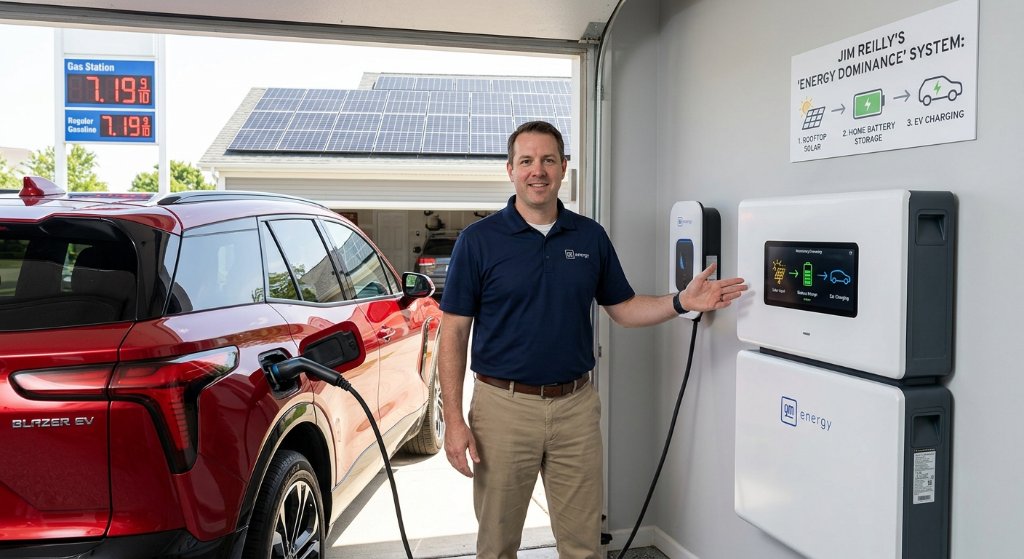
As retail gasoline prices spike to eye-watering heights—hitting over $7 per gallon in metro hubs like Chicago—and utility companies aggressively hike electricity rates, EV owners are realizing that merely plugging into the grid is no longer the ultimate financial shield. Enter Jim Reilly, Group Manager of Portfolio Planning at GM Energy. Rather than letting his household budget fall victim to volatile energy markets, Reilly has deployed what he calls the ultimate EV "life hack": a fully integrated home microgrid that delivers "energy dominance".
By bridging a rooftop solar system, home battery storage, and the massive bidirectional battery of his GMC Sierra EV, Reilly has bypassed both the gas pump and traditional utility bills. In doing so, he has created a blueprint for how modern electric vehicles are evolving from simple modes of transportation into central pillars of household energy independence.
Decoupling Driving Costs From the Global Energy Market
For decades, drivers have accepted that refueling costs are at the mercy of geopolitical instability and macroeconomic shifts. However, Reilly’s real-world setup demonstrates that clean energy investments can effectively lock in fuel costs for decades. With a $15,000 upfront hardware investment (before federal tax credits and discounts), Reilly’s Seattle-based home solar array is projected to produce around 253,000 kilowatt-hours (kWh) of electricity over its lifetime.
When you break down the math, the difference between legacy combustion ownership and integrated electrification is staggering:
- The Lifetime Solar Rate: Reilly's self-generated energy works out to an incredibly low $0.06 per kWh over the next 25 years.
- The Legacy Comparison: Filling up a gas-powered truck with a 24-gallon tank at $5.25 per gallon costs $126.
- The Solar EV Cost: Replenishing his GMC Sierra EV’s massive 200-kWh battery at his locked-in solar rate costs roughly $12.
- The Per-Fill Savings: Every single full charge translates to an immediate $114 back in his pocket compared to gas.
The Power of Bidirectional V2H Integration
This setup relies heavily on Vehicle-to-Home (V2H) bidirectional charging, a technology that automakers have been slow to scale but is now coming to fruition. Unlike a standard EV, which only pulls power from the grid, a V2H-capable vehicle can send electricity back to power the home. This makes the GMC Sierra EV’s massive battery equivalent to nearly 15 standard home backup batteries (such as a 13.5-kWh Tesla Powerwall).
Reilly’s system relies on key hardware components from GM Energy’s newly launched ecosystem:
- GM Energy PowerShift Charger: A bidirectional-enabled charging station that manages dual-direction power flow.
- GM Energy PowerBank: A 10.6-kWh stationary battery used to capture excess daily solar generation for immediate household use.
- GM Energy Home Hub & Inverter: The system's brain, which seamlessly switches power sources without a flicker when grid blackouts strike.
- GMC Sierra EV (Max Range): Sporting an enormous ~205-kWh Ultium battery pack, this truck functions as a rolling power plant that can back up a standard household for days during an outage.
While neighbors hummed through power outages relying on noisy, emission-spewing gas generators, Reilly’s home remained fully functional and whisper-silent, pulling power straight from his truck's battery pack.
Why This Matters:
This development signals a profound shift in both the automotive and utility landscapes, with massive long-term implications:
- For Automakers: This is no longer just about horsepower and zero-to-60 times. Legacy giants are transforming into full-scale energy providers. GM’s aggressive rollout of its GM Energy ecosystem is a direct shot at Tesla Energy. To win the EV transition, legacy brands must build cohesive energy ecosystems that capture high-margin revenue from home hardware, installation, and smart-grid energy management.
- For Utilities: The monopoly is cracking. As homeowners realize they can build private microgrids, local utility companies will lose lucrative peak-demand revenue. At the same time, virtual power plants (VPPs)—where utilities pay EV owners to feed power back into the grid during peak strain—will become standard, turning EVs from grid liabilities into vital grid stabilizers.
- For the Consumer: The true value of EV ownership is shifting from "saving money on gas" to "complete financial predictability". Pairing an EV with solar and home storage is the only way to genuinely opt out of the inflationary cycle of fossil fuels and rising public utility rates.
Conclusion
Jim Reilly's real-world experiment proves that the transition to electric mobility is about far more than swapping a tailpipe for a battery. By combining local solar generation with massive bidirectional EV storage, homeowners can take total control of their energy destiny. As gas prices continue to fluctuate wildly and local grids struggle under extreme weather, the "energy dominance" model will soon transition from an early-adopter luxury to an economic necessity for the modern household.