Giga Berlin Unleashed: Tesla’s 7,500-Model Y Weekly Target Fires a Warning Shot at Struggling European Rivals
Tesla is hitting the accelerator on its European manufacturing hub, signaling that the electric vehicle giant is ready to transition from a period of ...
Editorial Team
World Of EV
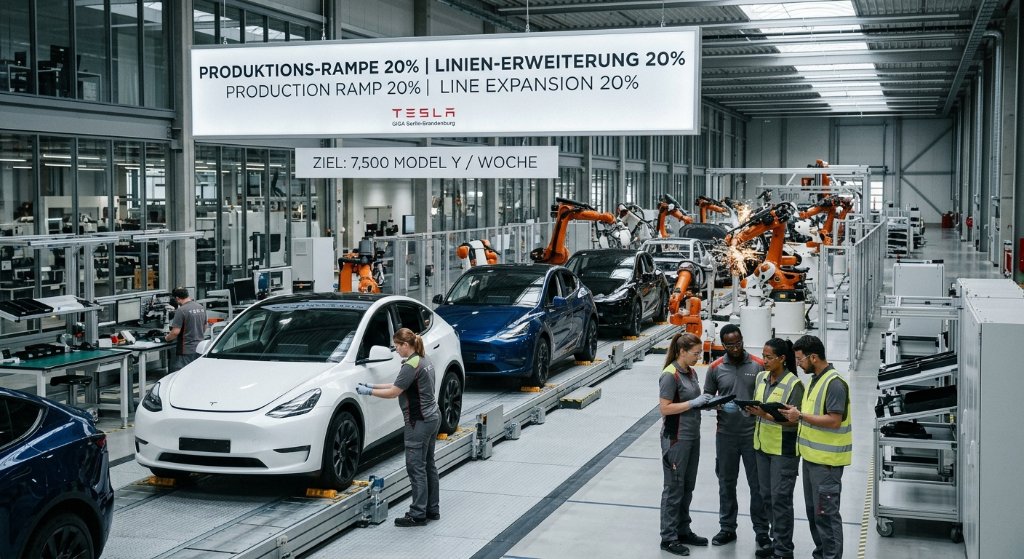
Tesla is hitting the accelerator on its European manufacturing hub, signaling that the electric vehicle giant is ready to transition from a period of defense to all-out market domination. In its latest German subsidiary annual report, Tesla announced a highly ambitious plan to ramp up production at its Grünheide Gigafactory (Giga Berlin) to approximately 7,500 Model Y vehicles per week by October 2026. This translates to an annualized run rate of roughly 375,000 units, representing a massive 20% jump from recent production levels.
This aggressive push comes at a critical juncture. Historically, Giga Berlin has struggled to find its stride, running at a meager 54% capacity utilization in 2025 and producing just 202,000 units due to a cooling European market and localized bottlenecks. Yet, even with the factory running at half-steam, Tesla's German operation managed to grow its net profit by 36% to €77.1 million last year, proving that the facility is highly lucrative even at lower volumes. Now, with European registrations for the Model Y surging once again in 2026—quadrupling in Germany alone in recent months—Tesla is moving quickly to unlock the factory's full capacity.
Unlocking Giga Berlin's True Scale
To make this massive volume increase a reality, Tesla isn't just tweaking assembly line speeds; it is launching a significant hiring campaign that defies the broader economic trends of the region. The expansion will add about 3,500 jobs to Giga Berlin’s workforce, including 1,000 positions directly linked to the physical assembly lines.
Here are the core pillars of the Giga Berlin expansion roadmap:
- Production Target: Ramping from a baseline of ~5,000 units/week in early 2026 to 7,500 units/week by October 2026.
- Localized Batteries: Integrating on-site battery cell manufacturing with a target capacity of 8 to 18 GWh annually, despite high local energy costs.
- Workforce Boost: Adding 3,500 employees, bringing the total workforce to over 14,000, contrasting sharply with legacy German automakers currently announcing layoffs and plant closures.
- Global Export Hub: Serving over 30 international markets from the Berlin-Brandenburg plant, reducing reliance on Giga Shanghai and Giga Texas.
Insulating Against Trade War Fallout
Being close to the customer is crucial, and Tesla's decision to rapidly scale Giga Berlin is a masterclass in risk mitigation. Ramping up local European manufacturing dramatically decreases Tesla's vulnerability to supply chain shocks—such as shipping delays in the Red Sea—and shields the brand from geopolitical crossfire.
Importing vehicles from Giga Shanghai has become an increasingly risky bet for Tesla, given escalating EU tariffs on Chinese-made electric cars. By manufacturing the Model Y on German soil, Tesla completely bypasses these trade barriers, allowing it to maintain lower manufacturing costs and pass those savings onto European consumers.
Why This Matters:
This production ramp is a definitive market signal that cements Tesla’s structural advantages in Europe while exposing the vulnerability of its direct competitors.
- The Winners: Tesla and European EV buyers. Tesla gains immense pricing flexibility through economies of scale, allowing it to drop prices if necessary to starve out competitors. Buyers benefit from shorter delivery windows, localized vehicle configurations, and highly competitive pricing.
- The Losers: Legacy European giants like Volkswagen, Stellantis, and Mercedes-Benz. While these traditional brands are pleading with regulators to ease emissions targets and are actively laying off workers to cut costs, Tesla is expanding its footprint. The European Commission’s proposal to soften the 2035 CO2 fleet targets actually works in Tesla's favor; it acts as a trap that will entice legacy rivals to split their capital between gas, hybrid, and electric powertrains, whereas Tesla remains hyper-focused on refining a single, incredibly efficient electric platform.
- The Bottom Line: Ramping vehicle assembly is a proven playbook for Tesla, but the real test is the battery cell factory. Ramping localized battery cell production in Germany is highly challenging due to high energy costs. If Tesla successfully pulls off full vertical integration—from raw battery cell to finished vehicle—under one roof in Grünheide, it will establish a fortress in Europe that no legacy manufacturer will be able to breach.
Tesla’s aggressive expansion in Germany demonstrates that the company is not content with simply maintaining its lead; it wants to build a moat. By investing in local manufacturing while competitors retreat, Elon Musk is ensuring that when the dust settles on the European EV transition, the Model Y remains the vehicle dictating the pace of the entire industry.