Geely Unleashes 2.25 MW Charging to Deliver a 4.5-Minute EV Top-Up
The race to eliminate EV range anxiety has officially moved past battery size and entered the realm of physics-defying charging speeds. For years, Wes...
Editorial Team
World Of EV
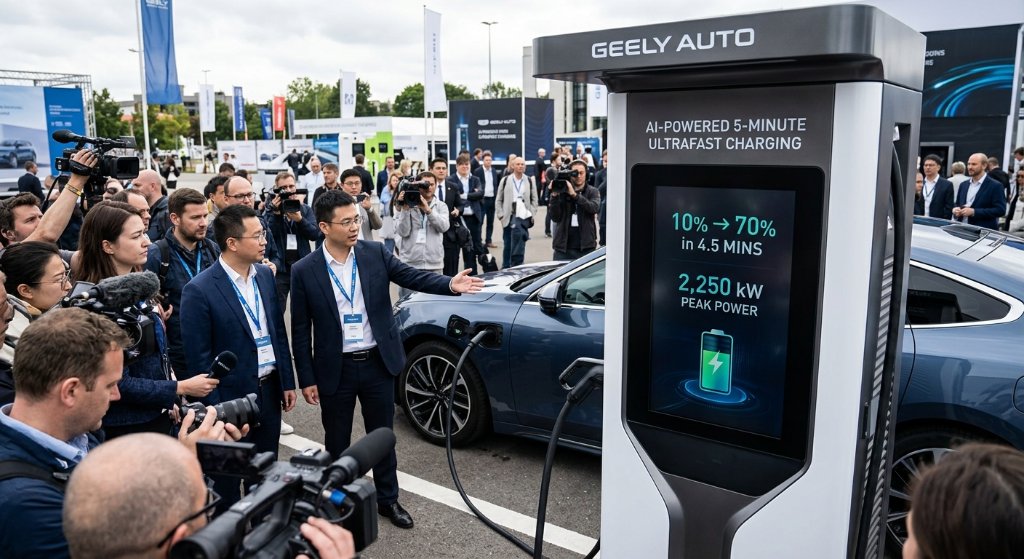
The race to eliminate EV range anxiety has officially moved past battery size and entered the realm of physics-defying charging speeds. For years, Western automakers like Tesla and Mercedes-Benz have settled for 15-to-25-minute fast-charging windows as the industry gold standard. Now, Chinese automotive giant Geely has completely rewritten the rulebook, unveiling an AI-powered 2.25-megawatt (MW) smart charging system and a next-generation ultra-short blade battery that can juice up an EV in the time it takes to buy a cup of coffee.
During real-world tests in Ningbo, China, Geely’s new setup successfully charged the Lynk & Co 10 and Zeekr 001 from 10% to 70% in just 4 minutes and 30 seconds—leapfrogging chief rival BYD’s latest achievements and signaling a paradigm shift in how the industry views battery longevity.
The Megawatt Leap: 2,250 kW and 12C Capability
At the heart of Geely’s breakthrough is its fifth-generation Smart Charging Station, which pumps out a peak power of 2,250 kW from a single charging gun. To put that in perspective, that is nearly double the power of Tesla's commercial Megachargers and roughly six times faster than the quickest public DC fast chargers currently available in Europe and North America, which peak at 350 to 400 kW.
This massive firehose of electricity is paired with Geely’s Next-Gen Ultra Short Blade Battery (Shendun Golden Battery), engineered with an astonishing 12C peak charging rate. Key performance metrics from Geely’s testing include:
- 10% to 70% State of Charge (SoC): Achieved in 4 minutes and 30 seconds on production-ready models.
- 10% to 97% State of Charge: Completed in a blistering 8 minutes and 40 seconds.
- Unprecedented Power Output: A single-gun rating of 2,250 kW, eclipsing BYD's recently announced 1,500 kW Flash Charging network.
AI in the Battery Box: Xingrui PowerMind and Pulse Healing
Pushing megawatt-level currents into a lithium-ion battery usually triggers a fatal combination of thermal runaway and rapid degradation. To circumvent this, Geely is leveraging "Xingrui PowerMind," a smart energy AI model co-developed with AI startup StepFun. PowerMind coordinates the vehicle, battery, and charger in real-time, predicting thermal changes before they happen.
Rather than waiting for the battery to heat up and then throttling the speed, Geely’s system uses predictive algorithms to forecast cell temperature up to 30 seconds in advance. But the real magic lies in its "lithium-ion pulse restoration technology". Fast charging typically causes "lithium plating" on the anode, permanently degrading the battery's capacity. Geely's system sends micro-pulse currents through the cells to reactivate these idle lithium ions, effectively "healing" the battery and extending its cycle life by up to 20%.
- Predictive Cooling: Keeps average charging temperatures below 131°F (55°C) and peak temperatures capped at 149°F (65°C).
- Active Regeneration: Micro-pulses counteract the anode plating typically caused by extreme high-voltage DC charging.
Why This Matters:
This is a shot fired directly across the bow of BYD and CATL, but the broader implications stretch far beyond the Chinese domestic market.
- The Winners: Geely and its premium sub-brands (Zeekr, Lynk & Co, Polestar, Volvo) stand to win massive mindshare. By proving that ultra-fast charging doesn't have to destroy a battery's health—especially with strict new Euro 7 battery durability regulations looming—Geely positions its premium EVs as highly durable, future-proof assets.
- The Losers: Western legacy automakers and Tesla. While the US and Europe struggle to deploy reliable 150 kW and 350 kW infrastructure, China is actively deploying multi-megawatt stations. Tesla's Supercharger network risks looking generationally outdated if it cannot match these ultra-fast charging speeds.
- The Grid Reality Check: While Geely’s achievement is a technological tour de force, the elephant in the room is infrastructure. A single 2,250 kW charger draws as much power as an entire small neighborhood. For Geely—or anyone else—to deploy these stations at scale, they will require massive on-site battery storage systems to buffer the local electrical grids. Without integrated energy storage, this technology remains a high-tech novelty limited to specialized hub locations.
Looking Ahead
Geely’s fifth-generation charging tech represents a monumental leap forward, proving that the five-minute EV "gas station" experience is no longer a pipe dream but a production-ready reality. By fusing extreme megawatt hardware with intelligent AI-managed thermal control and active battery healing, Geely hasn't just built a faster charger—it has redefined the limits of battery physics. The challenge now shifts from laboratory validation to the grueling work of grid integration and global deployment.