Gas Engines Lose Their Stronghold: EVs Crush ICE Vehicles by 109 Points in J.D. Power’s 2026 Satisfaction Study
After years of critics warning that mainstream buyers would reject electric vehicles once the forgiving "early adopter" phase ended, the data has deli...
Editorial Team
World Of EV
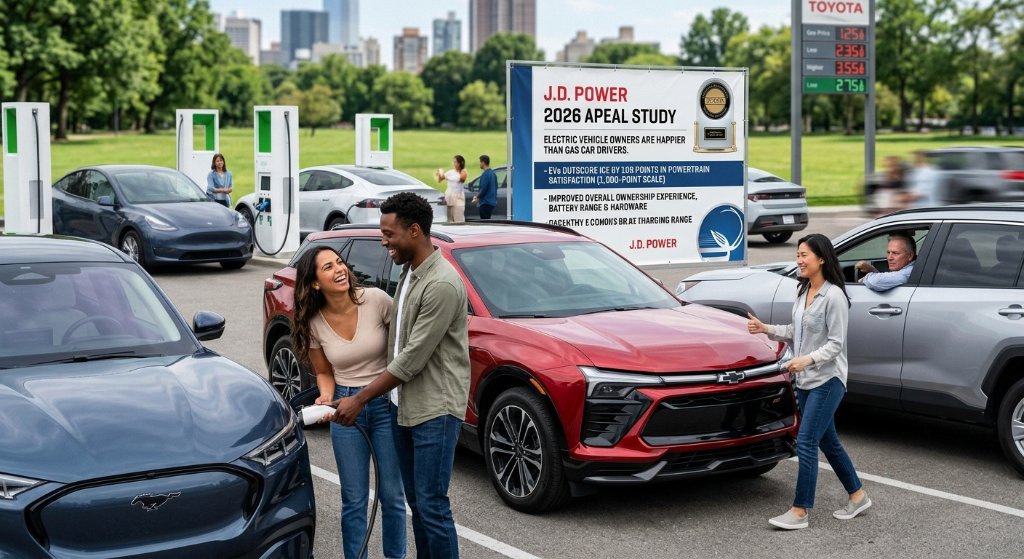
After years of critics warning that mainstream buyers would reject electric vehicles once the forgiving "early adopter" phase ended, the data has delivered a resounding verdict. In a stunning reversal of historic trends, battery-electric vehicles (BEVs) have not only caught up to internal combustion engine (ICE) cars in emotional appeal—they have completely run away with the lead.
According to the newly released J.D. Power 2026 Automotive Performance, Execution, and Layout (APEAL) study, EV satisfaction climbed by a massive 22 points year-over-year. The most devastating blow to gas-powered vehicles occurred in powertrain satisfaction, where EVs outscored ICE vehicles by a whopping 109 points on a 1,000-point scale. This massive gap represents a paradigm shift, proving that once drivers experience the instant torque, refinement, and quiet power of an electric drivetrain, there is simply no going back.
Hardware Maturity Overcomes Early Adopter Hurdles
For years, early EV buyers were willing to tolerate software glitches, subpar thermal management, and sparse charging networks. But as automakers expanded their EV lineups to target the mass market, satisfaction initially fluctuated. In the 2025 study, EV satisfaction actually slipped as new buyers struggled with complex interfaces and cold-weather range drops.
The 2026 rebound is a testament to engineering maturity. Instead of rushed, adapted ICE platforms—like Mazda's ill-fated and low-range MX-30—the 2026 model-year vehicles are built on dedicated EV architectures with meaningful, real-world hardware upgrades:
- The Death of Adapter Anxiety: The widespread integration of native NACS (North American Charging Standard) ports has dramatically simplified public charging, removing the friction of carrying clunky CCS-to-Tesla adapters.
- Standardized Cold-Weather Tech: Heat pumps, once a premium luxury, have become standard on mainstream trims, mitigating the dreaded winter range-drop.
- Refined Battery Chemistries: Upgraded cell chemistry has unlocked greater energy density and faster charging speeds, putting the "range anxiety" myth to bed for the average daily commute.
The Collapse of the Premium Exclusivity Barrier
Another crucial takeaway from the 2026 APEAL study is the narrowing gap between premium and mass-market brands. Historically, premium brands held a monopoly on "emotional appeal" because they offered better technology and materials. Today, that gap has shrunk to just 29 points.
- Mass-Market Heavy Hitters: Brands like Hyundai (858 points) and Kia (857 points) are delivering EV experiences that rival traditional luxury players.
- The Software Equalizer: Advanced infotainment, driver-assist features, and premium cabin layouts are no longer exclusive to $100,000 luxury cruisers.
Why This Matters:
This is the "do-or-die" moment for legacy automakers still on the fence about their electrification timelines. For years, the narrative from detractor OEMs was that "consumers do not want EVs." J.D. Power’s data—derived from 78,514 real-world owners of 2026 model-year vehicles—flatly disproves this. The barrier to EV adoption is no longer the vehicle itself; it is purely upfront price and charging infrastructure availability.
- The Winners: Automakers like Hyundai Motor Group and BMW (which took six segment awards) who invested heavily in dedicated EV engineering and robust software integration. They are earning fierce brand loyalty that will lock in customers for the next decade.
- The Losers: Legacy brands dragging their feet or relying on half-baked "multi-energy" platforms that compromise the inherent benefits of EV packaging. They risk being viewed as relics of a bygone, loud, and vibration-filled era.
- The Market Signal: Powertrain satisfaction is the heart of the automotive experience. To lose by 109 points on a 1,000-point scale is not a minor setback for ICE—it is a rout. As charging infrastructure continues to expand, the transition from gas to electric will likely accelerate, driven not by government mandates, but by sheer customer preference.
Conclusion
The 2026 J.D. Power APEAL study proves that the modern electric vehicle has officially graduated from a tech-forward experiment to the superior choice for daily driving. By focusing on hardware refinements like native NACS ports and improved battery chemistry, automakers have successfully engineered away the compromises of early EVs. The "visceral excitement" of driving is no longer defined by the rumble of pistons, but by the seamless, high-tech surge of electrons.