Ford's Bold Energy Pivot: A $19.5 Billion EV Loss Fuels Massive BESS Ambition
After enduring a staggering $19.5 billion loss attributed to its electric vehicle business in 2025, Ford Motor Company is making a decisive strategic ...
Editorial Team
World Of EV
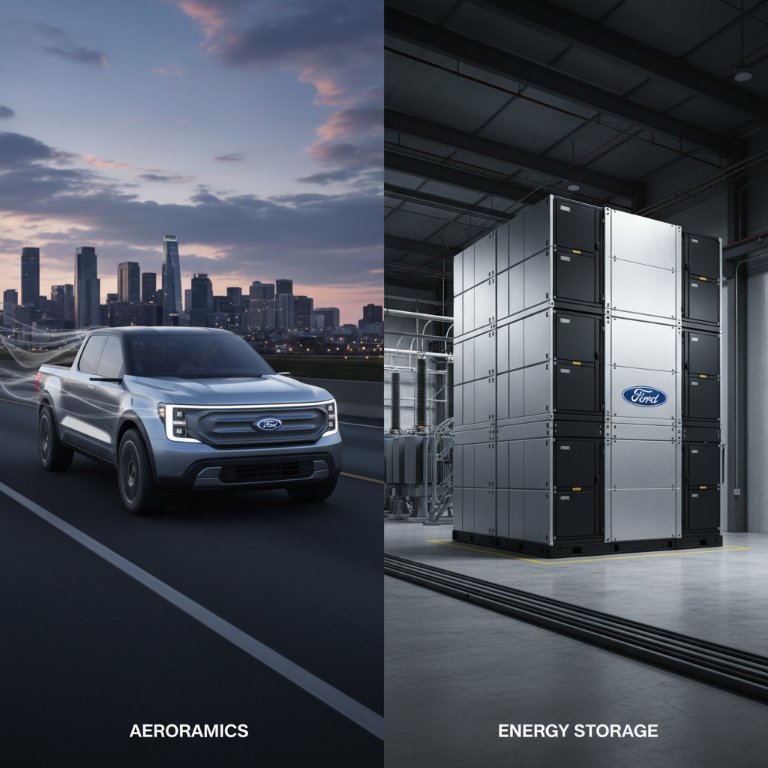
After enduring a staggering $19.5 billion loss attributed to its electric vehicle business in 2025, Ford Motor Company is making a decisive strategic shift, officially launching Ford Energy. This new, wholly-owned subsidiary is tasked with manufacturing U.S.-assembled battery energy storage systems (BESS) for a diverse clientele including utilities, data centers, and large industrial and commercial customers. This isn't merely a diversification; it's a profound reorientation, leveraging existing battery manufacturing infrastructure to tap into a rapidly expanding energy storage market.
Ford's move comes amid a challenging period for its EV ventures, where ambitious rollout plans, such as those for the F-150 Lightning and Mustang Mach-E, have faced headwinds, leading to significant financial setbacks. The company's CEO, Jim Farley, notably stated, "the customer has spoken," in response to lower-than-expected demand and changing market conditions for its initial EV offerings. While Ford remains committed to its EV future with upcoming, more affordable models, the Ford Energy launch signals a pragmatic recognition of broader opportunities within the electrification landscape, particularly in areas beyond passenger vehicles.
Ford Energy: A New Industrial Powerhouse Emerges
Ford Energy is set to become a significant player in the burgeoning BESS market. The company plans to repurpose a plant in Glendale, Kentucky—originally intended for EV battery production—for BESS manufacturing.
Key aspects of Ford Energy's operations include:
- Target Customers: Utilities, data centers, and large industrial and commercial operations.
- Production Goal: A formidable target of 20 GWh of annual BESS deployments by late 2027.
- Product Focus: The flagship Ford Energy DC Block is a standardized 20-foot containerized system built around 512 Ah lithium iron phosphate (LFP) prismatic cells. It will be offered in FE-250 (two-hour duration) and FE-450 (four-hour duration) configurations, delivering 5.45 MWh of rated energy capacity.
- Vertical Integration: Ford Energy's operations will span from electrode coil production through module and container assembly, alongside sales and service.
This strategic pivot into stationary storage capitalizes on Ford's manufacturing prowess and existing infrastructure, rather than letting valuable assets sit underutilized.
The 'Universal Electric Vehicle' Pickup: Aerodynamic Ingenuity
Concurrently with its BESS ambitions, Ford continues to refine its core EV offerings, particularly its upcoming 'Universal Electric Vehicle' (UEV) pickup, which is slated for a 2027 launch with a target price around $30,000. Ford is aggressively pursuing efficiency gains for this crucial vehicle:
- Aerodynamic Design: The pickup will feature a smooth undercarriage and a tapered roofline to significantly reduce aerodynamic drag.
- Efficiency Gains: Ford claims a 15% improvement in aerodynamic efficiency over any other pickup on the market today, potentially adding up to 50 miles of range or a 30% improvement at highway speeds.
- Dynamic Aerodynamics: A new patent filed by Ford suggests a system capable of dynamically altering the truck's profile through deployable nested panels and an adaptable bed cover. This could create a low-drag fastback shape akin to the Tesla Cybertruck when driving at high speeds, offering a transformative advantage.
- Cost Reduction: By improving efficiency, Ford can potentially reduce the size and cost of the battery required for its EVs, a critical factor given batteries account for approximately 40% of vehicle costs.
Why This Matters:
This dual announcement signals a critical juncture for Ford, transforming a substantial financial setback in its EV division into a catalyst for a broader energy play. The launch of Ford Energy is more than just a new product line; it's a sophisticated risk mitigation strategy and a savvy move to leverage core competencies.
- De-risking the EV Transition: Ford's $19.5 billion EV loss was a stark reminder of the immense capital demands and competitive pressures in the passenger EV market. By pivoting into BESS, Ford opens a new, high-growth revenue stream that utilizes similar battery technology and manufacturing expertise, diversifying its energy sector investments. The BESS market is booming, driven by renewable energy integration, grid stability needs, and the power demands of data centers, with projections showing significant growth.
- Leveraging Underutilized Assets: Repurposing the Kentucky plant, originally meant for EV battery production, is a brilliant strategic move. Rather than incurring further losses on underperforming EV battery capacity, Ford is reallocating it to a market where demand genuinely outstrips supply, thus maximizing the value of its prior investments.
- Building a 'Total Energy' Brand: This move positions Ford not just as an automaker, but as an integrated energy company, capable of contributing to the entire energy ecosystem. This holistic approach can create synergies, potentially integrating future home energy solutions for Ford EV owners or enhancing its charging infrastructure. This broader brand identity strengthens Ford's relevance in a rapidly electrifying world.
- Competitive Landscape Shift: While Ford Energy enters a BESS market with established players like Tesla Energy, Ford's immense manufacturing scale and supply chain experience could make it a formidable competitor. Tesla, for instance, aims for 50 GWh annual Megapack production, demonstrating the scale of the opportunity. On the EV front, the focus on extreme aerodynamic efficiency for the UEV pickup underscores Ford's commitment to making its next generation of EVs truly competitive on range and cost, challenging industry leaders directly.
In essence, this is a do-or-die moment for Ford's long-term electrification strategy. By broadening its horizons beyond just selling electric vehicles and aggressively innovating in core EV efficiency, Ford is attempting to stabilize its financial future while cementing its role as a significant player in the global energy transition.
Conclusion: Ford's decisive launch of Ford Energy, alongside its relentless pursuit of efficiency in its Universal Electric Vehicle platform, marks a profound strategic evolution. This dual approach signifies a mature understanding of the challenges and opportunities within the electrification megatrend. By tackling both the supply-side of energy storage and the demand-side of vehicle efficiency, Ford aims to forge a more resilient and profitable path forward in the electrified world.
Categories:
- Electric Vehicles
- Automotive Industry
- Energy Storage Systems
- Business Strategy
- Ford Motor Company
- Aerodynamics
- Battery Technology