Ditching the Dongle: 2027 GMC Hummer EV Drops CCS for Native Tesla NACS Charging
The GMC Hummer EV has always been a vehicle defined by excess: more than 9,000 pounds of metal, up to 1,160 horsepower, and a battery pack large enoug...
Editorial Team
World Of EV
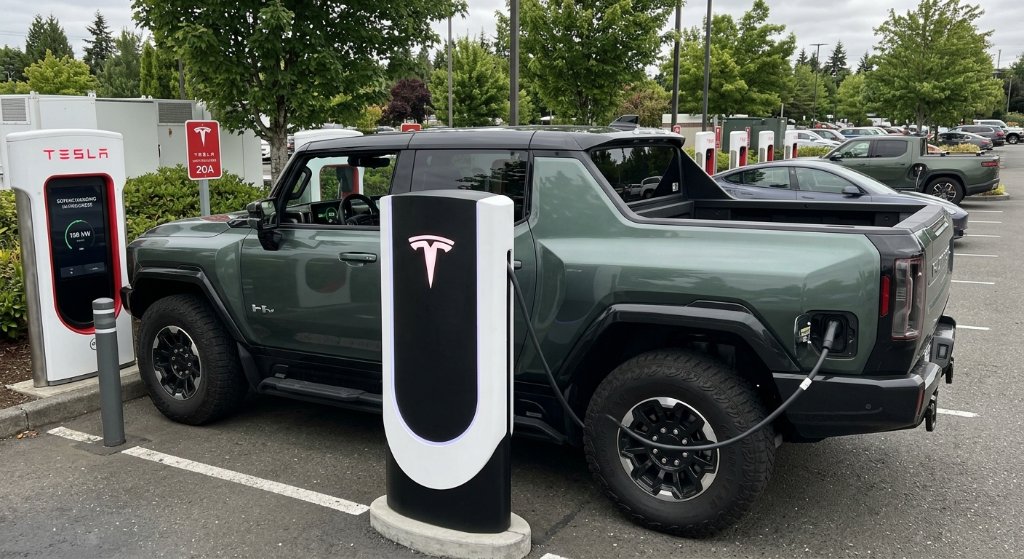
The GMC Hummer EV has always been a vehicle defined by excess: more than 9,000 pounds of metal, up to 1,160 horsepower, and a battery pack large enough to power an average home for days. Yet, despite its high-tech bravado, owners have still had to suffer the minor indignity of carrying clunky plastic adapters to juice up at the continent's best DC fast-charging network. That ends with the 2027 model year.
General Motors has officially announced that all upcoming 2027 GMC Hummer EV Pickup and SUV models will come equipped with factory-installed North American Charging Standard (NACS) ports right off the assembly line. Dropping the legacy CCS1 port marks a massive milestone in GM's transition to NACS, aligning its flagship electric supertruck with the charging network that has set the gold standard for EV road trips.
Ditching the Adapter: Native NACS Integration
By replacing the old CCS1 port with a native SAE J3400 (NACS) inlet, GM is delivering a seamless public charging experience for Hummer owners. No longer will drivers have to rely on third-party or OEM-provided CCS-to-NACS adapters to tap into Tesla's robust Supercharger network.
Key details of the 2027 update include:
- Direct Tesla Supercharger Access: Plug directly into the vast majority of Tesla’s Supercharger network and the expanding IONNA charging coalition without additional hardware.
- Maintained 800V Architecture: The Hummer’s massive 24-module battery pack retains its split-pack charging capability, allowing it to charge efficiently at both 400V (Tesla Superchargers) and 800V networks.
- Standard Integration: Native NACS ports will be standard across all 2027 trims of the Pickup and SUV, scheduled to begin production in mid-December 2026 at GM's Factory ZERO.
Grid Backup: Keeping V2H Bidirectional Power Intact
One of the major concerns with the industry-wide shift to the NACS port was whether vehicle-to-home (V2H) and vehicle-to-load (V2L) functionalities would be sacrificed. GM has put those worries to rest. The 2027 Hummer EV maintains its robust bidirectional power capability. When paired with the GM Energy PowerShift Charger and GM Energy V2H Enablement Kit, a 2027 Hummer EV essentially becomes a rolling backup generator capable of powering a typical household during a grid outage.
Celebrating a Quarter-Century of Hummer
The 2027 model year also coincides with the 25th anniversary of the Hummer nameplate. To celebrate, GMC is launching the limited-run GMC Hummer EV Icon | 25 edition, available on the 2X and 3X trims.
- Exclusive Icon Yellow Paint: A modern reinterpretation of the iconic H2 yellow.
- Styling Upgrades: Black front approach shields, deep void finishes on new 22-inch wheels, and the first-ever all-black interior option in Hummer EV history.
- Breathtaking Performance: Up to 1,160 horsepower, 13,000 lb-ft of torque, and a blistering 0-60 mph time of just 2.8 seconds on 3X Pickup models.
Why This Matters:
The transition to native NACS on GM's most power-hungry, heavy-duty EV is a watershed moment for the industry. Historically, GM struggled with early software glitches, sluggish Ultium production ramps, and charging network friction. Moving their flagship "halo" EV to native NACS shows that the legacy automaker is ready to fully mature its EV ecosystem.
Who Wins:
- The Consumers: Hummer EV owners, who often buy these vehicles for road trips and adventure, get hassle-free access to the most reliable charging infrastructure in North America.
- Tesla: Further solidifying its position as the de facto gatekeeper of EV charging in North America.
- GM's Energy Ecosystem: Maintaining V2H over NACS proves that NACS is not just a charging port but a robust bidirectional energy interface. It bolsters the value proposition of GM's expensive smart-home energy products.
Who Loses:
- Legacy CCS-only Charging Networks: Networks that fail to quickly retrofit their stations with NACS connectors will lose premium, high-volume customers like Hummer drivers, whose massive battery packs consume enormous amounts of electricity per session.
The Market Signal:
By standardizing NACS on its most extreme vehicle, GM is signaling that the CCS era in North America is officially dead. If a 9,000-pound behemoth with a complex dual-voltage battery architecture can seamlessly adopt Tesla’s port without losing its bidirectional home-power capabilities, there are no more excuses for other automakers to drag their feet.
In conclusion, the 2027 GMC Hummer EV's transition to native NACS is far more than a simple hardware swap; it is a declaration of convenience and maturity. Combined with the nostalgic nod of the Icon | 25 edition, GM is proving that its electric monster is ready for prime time, offering prospective buyers both the ultimate rugged statement and the ultimate hassle-free ownership experience.