Diesel Defectors: How the Tesla Cybertruck is Saving Heavy-Duty Owners $8,000 Annually
For years, the automotive establishment laughed at the Tesla Cybertruck. Critics, rival executives, and traditional truck purists dismissed Elon Musk’...
Editorial Team
World Of EV
For years, the automotive establishment laughed at the Tesla Cybertruck. Critics, rival executives, and traditional truck purists dismissed Elon Musk’s stainless-steel wedge as a high-priced "lifestyle toy" for Silicon Valley tech bros, utterly incapable of doing real work. Legacy giants like Ford and General Motors confidently rested on their laurels, assuming their diesel-chugging F-Series and Silverado HDs were untouchable. But as long-term ownership data begins to trickle in, the laughter is abruptly stopping, replaced by the cold, hard reality of fleet economics.
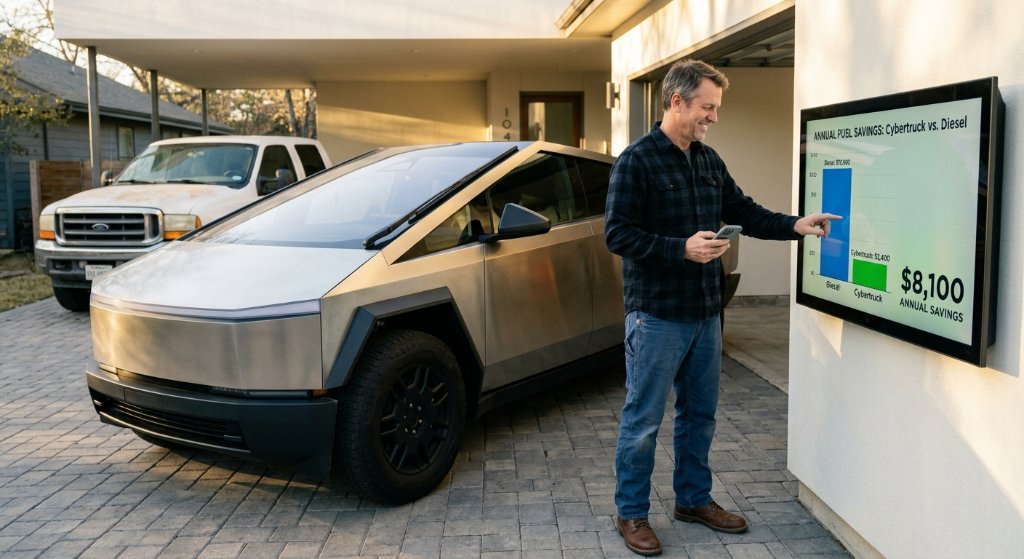
Traditional heavy-duty diesel owners are staging a quiet mutiny, trading in their heavy-duty rigs for Tesla's electric pickup. In online forums and owner groups, a surprising trend has emerged: those who use their trucks for actual, everyday labor are reporting massive financial windfalls. Far from being a mere novelty, the Cybertruck is proving to be a highly effective financial weapon, with some owners slashing over $8,000 in annual fuel costs alone—effectively allowing the EV to pay for itself.
Shattering the Utility Myth
The transition from heavy-duty diesel to electric is not just about environmental virtue; it is a ruthless calculation of operating costs. Former owners of heavy-duty trucks from Ford, Chevrolet, and Ram are finding that the Cybertruck seamlessly replaces their daily workhorses. Contractors and business owners are discovering that for local and regional work, the Cybertruck is not just a viable alternative—it is vastly superior.
While towing massive loads across state lines remains the final, stubborn stronghold of the heavy-duty diesel engine, the overwhelming majority of daily truck utility happens within a 100-mile radius. Within this operational sweet spot, the Cybertruck absolutely dominates.
The Math Behind the Diesel Defection
How does a truck with an $80,000+ price tag end up paying for itself? The answer lies in the massive operational disparity between diesel and electricity:
- Unparalleled Fuel Savings: Owners report saving roughly $8,000 in fuel for every 20,000 miles driven by utilizing cheap off-peak home charging, with some high-mileage users saving upwards of $12,500 annually.
- The Towing Efficiency Trap Resolved: While towing cuts range significantly, local contractors find that the immediate torque and massive fuel savings easily offset the need to plug in at the end of the day.
- Eradication of Diesel Maintenance: Traditional diesel trucks are notorious for high-cost upkeep, from DEF fluid and complex emissions systems to expensive oil changes and frequent brake pads. The Cybertruck’s regenerative braking and simplified drivetrain eliminate these financial pain points.
- On-Site Power Generation: The Cybertruck acts as a mobile generator, allowing contractors to run high-voltage power tools directly from the bed, eliminating the need to haul noisy, gas-guzzling generators to job sites.
Why This Matters:
This shift marks a critical inflection point for the entire automotive industry. For decades, Detroit’s "Big Three" have relied on the highly profitable, cult-like loyalty of the American truck buyer. By proving that an electric truck can win over die-hard diesel owners on pure financial merit, Tesla is penetrating the most profitable moat in the automotive world.
Who Wins:
- Tesla: This real-world utility validation silences the "lifestyle toy" narrative, positioning the Cybertruck as a legitimate commercial asset and opening the door for future fleet sales.
- Small Business Owners: Contractors and tradespeople who adopt early can dramatically lower their overhead, gaining a massive competitive pricing advantage over rivals still chained to expensive diesel.
Who Loses:
- Legacy Automakers: Ford, GM, and Stellantis are facing a worst-case scenario. Their EV strategies (like the F-150 Lightning and Silverado EV) have struggled to capture the heavy-duty crowd, while their highly profitable ICE and diesel truck divisions are now actively losing customers to Tesla.
- The Diesel Infrastructure: The decline of the commercial diesel buyer threatens the high-margin fuel and maintenance ecosystems that have long supported heavy-duty trucking.
Conclusion
The narrative that electric vehicles are impractical for "real work" is officially dead. While long-distance heavy towing remains a challenge that requires specialized diesel power for now, the vast majority of commercial truck utility is shifting rapidly toward electrification. As more fleet managers and independent contractors run the numbers, the $8,000 annual savings will prove too massive to ignore. The Cybertruck is no longer just a futuristic fashion statement; it is a disruptive, cost-slashing tool that is actively rewriting the rules of the American workforce.