Detroit’s Great Regulatory Escape: Trump Slashes CAFE Standards to 34.5 MPG in Historic Blow to EV Push
The inevitable march toward an all-electric American future has officially been put in park. In a move that fundamentally rewrites the regulatory land...
Editorial Team
World Of EV
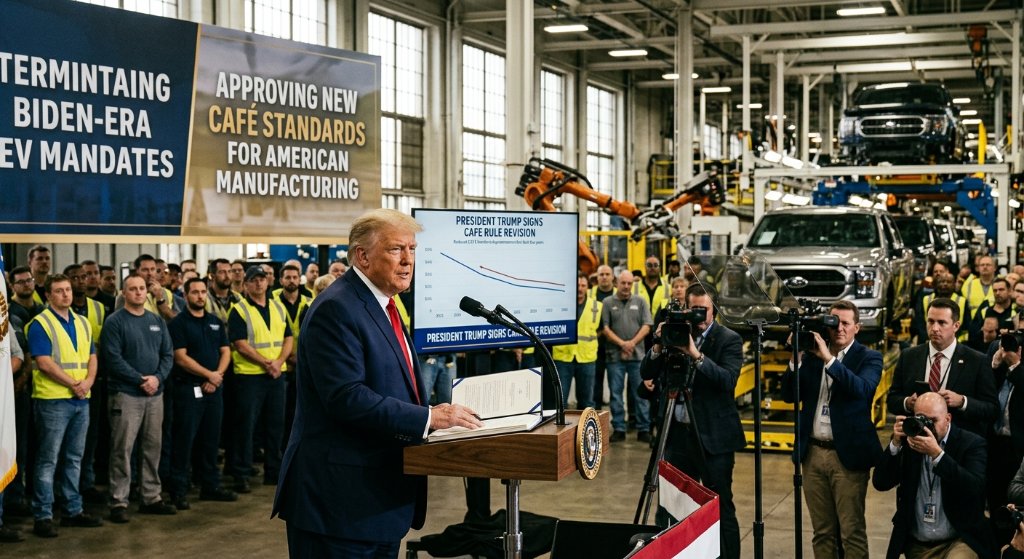
The inevitable march toward an all-electric American future has officially been put in park. In a move that fundamentally rewrites the regulatory landscape for the global automotive industry, President Donald Trump has approved a sweeping rollback of Corporate Average Fuel Economy (CAFE) standards. Set to be officially finalized on Monday, September 28, 2026, the new rule completely dismantles the Biden-era policies designed to force a rapid transition to zero-emission vehicles. This aggressive regulatory U-turn follows previous administration actions—such as the termination of the federal $7,500 EV tax credit in late 2025—and marks the absolute end of the federal government's push to mandate a pure battery-electric vehicle (BEV) market.
For legacy giants like General Motors and Ford, this represents an unprecedented, billion-dollar sigh of relief. For years, Detroit has struggled with the financial whiplash of investing tens of billions into unprofitable EV platforms while simultaneously funding them with lucrative internal combustion engine (ICE) and hybrid cash cows. This regulatory rollback gives these manufacturers the ultimate flexible pass, allowing them to shift their focus back to traditional ICE and hybrid models without the looming threat of ruinous compliance penalties.
Inside the Numbers: Slashes, Saves, and Spills
The Department of Transportation’s final rule represents a staggering shift in fuel efficiency expectations. Under the previous administration's guidelines, automakers faced a daunting climb to an industry-wide fleet average of roughly 50.4 miles per gallon (mpg) by model year 2031. The newly approved guidelines bring those expectations crashing back to reality.
Here are the key changes and specs of the newly approved CAFE framework:
- The Target Drop: The fleetwide fuel economy target for 2031 model-year passenger vehicles drops from roughly 50 mpg to a far more achievable 34.5 mpg.
- Minimal Annual Increases: Instead of the aggressive 8% to 10% annual efficiency gains mandated under Biden, the Trump administration’s plan raises efficiency targets by a nominal 0.25% to 0.5% annually through 2031.
- Retroactive Relief: The new rule retroactively scales back the baseline standards beginning with the 2022 model year, neutralizing past liabilities for automakers.
- The Financial Offset: The administration argues this will significantly lower the average transaction price of new cars—which soared past $50,000 recently—by slashing compliance and production costs. However, the federal government's own estimates acknowledge this shift will increase fuel consumption and carbon dioxide emissions for decades.
A Lifeline Amid Economic and Geopolitical Storms
This policy pivot does not exist in a vacuum. It comes at a highly volatile moment for both global energy markets and domestic politics. With fuel prices reaching historic heights following the US-Israeli conflict with Iran and ongoing geopolitical instability in Eastern Europe, consumers are hyper-sensitive to the cost of living.
The Trump administration is pitching this rollback as a critical economic shield, claiming it will democratize vehicle pricing and protect blue-collar autoworker jobs. Transportation Secretary Sean Duffy championed the move on social media, declaring a "major victory for America's auto workers". Rather than forcing carmakers to bleed cash on raw material supply chains for batteries, Detroit can now deploy capital where consumers are actually buying: larger, high-margin hybrid SUVs, crossovers, and pickup trucks.
Why This Matters:
This is not just a tweak to a regulatory spreadsheet; it is a seismic market shift that completely re-aligns the winners and losers of the global automotive sector.
- The Winners: Detroit Legacy and Oil Giants. Ford, General Motors, and Stellantis are the immediate beneficiaries. They can now pause the panic-induced rush to build "compliance EVs" and focus their manufacturing might on highly profitable ICE trucks and increasingly popular hybrid powertrains. For the oil industry, this is an absolute jackpot, locking in high-volume domestic fuel consumption for another generation.
- The Losers: EV Startups, Charging Networks, and Consumers. Pure-play EV startups like Rivian and Lucid, which do not have legacy gas portfolios to subsidize, will find an already cold market even more hostile. Charging infrastructure providers (like EVgo and ChargePoint) will see a slowdown in demand, jeopardizing massive grid investments. Moreover, despite lower vehicle purchase costs, consumers lose at the pump; more fuel-thirsty cars mean higher long-term operating costs in an era of volatile, $4+ per gallon gasoline.
- The Global Risk: Creating an American "Hermit Kingdom." The most dangerous long-term implication is the threat of global isolation. While the U.S. pauses its EV transition, European and Chinese auto giants like BYD and Geely are aggressively scaling up advanced EV technologies, software integration, and manufacturing efficiencies. By shielding Detroit from the pressure to innovate, this rollback risks turning the American automotive market into a technology island—producing large, gas-chugging vehicles that the rest of the decarbonizing global market simply does not want.
Ultimately, the newly finalized CAFE standards offer short-term financial breathing room to legacy automakers at the expense of long-term technological competitiveness. Detroit has been handed the flexibility it begged for, but flexibility can breed complacency. As global markets transition toward electrification, U.S. legacy automakers must use this regulatory pause to refine, rather than abandon, their EV programs—or risk waking up in 2031 to find themselves hopelessly outpaced on the world stage.