Debunking the Battery Myth: Massive 500,000-Vehicle Study Proves Used EVs Retain 90% Capacity After 93,000 Miles
For years, the specter of a dead battery pack costing five figures has haunted the used electric vehicle market, suppressing residual values and keepi...
Editorial Team
World Of EV
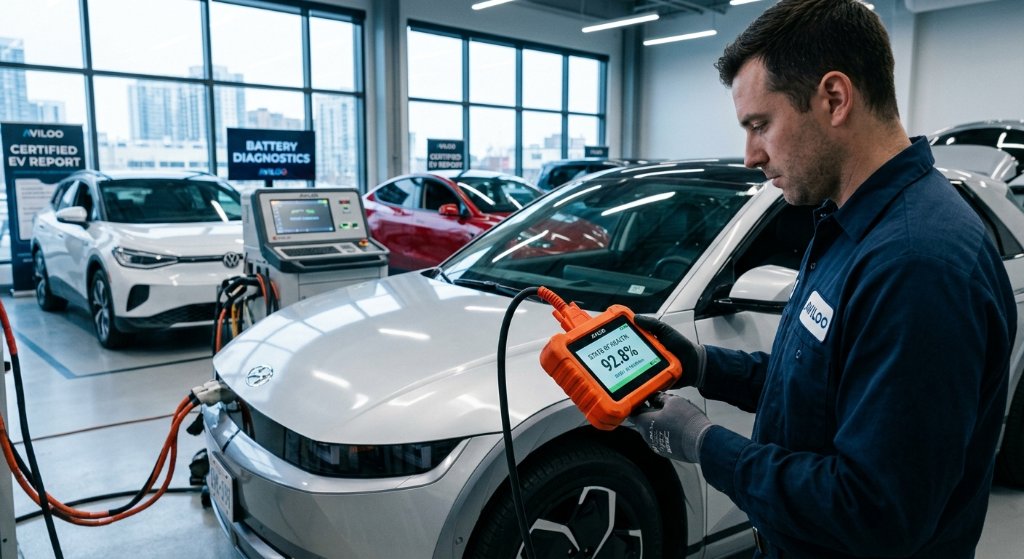
For years, the specter of a dead battery pack costing five figures has haunted the used electric vehicle market, suppressing residual values and keeping hesitant buyers on the sidelines. But a groundbreaking new study from Austrian battery diagnostics pioneer AVILOO has just shattered these fears, delivering the most comprehensive proof yet that modern EV batteries are far more resilient than skeptics claim.
This battery anxiety wasn't entirely baseless. Early pioneering EVs, most notably the first-generation Nissan Leaf, relied on passive air cooling that left cells highly vulnerable to heat-induced degradation—especially in warmer climates. However, AVILOO’s data from over 500,000 real-world battery tests across 20 popular EV models globally reveals that the industry’s shift to advanced liquid thermal management has fundamentally cured this early-onset aging disease.
The 90% Benchmark: Modern Engineering Triumphs Over Degradation
The landmark study confirms that at 150,000 kilometers (roughly 93,000 miles), the vast majority of modern EVs retain approximately 90% of their original usable capacity. This isn't theoretical laboratory data; it represents half a million real-world vehicles driven in diverse climates, proving that EV powertrains are easily outlasting the typical ownership cycle of their first buyers.
While the overall average is outstanding, some manufacturers are managing thermal chemistry better than others. AVILOO’s data highlights a few standout performers at the 150,000-km mark:
- Hyundai Ioniq 5 (92.8% Median State of Health): The South Korean automaker’s E-GMP platform leads the pack, proving that its ultra-fast 800V architecture and highly optimized thermal management do not compromise long-term durability.
- Volkswagen ID.4 (90.6% Median State of Health): Despite early software stumbles, VW’s MEB platform delivers highly robust battery chemistry that comfortably beats the 90% benchmark.
- Tesla Model Y (90.3% Median State of Health): The world’s best-selling vehicle proves its battery longevity matches its sales dominance, thanks to Tesla's industry-leading battery management system (BMS) algorithms.
Why This Matters:
This is a seismic shift for the entire automotive ecosystem, particularly the struggling used EV market. Historically, steep depreciation has plagued electric vehicles because buyers feared inheriting a five-figure battery replacement bill. By proving that a 93,000-mile EV still has 90% of its range, AVILOO’s data provides the financial sector and insurance companies with the hard actuarial data they need to underwrite EV loans and warranties accurately.
Ultimately, this is a a massive win for used car buyers and leasing companies alike. Buyers can now purchase second-hand EVs with high mileage, confident that the battery is far from its end-of-life stage. For leasing firms, stabilized residual values will directly translate to lower, more competitive lease payments on new EVs. On the losing side are legacy internal combustion engine (ICE) dealerships who rely on 'battery anxiety' as a key sales tactic to steer buyers back to gas-powered cars. This data effectively neutralizes that argument, signaling a major market shift toward long-term EV viability.
Conclusion
AVILOO’s massive data pool has effectively dismantled the loudest argument against EV adoption. As these vehicles transition to their second and third owners, the narrative must pivot from 'will the battery die?' to 'how do we maximize this enduring asset?' The era of the disposable EV is officially over; the era of the 300,000-mile electric powertrain is here.