Croatia Greenlights Tesla FSD, But A Massive Regulatory Clash Threatens to Derail Europe's Rollout
Tesla's slow-burn conquest of Europe just ticked up another notch as Croatia officially cleared Full Self-Driving (Supervised) for its roads, making i...
Editorial Team
World Of EV
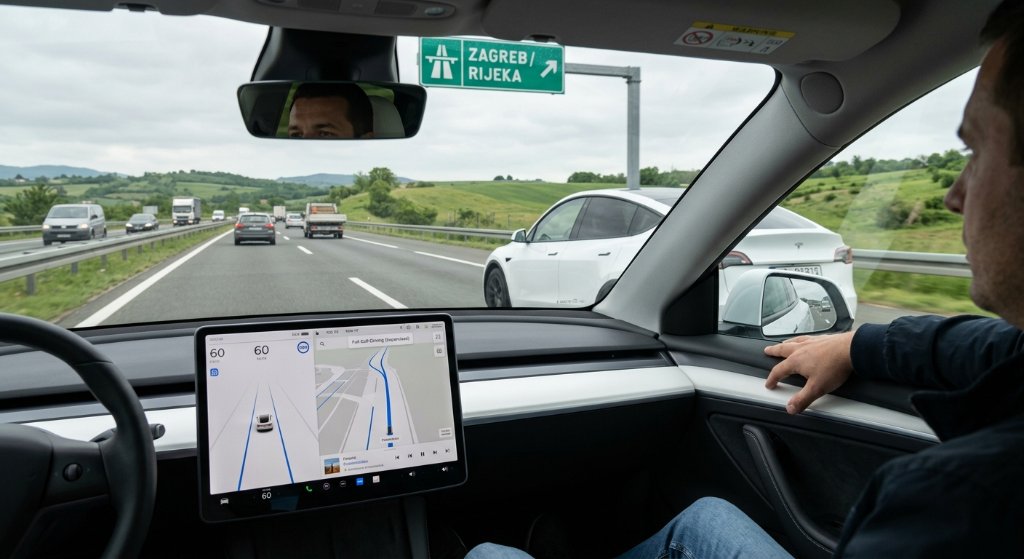
Tesla's slow-burn conquest of Europe just ticked up another notch as Croatia officially cleared Full Self-Driving (Supervised) for its roads, making it the eighth European Union country to bypass a stagnant central bureaucracy. But while Elon Musk’s camp celebrates another victory, a high-stakes regulatory war is brewing behind the scenes. The European Transport Safety Council (ETSC) has launched a direct offensive, urging EU member states and the European Commission to reject the technology outright over allegations that Tesla is building cars designed to break the law.
For years, European Tesla owners have suffered under a severely "nerfed" version of Autopilot. Bound by restrictive United Nations Economic Commission for Europe (UNECE) regulations, European Teslas have been unable to perform the seamless maneuvers and advanced lane-centering that North American drivers take for granted. Tesla's clever workaround has been a state-by-state strategy, securing provisional national approvals by leveraging an initial nod from the Dutch regulator RDW back in April. Croatia’s sudden approval marks a significant acceleration of this patchwork expansion.
The European Dominoes Fall, One by One
Rather than waiting for a centralized EU ruling, Tesla has been playing a masterful game of regulatory chess, winning over national watchdogs. By securing individual approvals, the automaker is building a grassroots coalition of support.
The current European FSD footprint now includes:
- The Pioneer: The Netherlands, which granted the initial provisional approval in April 2026, setting the entire domino effect in motion.
- The Early Adopters: Belgium, Lithuania, Estonia, and Denmark.
- The Autumn Wave: Slovenia, the Czech Republic, and now Croatia, all joining the fold in September 2026 alone.
This state-by-state land grab is a race against the clock. A highly anticipated EU-wide vote by the Technical Committee on Motor Vehicles (TCMV) was recently postponed until at least December 2026. Tesla needs a "qualified majority" of 15 out of 27 EU nations—representing at least 65% of the total EU population—to secure blanket approval. Winning individual states like Croatia is vital to building that momentum, but the opposition is organizing.
The Speeding Offense That Could Stop FSD Cold
The ETSC's objection is not a minor administrative hurdle; it targets the core behavior of Tesla's AI driving logic. The watchdog has called out two specific software functions that it claims violate UN Regulation No. 171, which governs driver-assistance systems:
- The Speed Offset Function: This feature allows drivers to configure FSD to drive up to 50% faster than the detected speed limit. ETSC points out that UN Regulation No. 171 explicitly prohibits driver-assistance systems from letting drivers set default speed offsets above system-determined limits. In practice, this means a 50 km/h zone can legally become a 75 km/h limit in the eyes of the AI.
- Contextual Max Speed: Rather than strictly obeying speed signs, Tesla’s latest "flow of traffic" logic allows FSD to match the speed of surrounding vehicles. While this makes the car drive more naturally, ETSC argues it reinforces systemic speeding, as human drivers on European roads frequently exceed official limits.
According to the ETSC, Tesla has bypassed these restrictions without seeking the required exemptions under the EU's Article 39 procedure, prompting several countries—including Sweden and France—to investigate.
Why This Matters:
This is a make-or-break moment for Tesla's European ambitions. In North America, FSD is a high-margin premium software feature that keeps profit margins healthy. In Europe, however, Tesla is facing an unprecedented onslaught from highly competitive, tech-forward Chinese EV giants like BYD and Geely, who are rapidly eating into its market share. Tesla desperately needs FSD as a technological moat to justify its premium pricing.
The losers here are European consumers. If the ETSC succeeds in rallying EU member states to reject FSD over the speed offset feature, Tesla will be forced to neuter the software yet again. European drivers would be left with a sluggish, overly cautious system that drives like a timid student driver, rather than the fluid, human-like AI experienced in North America. The ultimate winners would be rival automakers, who would breathe a massive sigh of relief knowing Tesla’s most formidable software weapon has been disarmed by European red tape.
As Croatia opens its highways to Tesla's neural-net-driven future, the clock is ticking toward the decisive December vote. If Tesla cannot convince regulators that its speed-offset functions represent natural driving behavior rather than reckless software engineering, its dream of a unified European autonomous rollout could crash before it ever reaches the highway.