Beyond the Road: Tesla's Synthetic Data Engine Accelerates FSD Mastery
For years, Tesla's ambitious Full Self-Driving (FSD) system has captivated and challenged the automotive world, promising a future of true autonomous ...
Editorial Team
World Of EV
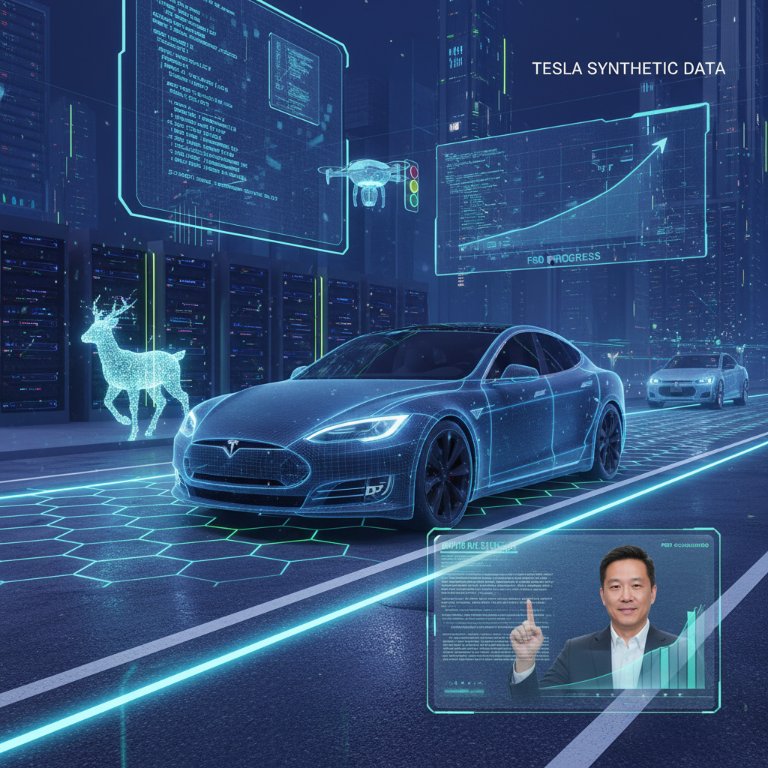
For years, Tesla's ambitious Full Self-Driving (FSD) system has captivated and challenged the automotive world, promising a future of true autonomous mobility. While the company has meticulously collected billions of miles of real-world driving data, the inherent limitations of such an approach – particularly in capturing rare, unpredictable 'edge cases' – have presented formidable hurdles. Now, a significant strategic pivot is underway: Tesla is increasingly leveraging synthetic data generation, creating artificial driving scenarios at an unprecedented scale to supercharge its FSD neural network development. This pivotal shift promises to unlock faster, more robust improvements for the highly anticipated autonomous system.
The Digital Dojo: Forging FSD in Virtual Worlds
The reliance on real-world data, while invaluable for general driving patterns, has always faced a fundamental challenge: the sheer rarity of truly unusual road conditions or highly specific, critical driving behaviors. Imagine waiting for a meteor shower to train a system on celestial events; similarly, relying solely on unpredictable real-world occurrences for rare traffic anomalies is inefficient and time-consuming. Tesla’s synthetic data generation directly addresses this bottleneck by creating a virtually infinite 'digital dojo' where its FSD neural network can train against every conceivable scenario.
- Unlocking Edge Cases: The system can now simulate rare road conditions, extreme weather events, and highly unusual vehicle or pedestrian behaviors that might occur only once in a million miles of real-world driving. This is a game-changer for safety and reliability, ensuring the FSD system is prepared for the unexpected.
- Accelerated Learning: By generating these scenarios at scale, Tesla can feed its neural networks with vast quantities of diverse, targeted training data far more rapidly than real-world collection ever could. This dramatically shortens the iteration cycle for FSD improvements.
- Cost-Efficiency and Safety: Simulating scenarios is inherently safer and more cost-effective than attempting to find and test for every possible real-world anomaly on public roads.
Industry Validation: Nvidia's Jensen Huang Weighs In
The strategic importance of this approach has not gone unnoticed by industry titans. Nvidia CEO Jensen Huang, a recognized visionary in AI and high-performance computing, has openly praised Tesla's innovative application of synthetic data, describing its FSD stack as "world-class" specifically because of its handling of "data collection, curation, synthetic data generation, and all of their simulation technologies." This endorsement from the head of a company synonymous with advanced AI computation lends significant credibility to Tesla's methodology, highlighting it as a leading-edge development in autonomous systems training. It underscores a growing consensus among AI experts that synthetic data is not merely a supplementary tool, but a foundational pillar for achieving true artificial intelligence in complex, safety-critical applications like self-driving.
Why This Matters:
- Tesla Wins Big: For Tesla, this move is critical. It offers a clear pathway to overcome the long-standing challenges and criticisms surrounding FSD's full capabilities and rollout timelines. Faster, safer, and more comprehensive training directly translates into a more reliable and marketable product, potentially accelerating FSD's journey towards true Level 4 or Level 5 autonomy. It positions Tesla at the forefront of AI-driven simulation for automotive applications.
- Consumers Benefit Directly: A more robust and reliable FSD system means a safer and more confident autonomous driving experience for consumers who have invested in the technology. The ability to handle diverse and unusual situations effectively builds trust and accelerates acceptance of autonomous vehicles.
- Competitors Face a New Benchmark: Companies relying predominantly on real-world data collection for their autonomous systems may find themselves at a significant disadvantage. Tesla's approach sets a new benchmark for development speed and the breadth of training scenarios, forcing competitors to re-evaluate their own strategies and potentially invest heavily in similar synthetic environments to remain competitive. This could spark an 'AI arms race' in simulation.
- A Maturing AI Landscape: This shift signals a maturation in the broader field of AI for autonomous vehicles. It legitimizes synthetic data as not just a supplement but a core, essential component of achieving highly capable and safe AI systems in complex, real-world environments. It underscores that the future of autonomy is inextricably linked with advanced simulation and AI-generated realities.
Tesla's amplified reliance on synthetic data marks a defining moment in its quest for Full Self-Driving. By effectively creating an infinite, customizable training ground for its neural networks, the company is not just refining its existing system; it's fundamentally accelerating its trajectory towards a truly autonomous future. This strategy will likely be a blueprint for success in the rapidly evolving world of self-driving technology, pushing the entire industry forward towards a safer, more automated tomorrow.