Uber and Rivian Forge $1.25 Billion Autonomous Alliance: A Bold Bet on the R2 Robotaxi
The autonomous ride-hailing landscape just got a monumental jolt. In a strategic move set to redefine urban mobility and bolster Rivian's ambitious gr...
Editorial Team
World Of EV
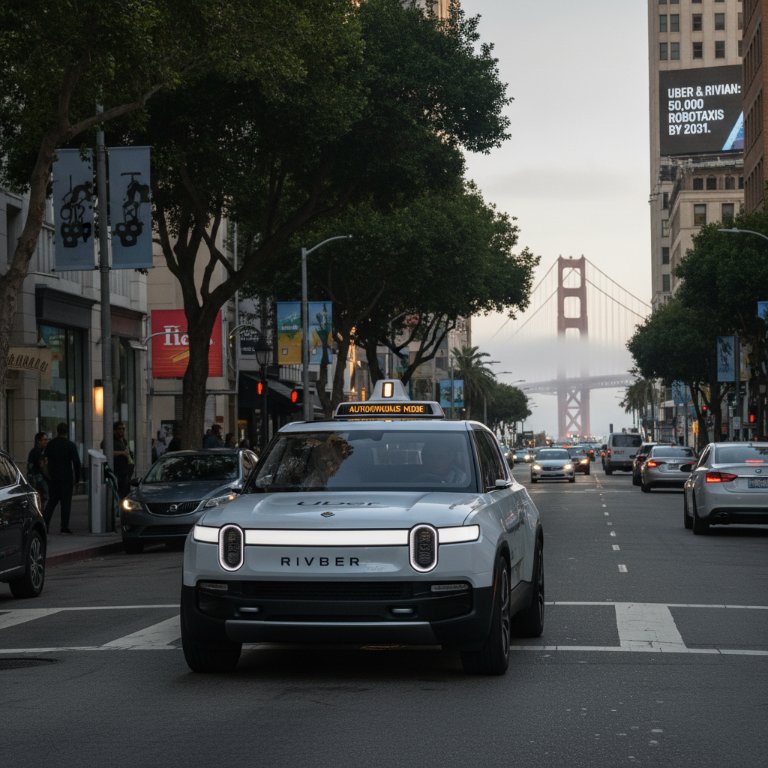
The autonomous ride-hailing landscape just got a monumental jolt. In a strategic move set to redefine urban mobility and bolster Rivian's ambitious growth plans, Uber Technologies, Inc. and Rivian Automotive, Inc. have announced a sweeping partnership. Uber will infuse up to $1.25 billion into Rivian through 2031, securing a dedicated fleet of fully autonomous R2 robotaxis and signaling a profound commitment to the future of driverless transportation.
This alliance comes at a pivotal moment for both companies. Rivian, a darling of the EV startup world, has captivated consumers with its R1T pickup and R1S SUV, but like many nascent automakers, it grapples with the complexities of scaling production and achieving consistent profitability. Uber, meanwhile, has long pursued the elusive promise of autonomous ride-hailing, navigating various in-house efforts and collaborations with mixed results. This partnership represents a significant evolution in their respective strategies, marrying Rivian's electric vehicle platform prowess with Uber's vast network and autonomous aspirations.
The Deal: A Massive Vote of Confidence in Rivian's R2
The core of this transformative agreement centers on Rivian's forthcoming R2 platform, a more compact and accessible EV designed to broaden the brand's appeal beyond its premium R1 offerings. Under the terms of the deal:
- Significant Investment: Uber will invest up to $1.25 billion into Rivian over the next eight years, a substantial capital injection that will undoubtedly aid Rivian's manufacturing scale-up and R&D efforts for the R2.
- Fleet Commitment: Uber, or its designated fleet partners, commits to purchasing an initial 10,000 Rivian R2 robotaxis. This foundational order comes with an option for an additional 40,000 R2s by 2030, potentially bringing the total fleet to 50,000 vehicles.
- Aggressive Rollout: Initial commercial deployments are slated for 2028 in key markets: San Francisco and Miami.
- Rapid Expansion: The plan outlines an ambitious expansion to 25 cities across the U.S., Canada, and Europe by 2031, demonstrating a global vision for this autonomous service.
This guaranteed demand for the R2 is nothing short of a game-changer for Rivian. As the company ramps up for R2 production, which is crucial for its long-term viability, this partnership de-risks a significant portion of its early sales outlook, providing a stable revenue stream and validating its platform strategy.
Why the Rivian R2 is a Strategic Choice
The selection of the R2 platform by Uber is not arbitrary. While specific robotaxi modifications are yet to be fully detailed, the R2's inherent design offers several advantages for autonomous ride-hailing:
- Purpose-Built EV Platform: Unlike retrofitting internal combustion vehicles, the R2 is designed from the ground up as an electric vehicle, allowing for optimal packaging of battery, electric motors, and crucial autonomous hardware. This translates to better efficiency, range, and passenger experience.
- Optimized Size and Cost: The R2 is expected to be more compact and more affordably priced than Rivian's current R1 models, making it a more suitable and economically viable option for high-volume urban robotaxi operations.
- Robustness and Durability: Rivian's engineering has proven capable of producing rugged, adventure-ready vehicles. This durability will be critical for the demanding 24/7 operational cycle of a robotaxi fleet, minimizing downtime and maintenance costs.
Why This Matters:
For Rivian: A Lifeline and Launchpad. This deal is arguably one of the most significant validations Rivian has received to date. The $1.25 billion investment provides crucial capital, while the commitment to 50,000 R2 units offers an unparalleled guaranteed order book, something most EV startups can only dream of. It dramatically accelerates the R2's market entry and positions Rivian as a key hardware provider in the burgeoning autonomous commercial fleet sector, diversifying its revenue beyond consumer sales. This isn't just about selling vehicles; it's about embedding Rivian's technology into the future of mobility, potentially solidifying its long-term financial health and market perception.
For Uber: A Clear Path to Autonomous Scale. After years of exploring various autonomous strategies, Uber has found a dedicated, electric vehicle partner that aligns with its sustainability goals and scaling ambitions. By leveraging Rivian's EV platform, Uber can focus its resources on refining its autonomous driving software and operational logistics, rather than designing and manufacturing specialized vehicles from scratch. This strategy could allow Uber to outmaneuver competitors who are either struggling with in-house hardware development (like some past autonomous ventures) or relying on less optimized vehicles. Securing a purpose-built EV fleet is a critical advantage in the race for cost-effective, emissions-free robotaxi services.
For the Autonomous Driving Industry: Heightened Competition and Consolidation. This mega-deal signals a significant acceleration in the autonomous ride-hailing space. While companies like Waymo and Cruise have made strides, regulatory hurdles and the sheer cost of deployment have kept widespread adoption in check. The Uber-Rivian alliance, with its aggressive timeline and substantial investment, is a clear declaration of intent that will intensify competition. It suggests that strategic partnerships between technology providers and hardware manufacturers will be key to overcoming the immense capital and technical challenges of scaling autonomous services. It also puts pressure on traditional automakers to solidify their own autonomous strategies, lest they be left behind in this rapidly evolving market.
For Consumers and Cities: The Promise of EV Robotaxis Nears. For the public, this partnership means the prospect of widely available, fully autonomous, and zero-emission ride-hailing services is becoming a tangible reality within the next few years. The expansion to 25 cities across continents indicates a commitment to broad access, potentially transforming urban transportation by reducing congestion, improving accessibility, and lowering per-mile costs in the long run.
This partnership between Uber and Rivian is more than just a business deal; it's a strategic fusion that promises to reshape the landscape of electric vehicles and autonomous transportation. With a substantial financial commitment and an ambitious deployment roadmap, both companies are making a powerful statement about their intent to dominate the future of urban mobility. The road ahead for autonomous vehicles is still fraught with technical and regulatory challenges, but with this alliance, the journey just got a significant boost.