The True Cost Advantage: EVs Prove Dramatically Cheaper to Maintain, Saving Owners Thousands
For years, prospective electric vehicle (EV) buyers have weighed the environmental benefits and instant torque against concerns about range anxiety an...
Editorial Team
World Of EV
For years, prospective electric vehicle (EV) buyers have weighed the environmental benefits and instant torque against concerns about range anxiety and, crucially, the long-term cost of ownership. While upfront purchase prices and charging infrastructure often dominate the conversation, robust new data from leading automotive authorities now delivers a definitive answer to one of the most persistent questions: Are EVs genuinely cheaper to maintain? The answer, unequivocally, is yes—by a significant margin.
A Clear Financial Victory for EV Owners
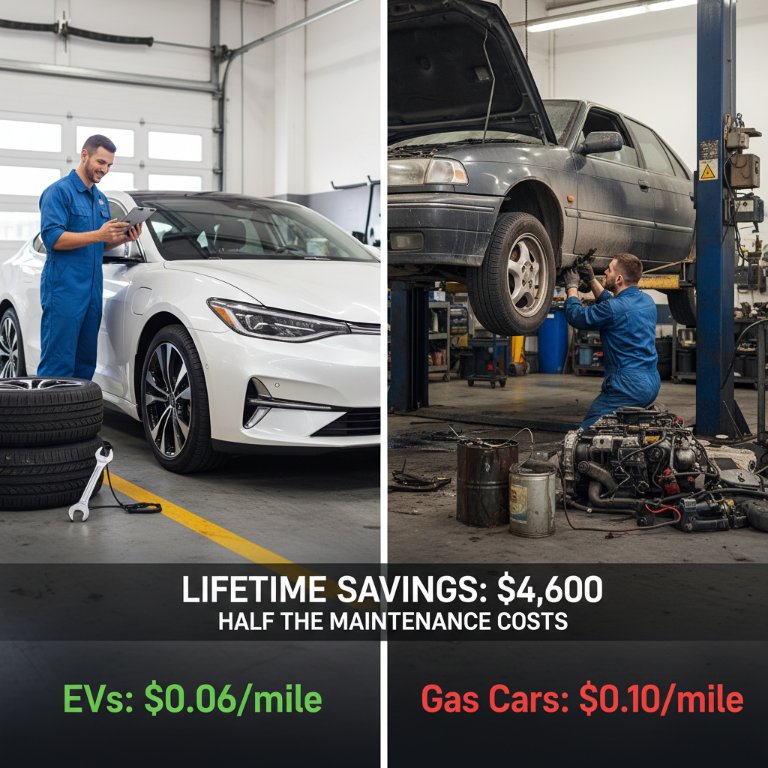
New, comprehensive data from Consumer Reports and AAA confirms that electric vehicle owners incur approximately half the cost for maintenance and repairs over their vehicle's lifetime compared to owners of gasoline-powered cars. This translates to an average saving of about $4,600, a figure that directly impacts the wallet of every EV driver. This finding isn't an isolated anomaly; the U.S. Department of Energy (DOE) independently supports these conclusions, underscoring the consistent financial advantage of electric propulsion.
Breaking Down the Per-Mile Advantage
Delving deeper into the operational economics, the DOE's analysis reveals that scheduled maintenance costs for battery-electric vehicles (BEVs) average around 6.1 cents per mile. In stark contrast, conventional internal combustion engine vehicles (ICEVs) rack up an average of 10.1 cents per mile for similar scheduled upkeep.
This dramatic difference stems from the fundamental engineering of EVs. Unlike complex ICE powertrains with their hundreds, sometimes thousands, of moving parts, an EV motor typically features fewer than 20. This simplicity eliminates a litany of routine, costly services inherent to gasoline cars, such as:
- Oil changes and filter replacements
- Spark plug and oxygen sensor replacements
- Timing belt replacements
- Exhaust system repairs
Furthermore, electric vehicles benefit from regenerative braking, a technology that converts kinetic energy back into electricity to recharge the battery. This process significantly reduces wear and tear on conventional brake components, leading to less frequent brake pad and rotor replacements.
Why This Matters:
This data represents a watershed moment for the EV market and for consumers. For too long, the narrative around EV adoption has been bogged down by perceived cost barriers beyond the initial purchase. This comprehensive analysis, drawing from credible sources like Consumer Reports, AAA, and the DOE, firmly reframes the total cost of ownership (TCO) discussion. It provides concrete evidence that EVs offer substantial long-term financial relief, moving beyond the anecdotal to the empirically proven.
Who Wins? Consumers, first and foremost, who gain significant savings over their vehicle's lifespan. EV manufacturers also win, as this data provides a powerful new pillar for their marketing efforts, enabling them to highlight the true economic value proposition of their products. This insight could accelerate mainstream EV adoption, as one of the key psychological hurdles—the uncertainty of long-term costs—is now effectively addressed. Policy makers also benefit from this, as increased adoption helps meet environmental goals.
Who Loses? Traditional automotive service centers that rely heavily on the frequent maintenance needs of ICE vehicles will need to adapt, investing in EV-specific training and equipment to remain competitive. This also subtly shifts the market away from a reliance on fossil fuels, impacting industries tied to gasoline production and distribution.
This data signals a maturing market where the financial benefits of EVs are becoming undeniable. It's not just about fuel savings anymore; it's about a holistic reduction in operational expenses that makes EV ownership a compelling economic choice. Expect manufacturers to lean heavily into these TCO arguments, and for a new wave of prospective buyers to give serious consideration to EVs, now armed with clarity on the bottom line.
In conclusion, the days of questioning the economic viability of electric vehicles are drawing to a close. With verifiable savings of thousands of dollars in maintenance and repair costs, EVs are not just a cleaner, more engaging way to drive—they are increasingly the smarter financial choice for the discerning driver looking ahead. This data solidifies the EV's position as a wise investment for the future, promising not only environmental benefits but also tangible, long-term economic advantages.