The Silent Threat: How Sealed Power Electronics Drive a Looming 'Totalling Crisis' for EVs
Electric vehicles (EVs) represent the vanguard of sustainable transportation, promising lower running costs and reduced emissions. However, a hidden c...
Editorial Team
World Of EV
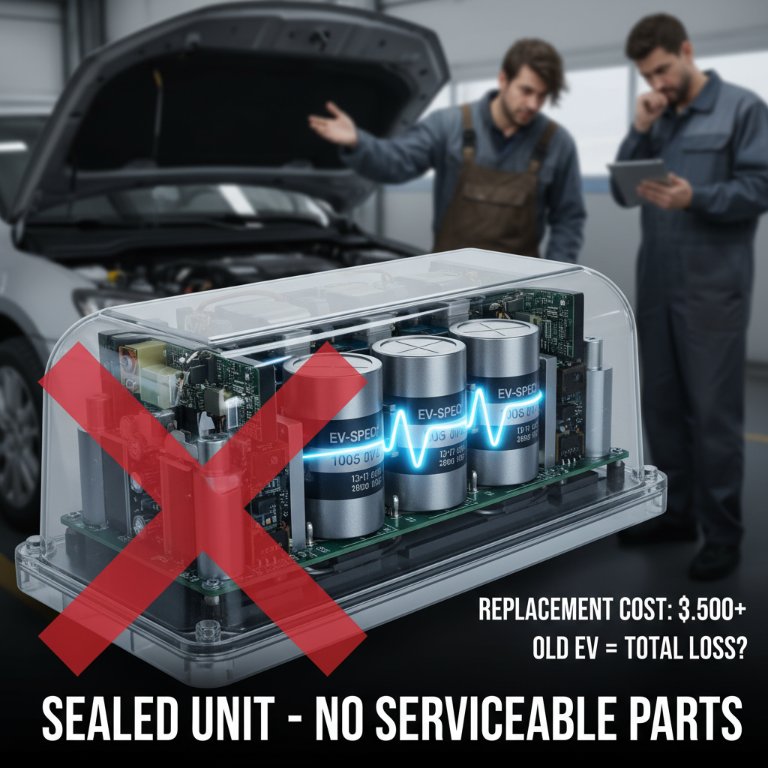
Electric vehicles (EVs) represent the vanguard of sustainable transportation, promising lower running costs and reduced emissions. However, a hidden challenge, often overlooked in the hype, is rapidly emerging as a significant threat to long-term EV ownership and market perception: the prohibitive cost and complexity of repairing power electronics assemblies. These critical components, heavily reliant on capacitors for instantaneous energy buffering, are typically sealed units, transforming what might be a minor component failure into a financially devastating repair.
Beyond the primary battery pack, capacitors are the unsung heroes of EV power management systems. They ensure stable voltage, suppress harmful electrical noise, and deliver bursts of power far beyond the battery's instantaneous capabilities, crucial for everything from acceleration to regenerative braking. Yet, the very sophistication of these integrated systems is now exposing a critical vulnerability in the EV lifecycle.
The Sealed System Trap: From Fuse to Five-Figure Fix
Unlike traditional internal combustion engine (ICE) vehicles where individual components can often be diagnosed and replaced, EV power electronics assemblies are predominantly sealed units. This design choice, while offering benefits in terms of ingress protection and manufacturing efficiency, renders component-level service impossible. What might be a failure of a single, inexpensive capacitor or another small electronic part, a component potentially costing as little as $25, necessitates the replacement of an entire assembly.
Exorbitant Replacement Costs: These full assembly replacements can range dramatically, often falling between $3,000 and $4,500. This figure pales in comparison to the cost of replacing an entire EV battery pack, which can be $5,000 to $20,000+, but these power electronic assemblies are far more prone to failure than the battery itself. For context, this is akin to replacing an entire engine control unit (ECU) for a blown fuse in a gasoline car, an unthinkable proposition in the ICE world.
Lack of Third-Party Repair: The specialized, high-voltage nature of these systems, coupled with proprietary designs and diagnostics, severely limits the ability of independent repair shops to service these components. Technicians require highly specialized training and equipment, creating a significant service gap outside of authorized dealerships.
A Looming 'Totalling Crisis'
This economic dynamic is creating a profound 'totalling crisis' for older EVs. As these vehicles age and exit warranty coverage, the probability of component failures within these power electronics assemblies increases. When a $3,000-$4,500 repair bill for a power electronics assembly arises for a five-year-old EV with, for instance, only $12,000 in residual equity, the repair cost can quickly exceed a significant portion of the vehicle's remaining value. Insurance companies may then deem the vehicle an economic total loss, even if the vehicle is otherwise in good condition and has a healthy battery.
This phenomenon directly impacts market perceptions of EV durability and the long-term economics of ownership. Just as concerns about battery replacement costs have historically shadowed used EV markets, this emerging power electronics issue threatens to further depress residual values. Furthermore, the potential for component obsolescence means that finding replacement assemblies for older models could become increasingly difficult and expensive over time.
Why This Matters:
This 'totalling crisis' isn't just an inconvenience for a few early adopters; it signals a fundamental flaw in the current EV design and service paradigm that could have far-reaching consequences for the entire industry. For the savvy EV enthusiast and prospective buyer, this means carefully scrutinizing warranty terms for power electronics and understanding the potential financial cliff that awaits post-warranty. A vehicle that was promoted for its low maintenance could quickly become a financial liability, directly contradicting a core promise of EV ownership.
Who Wins? Manufacturers that anticipate this problem and design their power electronics with modularity and repairability in mind stand to gain significant trust and market share. Independent repair networks, if given access to diagnostics, parts, and training, could also carve out a vital niche. The nascent EV component recycling industry also stands to benefit from a greater push for component recovery rather than entire unit disposal.
Who Loses? Current owners of older EVs, particularly those outside warranty, face the most immediate financial risk. Manufacturers who continue to prioritize sealed, non-serviceable components without addressing the long-term cost implications risk damaging the perception of EV reliability and affordability, potentially slowing mainstream adoption. The used EV market will struggle with depressed residual values as buyers factor in this hidden repair risk.
This situation is a clarion call for a shift in industry practices, echoing calls for 'right to repair' movements seen in other electronics sectors. Without a concerted effort to make EV power electronics more serviceable, the industry risks undermining its own growth by creating an untenable long-term ownership proposition for a significant portion of the market.
The Road Ahead: A Call for Repairability
The long-term success of the EV revolution hinges not just on range and charging speeds, but on fundamental ownership economics and repairability. The industry must move towards more modular power electronics designs, enabling component-level diagnosis and replacement, rather than forcing costly full-assembly swaps. This will require collaboration between automakers, component suppliers, and the aftermarket service industry to develop standardized diagnostic tools, training programs, and accessible parts channels. Only then can we ensure that the promise of sustainable electric mobility is also a promise of sustainable and affordable ownership for everyone.