The Countdown Begins: Prediction Markets Declare Unsupervised FSD Inevitable by Mid-2026, Ushering in a New Era of Autonomy
The automotive world is abuzz with an unprecedented development: prediction markets are signaling a 100% certainty for Tesla to launch unsupervised Fu...
Editorial Team
World Of EV
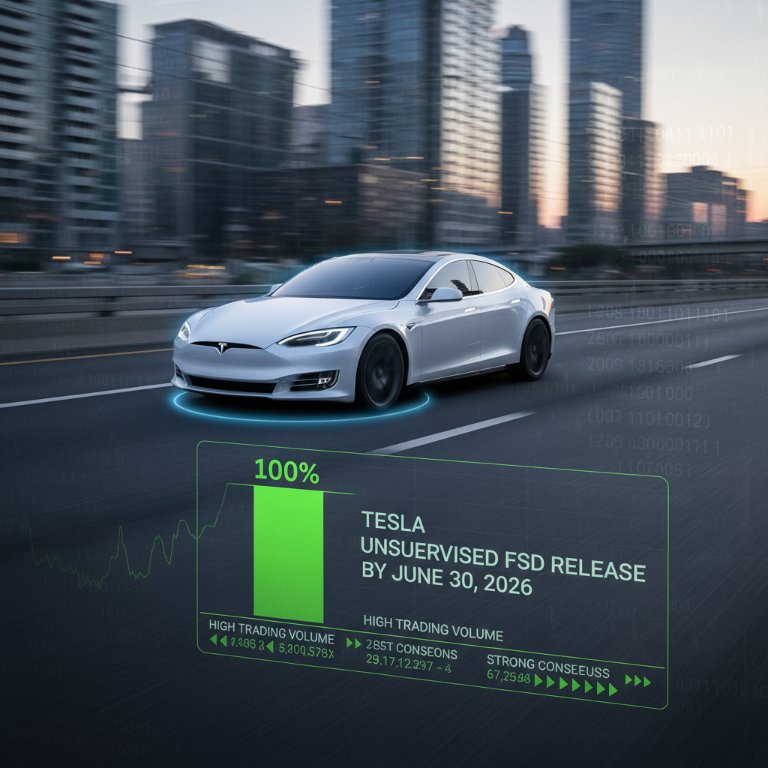
The automotive world is abuzz with an unprecedented development: prediction markets are signaling a 100% certainty for Tesla to launch unsupervised Full Self-Driving (FSD) by June 30, 2026. This isn't merely a strong indication; it's a financial consensus, underscored by significant trading volume that reflects robust trader confidence in the imminent delivery of this highly anticipated, advanced FSD capability.
The Long Road to Autonomy: A Legacy of Promise and Progress
For years, Tesla and its CEO, Elon Musk, have championed a vision of ubiquitous self-driving cars, often setting ambitious timelines that have both inspired and, at times, frustrated enthusiasts and investors alike. From early promises of cross-country autonomous drives by 2016 to ongoing iterative beta releases, the journey toward true FSD has been a complex and challenging one, marked by constant software refinement and hardware advancements. Currently, Tesla's FSD Beta is classified as a Level 2 advanced driver-assistance system (ADAS), requiring active driver supervision and intervention. This new market prediction, however, points to a leap into genuine unsupervised operation, a critical distinction that moves beyond mere assistance.
Defining Unsupervised: A Paradigm Shift in Driving
Unsupervised FSD fundamentally redefines the driving experience. It signifies a transition from Level 2 driver assistance to a higher echelon of autonomy, likely Level 4 (Highly Automated Driving) or a robust Level 3 (Conditional Driving Automation) operating within a defined operational design domain. In practical terms, this means the vehicle will handle all aspects of driving under specific conditions without requiring human intervention or constant monitoring. The driver would not be obligated to constantly monitor the system and could engage in other activities, though they might still need to be available for intervention at Level 3. Level 4, in contrast, implies the vehicle can handle situations autonomously and even park itself safely if the driver fails to respond to a prompt. This represents a monumental shift from the current FSD Beta, where drivers remain legally and practically responsible for the vehicle's operation at all times.
Why This Matters:
For the Consumer: Imagine reclaiming commute time for work, relaxation, or entertainment. Unsupervised FSD promises unprecedented convenience and could fundamentally alter vehicle ownership, potentially making personal transportation safer by significantly reducing human error. For prospective EV buyers, this capability could become a decisive factor, differentiating Tesla dramatically from competitors whose ADAS offerings, while advanced, often remain limited to highway driving or require hands-on supervision.
For Tesla: This is the ultimate validation of years of immense investment, persistent development, and bold pronouncements. Delivering unsupervised FSD will cement Tesla's position not just as an EV leader, but as a dominant force in artificial intelligence and autonomous technology. It unlocks enormous potential revenue streams, including widely anticipated Robotaxi services and FSD subscriptions, fundamentally transforming its business model. Failure to deliver, after such strong market consensus, would represent a colossal blow to credibility, making this a near 'do-or-die' moment for proving the long-term vision.
For the Industry: The entire automotive sector will feel the ripple effects. Competitors who have struggled to advance their own autonomous driving solutions, such as GM with Ultra Cruise or others still focused on Level 2 systems, will face immense pressure to accelerate their efforts or risk being left behind. This development will intensify the race for autonomous driving talent and investment, potentially leading to further consolidation or strategic partnerships. The entry of truly unsupervised systems will also force regulators globally to adapt and establish new frameworks for deployment, liability, and safety, a significant challenge given the complexity of the technology. It also signals to other tech giants and startups in the autonomous space (like Waymo or Cruise) that a formidable, vision-based approach is indeed viable for consumer vehicles, contrasting with their typically geofenced or lidar-heavy strategies.
The Road Ahead: A New Horizon for Mobility
The certainty of unsupervised FSD's arrival by June 2026 marks a pivotal moment in the evolution of personal transportation. It's a testament to the relentless pursuit of technological advancement and a harbinger of a future where vehicles aren't just modes of transport but intelligent, autonomous partners. While regulatory hurdles and ongoing public acceptance will remain crucial, the financial markets have spoken: the era of truly hands-off driving is on our immediate horizon, poised to redefine how we interact with our cars and our world.