Tesla's 'Unboxed Process' Unleashes a Manufacturing Revolution at Gigafactory Texas, Halving Production Costs
Tesla, the undisputed pace-setter in electric vehicle innovation, has quietly launched its most significant manufacturing paradigm shift since its inc...
Editorial Team
World Of EV
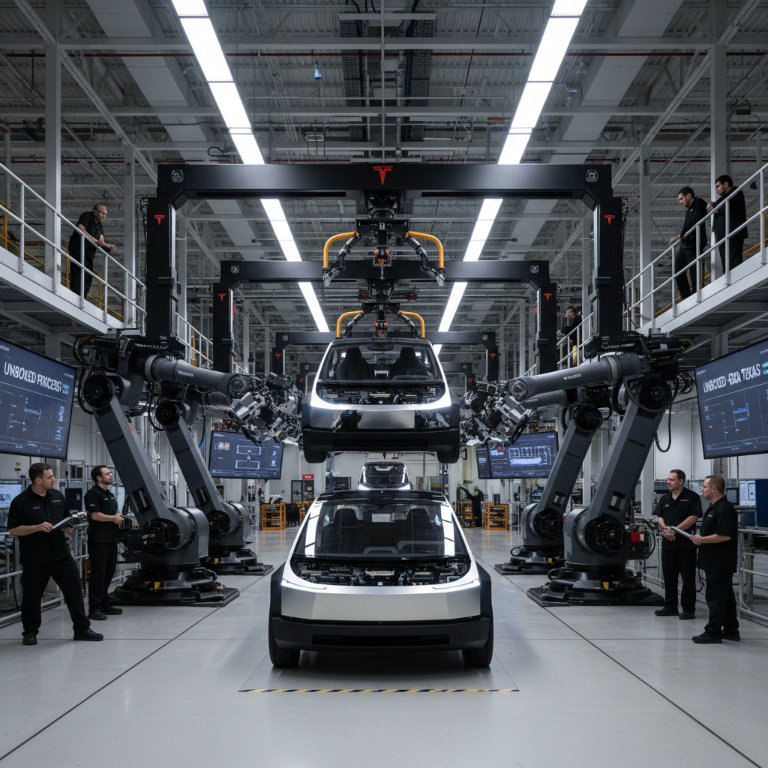
Tesla, the undisputed pace-setter in electric vehicle innovation, has quietly launched its most significant manufacturing paradigm shift since its inception. Gigafactory Texas is now the proving ground for the 'Unboxed Process,' a radical parallel-assembly method poised to fundamentally reshape automotive production and the broader EV landscape.
This isn't merely an iterative improvement; it's a complete reimagining of the assembly line. While other manufacturers grapple with the complexities of traditional sequential production, Tesla is moving beyond it, promising unprecedented efficiencies that will resonate across the industry.
The Unboxed Process: Disrupting the Assembly Line
At its core, the 'Unboxed Process' inverts the traditional automotive assembly method. Instead of building a vehicle sequentially on a moving line, Tesla is assembling large sub-sections of the car – like the front underbody, rear underbody, battery pack, and body side panels – in parallel. Only at the final stages do these major modules converge, allowing for simultaneous work on different components. This drastically reduces the physical footprint required and the complexity of moving an increasingly complete vehicle down a single line.
Unprecedented Cost Savings and Efficiency Gains
The immediate implications of this shift are staggering. Tesla anticipates the 'Unboxed Process' will deliver:
- 50% reduction in production costs: This cost efficiency is monumental, directly impacting profitability and enabling more aggressive pricing strategies.
- 40% reduction in factory footprint: By optimizing space and eliminating redundant movements, Gigafactory Texas can produce more vehicles in a smaller area, improving capital efficiency for future expansions.
Cybercab and the Affordable EV Era Lead the Charge
The fruits of this innovative manufacturing strategy will first materialize in Tesla's highly anticipated Cybercab, designed for the company's autonomous ride-hailing network. This futuristic vehicle is confirmed to be the first to fully utilize the complete 'Unboxed Process.'
Looking ahead, the 'Unboxed Process' is critical to Tesla's vision of widespread EV adoption. The company plans to apply this method to the mass production of its upcoming affordable model, projected to retail for approximately $25,000, with mass production slated for mid-2026. This move signals a direct assault on the mass market, where price remains a significant barrier for many prospective EV buyers.
Why This Matters:
This is not just a technological curiosity; it's a pivotal moment for Tesla and the entire automotive industry. For Tesla, the 'Unboxed Process' is a strategic masterstroke that underpins its long-term profitability goals and its ambition to scale to millions of vehicles annually. Halving production costs provides an immense competitive advantage, allowing Tesla to either increase profit margins significantly or pass savings to consumers, accelerating EV adoption.
Who Wins? Tesla unequivocally wins, solidifying its manufacturing leadership and potentially opening up new market segments. Consumers also stand to gain immensely from more affordable electric vehicles, making EV ownership accessible to a broader demographic. This could finally be the catalyst for the mainstream adoption of electric cars. Suppliers who can adapt to a modular, parallel assembly paradigm will also find new opportunities.
Who Loses? Traditional automakers and many EV startups, still largely reliant on conventional assembly methods, face an existential threat. This process widens the cost gap, making it harder for competitors to match Tesla's pricing and scale. Companies that cannot rapidly innovate their manufacturing processes risk being left behind in a fiercely competitive market, similar to how traditional carmakers struggled to adapt to electric powertrain development a decade ago. It also signals that the race for EV dominance will increasingly be won on the factory floor, not just in design studios.
This signals that the industry is entering a new phase where manufacturing efficiency and cost control become paramount, possibly overshadowing mere technological specs in the battle for market share.
Tesla's 'Unboxed Process' at Gigafactory Texas represents a bold leap forward, promising to redefine how vehicles are built and priced. As the Cybercab and the $25,000 model roll off these advanced lines, the industry will undoubtedly be watching closely, as Tesla yet again attempts to set the standard for the future of automotive manufacturing. This isn't merely about building cars differently; it's about making them more affordably and efficiently than ever before, paving the way for a truly electric future.