Tesla's Terafab: The Gigafactory of Chips Signals a New Era of EV Manufacturing
Tesla, the undisputed titan of electric vehicles, is embarking on its most ambitious vertical integration play yet: the 'Terafab' project. This monume...
Editorial Team
World Of EV
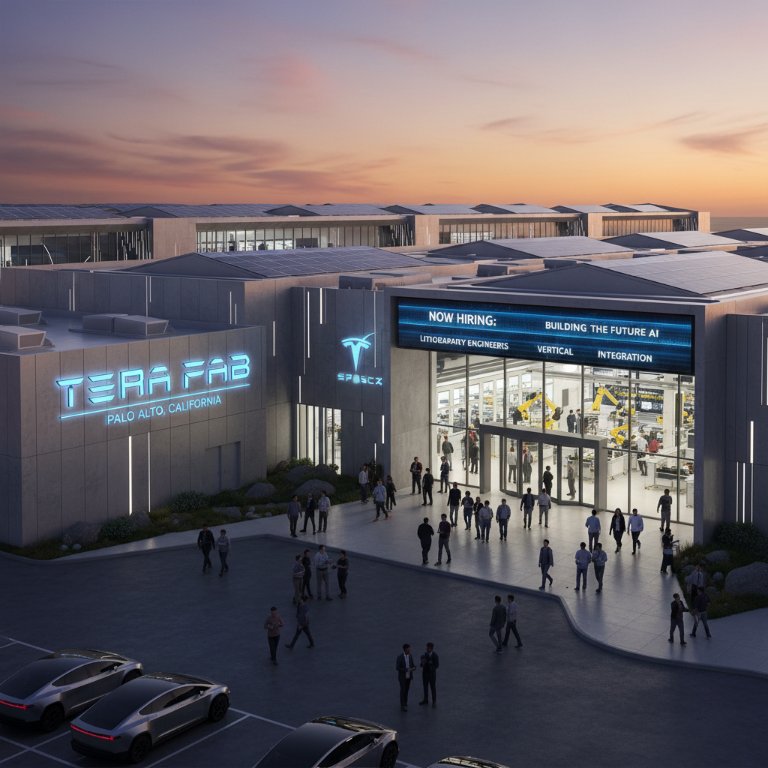
Tesla, the undisputed titan of electric vehicles, is embarking on its most ambitious vertical integration play yet: the 'Terafab' project. This monumental initiative aims to establish the largest semiconductor manufacturing plant in history, marking a decisive pivot for the company as it seeks unparalleled control over its critical technology stack. The move comes as a direct response to the crippling chip shortages that plagued the global automotive industry from 2020-2022, exposing severe vulnerabilities in supply chains and stifling production for countless manufacturers, including Tesla itself. With the Terafab, Elon Musk's enterprise isn't just building cars; it's forging the very silicon that powers them.
Unveiling the Terafab: Tesla's Semiconductor Powerhouse
The audacious Terafab project, a joint effort between Tesla, SpaceX, and xAI, is already ramping up its talent acquisition, with a planned cost up to $25 billion. The company is aggressively recruiting highly specialized Terafab engineers in key innovation hubs like Palo Alto and Austin. The focus? Expertise in advanced lithography—the intricate process of etching circuits onto silicon wafers—to build advanced logic chips and produce lithography masks in-house. This initiative signals a significant move towards vertical integration in chip production for Tesla, aiming to consolidate every stage of semiconductor device production under one roof. Elon Musk has stated that the facility would create lithography masks in-house, a capability he believes doesn't exist anywhere else in the world, allowing for rapid iteration and improvement of chip designs.
Why This Matters:
This isn't merely an expansion; it’s a seismic shift that could redefine the automotive and technology landscapes. For Tesla, the implications are profound:
Unrivaled Control and Optimization: Owning chip production grants Tesla unprecedented control over its silicon architecture. This means designing and manufacturing chips custom-tailored for its Full Self-Driving (FSD) capabilities, AI inferencing, and vehicle control systems. This could unlock performance and efficiency levels unattainable with off-the-shelf solutions, leading to superior functionality and a distinct competitive advantage in future Tesla vehicles, including the Cybercab robotaxi and Optimus humanoid robot lines.
Supply Chain Resilience: The Terafab project is a direct antidote to future supply chain disruptions. By bringing chip production in-house, Tesla dramatically reduces its reliance on external suppliers, securing a vital component of its production pipeline and ensuring it can scale manufacturing without being beholden to geopolitical tensions or industry-wide shortages. Musk explicitly stated, "We either build the Terafab or we don't have the chips, and we need the chips, so we build the Terafab."
Cost Efficiency and Innovation Acceleration: Eliminating third-party markups and streamlining the design-to-production cycle could lead to significant cost reductions in the long run. More importantly, this integration will accelerate innovation, allowing Tesla to rapidly iterate on chip designs, integrating new features and improvements into its vehicles faster than competitors. The facility is targeting 2-nanometer process technology, among the most advanced nodes, and aims for an initial output of 100,000 wafer starts per month, scaling to 1 million wafer starts per month at full capacity, which would represent roughly 70% of TSMC's entire current global output.
For the broader EV industry, Tesla's Terafab project serves as a potent wake-up call. This move sets a new benchmark for vertical integration, raising the stakes for every other automaker. Competitors who continue to rely solely on external chip manufacturers may find themselves at a growing disadvantage, struggling to match Tesla’s pace of innovation and supply chain security. This could ignite an 'arms race' in silicon development, forcing other major players to either deepen their partnerships with existing chipmakers or explore similar in-house production strategies. Traditional automotive chip suppliers, while still critical for many, will undoubtedly face increased competitive pressure and a need to demonstrate unparalleled value to retain clients against Tesla's self-sufficiency drive.
Tesla's Terafab isn't just about building chips; it's about building an unassailable technological fortress. This audacious undertaking signals a future where the company not only designs its vehicles but also meticulously crafts the very digital brains that empower them. As Tesla pushes the boundaries of manufacturing, the automotive world watches, poised for the profound disruptions this new era of integrated production promises.