Tesla's Supervised FSD on Europe's Horizon: RDW Decision Looms, Setting Stage for Autonomous Shift
The European automotive landscape stands on the cusp of a significant transformation as February 2026 reports reiterate Elon Musk's expectation for im...
Editorial Team
World Of EV
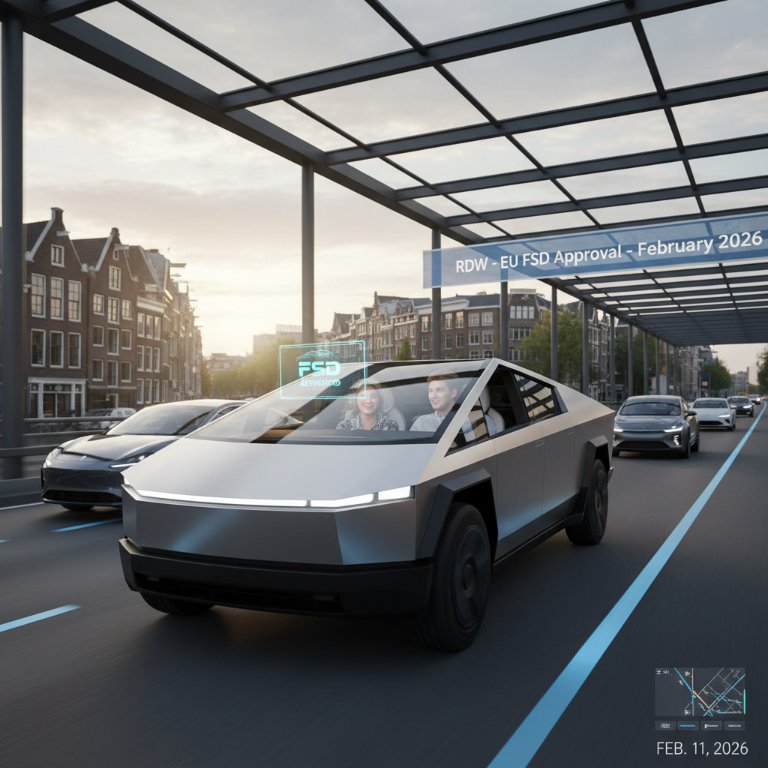
The European automotive landscape stands on the cusp of a significant transformation as February 2026 reports reiterate Elon Musk's expectation for imminent regulatory approval of Tesla's driver-supervised Full Self-Driving (FSD) system. The Netherlands Vehicle Authority (RDW) is widely anticipated to deliver a verdict this month, a decision that could unlock FSD's broader rollout across the continent, fundamentally reshaping the trajectory of advanced driver-assistance systems in a historically cautious market.
Europe's Regulatory Gauntlet: A History of Hurdles
For years, bringing Tesla's FSD to Europe has been a formidable challenge, often described by Musk himself as navigating a "layer cake of regulations of bureaucracy." Unlike the more fragmented, state-by-state approach in the United States, Europe operates under a complex framework of national and EU-wide regulations, necessitating rigorous compliance and a slower pace for novel technologies. This regulatory environment has long kept European Tesla owners on a more limited version of Autopilot, generating considerable frustration among the enthusiastic fanbase. Tesla's strategy has therefore centered on securing national type-approval through a recognized European authority, with the Dutch RDW serving as the pivotal gateway. The RDW, as the Netherlands' vehicle authority, holds the distinction of being designated for conducting motor vehicle type approvals for the entire European Union, making its decision a crucial precedent for other member states.
The RDW's Crucial Role and Tesla's Strategic Pathway
Tesla's current approach bypasses continent-wide legislative processes by pursuing a "national exemption" via the RDW. While Musk has expressed confidence, reports indicate the RDW has clarified that February 2026 marks a target window for Tesla to demonstrate FSD (Supervised) compliance with safety and regulatory standards, not a guaranteed approval. The RDW has underscored that its decision will be based solely on safety, not public pressure, even requesting the public to cease contacting them after a previous call to action from Tesla prompted an influx of messages. This "driver-supervised" distinction is paramount: FSD in Europe will require an attentive human driver ready to intervene, maintaining the driver's ultimate responsibility. Tesla has invested significant resources, claiming over 1 million kilometers of internal testing across 17 European countries, to prove the system's safety to regulators.
Why This Matters:
Validation of Advanced ADAS in Europe: An RDW approval, even if initially a national exemption, would provide a powerful validation for advanced Level 2 driver-assistance systems in Europe. It signals a breakthrough in overcoming the continent's stringent regulatory hurdles and could accelerate the acceptance and development of similar technologies from other manufacturers. This isn't just a win for Tesla; it's a critical step for the broader autonomous driving industry in Europe.
Tesla's Revenue Diversification: With intensifying competition and fluctuating EV sales, FSD represents a crucial, high-margin software revenue stream for Tesla. Unlocking the European market for FSD subscriptions or outright purchases would significantly boost the company's financial outlook and global average revenue per user, reinforcing its software-centric business model.
Competitive Catalyst: A successful FSD rollout in Europe will inevitably put pressure on legacy automakers and other EV players. Companies like Mercedes-Benz, with its Drive Pilot Level 3 system already approved in some regions, and others developing their own advanced ADAS, will face renewed impetus to accelerate their offerings and navigate the complex regulatory landscape, potentially leading to a more competitive and innovative European market.
Precedent for Future Autonomy: The RDW's specific process for evaluating and potentially approving FSD (Supervised) could set a critical precedent for how Europe approaches regulating higher levels of autonomous driving. The details of any exemptions granted, and the subsequent recognition by other EU states, will offer invaluable insights for the entire industry's pursuit of fully autonomous vehicles.
Public Trust and Education: A carefully managed rollout, emphasizing the supervised nature of FSD, is vital for building public trust. Europe has historically shown greater skepticism toward autonomous technologies than some other markets. Clear communication and demonstrable safety will be paramount to avoid setbacks and ensure long-term adoption.
This month's anticipated decision from the RDW represents a pivotal moment, not just for Tesla but for the evolution of autonomous driving technology across Europe. While the path to widespread, fully autonomous vehicles remains long, the imminent arrival of supervised FSD marks a profound leap forward, signaling a new era for how Europeans interact with their cars and the roads they drive on.