Tesla's Robotaxi Reality Check: Austin Rollout Stumbles, Safety Concerns Undermine Ambitious Promises
Eight months after its highly anticipated launch in Austin, Texas, Tesla's 'Robotaxi' service, a cornerstone of Elon Musk's long-term vision for the c...
Editorial Team
World Of EV
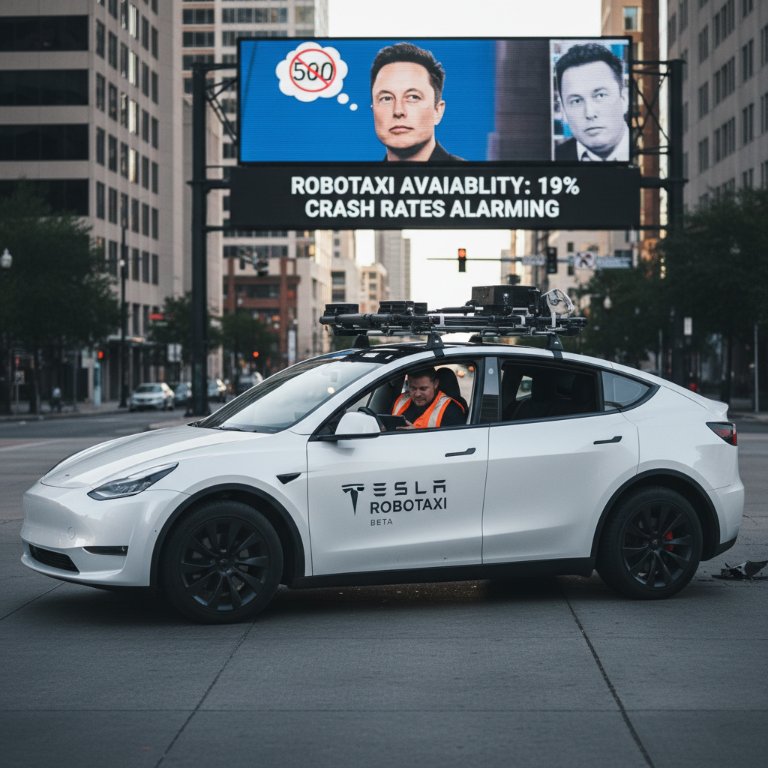
Eight months after its highly anticipated launch in Austin, Texas, Tesla's 'Robotaxi' service, a cornerstone of Elon Musk's long-term vision for the company, appears to be grappling with significant challenges. What was once heralded as a paradigm shift in urban mobility is currently revealing a stark contrast between ambitious promises and a nascent, troubled reality on public roads.
The Austin Experiment: Limited Deployment, Lagging Availability
The service, a key indicator of Tesla's progress towards fully autonomous ride-hailing, demonstrates limited real-world deployment. Data reveals that the Robotaxi service in Austin was available just 19% of operating hours over a recent 48-hour period, falling significantly short of the ubiquitous presence one would expect from a service eight months post-launch. This restricted access paints a picture of a project still very much in its infancy, rather than a rapidly expanding network.
Alarming Safety Metrics: A Ninefold Increase in Crash Rates
Perhaps even more concerning than the limited availability are the reported safety statistics. The Tesla Robotaxi service in Austin has reportedly exhibited a crash rate nine times worse than that of human drivers. This alarming figure is particularly striking given that a human safety monitor is still present during these operations, suggesting fundamental issues within the autonomous driving system that even human oversight struggles to mitigate effectively. Tesla's robotaxis logged approximately 500,000 cumulative miles by November 2025, with one crash reported every 55,000 miles, compared to human drivers averaging one police-reported crash every 500,000 miles.
Musk's Unfulfilled Prophecies: A Pattern of Overpromise?
This current state of affairs in Austin starkly contrasts with a series of bold predictions from CEO Elon Musk over the years. Readers will recall Musk's previous assurances of having 500 Robotaxis in Austin, providing coverage for half the U.S. population, and achieving fully unsupervised rides by the end of 2025. Not only have these targets remained unmet – with the Austin fleet reportedly around 42 cars and operations confined mostly to Austin and San Francisco – but the very notion of 'unsupervised' rides has largely vanished from official trackers. This signals a significant recalibration of expectations, if not an outright retreat from earlier timelines. This pattern of missed deadlines and overblown projections is not new for Tesla's Full Self-Driving (FSD) endeavors, reminding industry observers of past optimistic forecasts that often precede protracted development cycles.
Why This Matters:
For discerning EV enthusiasts, prospective buyers, and industry professionals, these developments in Austin are more than just teething problems; they represent a critical reality check for Tesla's autonomous ambitions.
Reputational Damage: The high crash rate, even with a safety driver, chips away at public trust in Tesla's FSD technology, a crucial factor for widespread adoption. This could have lasting implications for perception, not just for Tesla but for the entire autonomous vehicle industry.
Financial Implications: Robotaxi was often cited as a future revenue stream that would transform Tesla's valuation. Continued delays and safety issues undermine this narrative, potentially impacting investor confidence and putting pressure on the company's long-term growth projections.
The AI Race: While Tesla has positioned itself as a leader in AI and autonomous driving, these struggles suggest the complexity of achieving true L4/L5 autonomy in dynamic urban environments remains an immense challenge. This could embolden competitors, or at least temper the hype around any single company's 'imminent' breakthrough.
Regulatory Scrutiny: Persistent safety concerns are likely to attract heightened scrutiny from regulators, potentially leading to more restrictive operating conditions or even delays in wider deployment, further hindering progress.
A Broader Industry Bellwether: Tesla's challenges serve as a stark reminder that even with significant resources and a visionary leader, the path to widespread, safe, and profitable autonomous ride-hailing is fraught with technical, ethical, and regulatory hurdles. This isn't just a 'Tesla problem'; it's an industry-wide challenge being played out under a powerful microscope.
The Austin Robotaxi saga underscores a persistent disconnect between Tesla's ambitious autonomous driving rhetoric and its operational reality. While the promise of a fully autonomous future remains compelling, the current challenges in deployment, availability, and crucially, safety, indicate that the road to widespread Robotaxi services is far longer and more arduous than previously anticipated. The industry, and particularly Tesla, must now demonstrate tangible, consistent progress in safety and reliability to regain momentum and validate the immense investments made in this transformative technology.