Tesla's Robotaxi Offensive Gains Ground While Union Opposition Stalls SF Charging Hub
Tesla, the vanguard of the electric vehicle revolution, is accelerating its ambitious robotaxi service expansion, signaling a pivotal moment in its lo...
Editorial Team
World Of EV
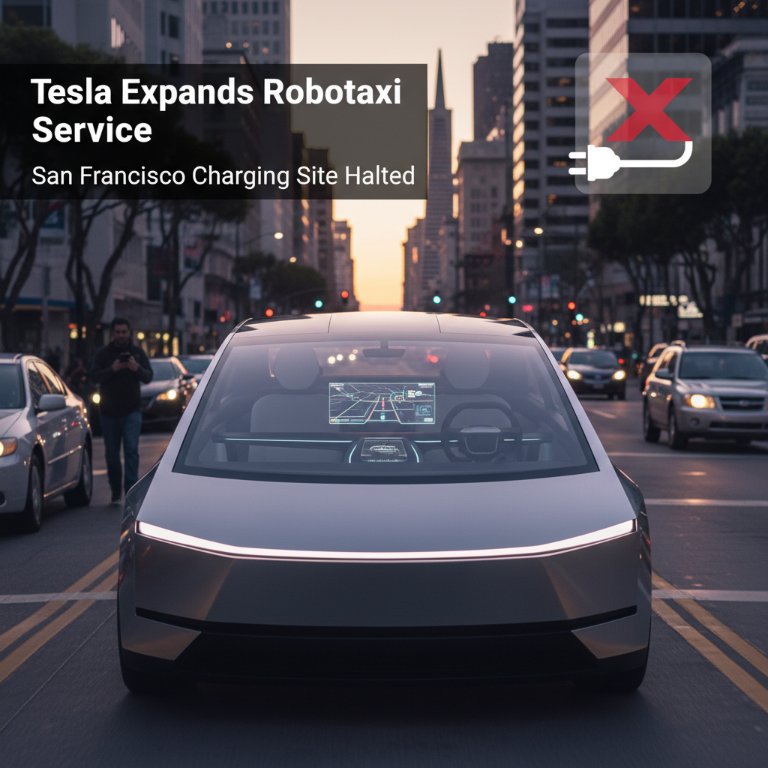
Tesla, the vanguard of the electric vehicle revolution, is accelerating its ambitious robotaxi service expansion, signaling a pivotal moment in its long-pursued autonomous driving vision. However, this forward momentum is juxtaposed against a notable setback on its charging infrastructure front, as labor disputes halt a key project in San Francisco.
Robotaxi Rollout Intensifies Across the U.S.
After years of development and incremental advancements in its Full Self-Driving (FSD) software, Tesla is poised to significantly scale its autonomous ride-hailing service. The company plans to launch its robotaxi operations in seven additional U.S. cities during the first half of 2026. This aggressive rollout underscores Tesla's commitment to monetizing its extensive investment in AI and autonomous technology, a vision frequently articulated by CEO Elon Musk.
Crucially, Tesla has begun removing safety employees from its robotaxis operating in Austin, Texas. This move is a critical indicator of increasing confidence in the maturity and reliability of its autonomous driving software. The presence of safety drivers has long been a regulatory and operational necessity, but their removal signifies a tangible step towards true driverless operations, an elusive benchmark in the autonomous vehicle industry. For consumers in these expanding markets, this means the potential for a new era of on-demand, self-driving transportation, reshaping urban mobility and potentially offering a compelling alternative to traditional ride-sharing services.
San Francisco Charging Hub Scrapped Amidst Labor Clash
Conversely, Tesla has hit a roadblock in its infrastructure expansion, canceling plans for a mixed-use autonomous charging station at 825 Sansome Street in San Francisco. This decision follows strenuous opposition from the powerful Teamsters union, which appealed the project and demanded unionized staffing for the site.
This specific incident highlights a growing tension between Tesla's direct-to-consumer and non-unionized operational model and the established labor forces seeking to assert their influence in the rapidly expanding EV ecosystem. The San Francisco site was envisioned as more than just a charging hub; it likely represented a blueprint for future integrated facilities that could serve both individual EV owners and potentially, Tesla's burgeoning robotaxi fleet. The cancellation reflects the increasing complexities of real-world deployment, where technological ambition must contend with local regulations and organized labor's demands.
Why This Matters:
This dual narrative offers profound insights into Tesla's current strategic landscape and the broader EV industry. The accelerated robotaxi expansion is a do-or-die moment for Tesla's FSD ambitions. Success in these new cities would not only validate years of unparalleled investment in AI and data collection but also unlock a potentially massive new revenue stream, solidifying Tesla's position as a technology company as much as an automotive manufacturer. It signals Tesla's readiness to move beyond beta testing in controlled environments and genuinely challenge established ride-hailing giants, with the promise of lower operational costs due to the absence of human drivers. If successful, it could fundamentally reshape urban transportation and drive a new wave of demand for Tesla vehicles, both for individual ownership and as part of the robotaxi fleet.
However, the San Francisco setback serves as a stark reminder that even a tech titan like Tesla is not immune to ground-level operational challenges. The Teamsters' successful intervention signals a growing assertiveness of organized labor in the clean energy transition. This isn't merely about a single charging station; it sets a precedent and signals to the entire EV industry that future infrastructure development will likely face increased scrutiny and demands for unionized labor. For Tesla, accustomed to dictating its terms, this forces a reconsideration of its labor strategy and could lead to increased costs and slower deployment for future critical infrastructure projects. Who wins? In the short term, organized labor has demonstrated its clout, while Tesla faces delays and potentially higher operational expenses for future builds. For the market, it signals a more complex and potentially more expensive path for infrastructure build-out across the EV sector.
Tesla's journey toward full autonomy and ubiquitous charging infrastructure is a complex tapestry woven with technological brilliance and significant real-world friction. The coming months will be crucial in determining whether its aggressive robotaxi push can overcome regulatory hurdles and public perception, while also navigating the increasingly vocal demands of labor. The path forward for Tesla, and indeed for the entire autonomous and EV industry, remains a captivating study in innovation meeting reality.