Tesla's Robotaxi Gamble: Musk Promises 70% US Coverage in Two Weeks Amidst Lingering Doubts
Elon Musk has once again set an audacious target, declaring that Tesla’s Robotaxi service will encompass 70% of the US population within the next two ...
Editorial Team
World Of EV
The Unprecedented Rollout: Model 3 and Y Lead the Charge
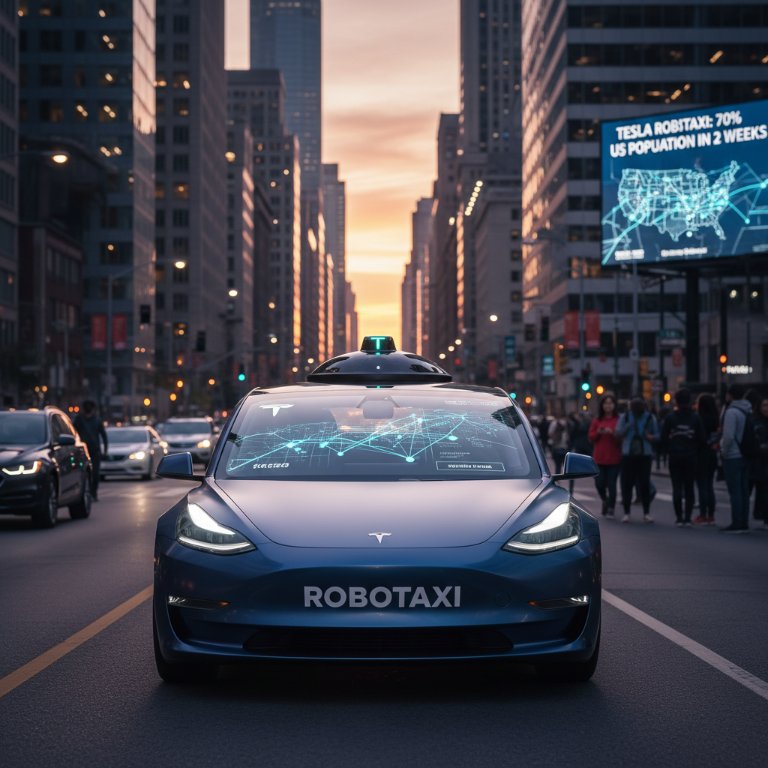
Elon Musk has once again set an audacious target, declaring that Tesla’s Robotaxi service will encompass 70% of the US population within the next two weeks. This aggressive rollout, initially leveraging existing Model 3 and Model Y vehicles before the eventual integration of dedicated Cybercabs and Cybervans, marks a critical acceleration in Tesla's long-promised autonomous future. The announcement, however, arrives with a familiar undercurrent of skepticism, especially considering the company's prior miss on a 50% US population coverage target by the close of 2025.
This new projection catapults Tesla into an unprecedented deployment phase, aiming for widespread availability across the United States. The strategy to utilize its vast existing fleet of Model 3 and Model Y vehicles for the initial expansion is pragmatic, offering a rapid path to market penetration. The subsequent introduction of purpose-built Cybercabs and Cybervans, as their production ramps up, signals Tesla's long-term vision for a dedicated, optimized Robotaxi fleet. However, the sheer scale of moving from current limited deployments to 70% population coverage in such a short timeframe raises significant questions about the operational readiness and underlying technological maturity.
The Human Element: A Safety Net or a Crutch?
Adding a layer of complexity to the 'fully autonomous' narrative is Tesla's disclosure regarding human operator intervention. The company has revealed that in situations where the autonomous system encounters limitations, human operators can remotely control robotaxis at speeds up to 10 mph. This capability, while presented as a safety net, simultaneously highlights the ongoing challenges in achieving Level 5 autonomy and could be viewed by some as a tacit admission of the system's current limitations. For a service touted as revolutionary, the reliance on human oversight, even at low speeds, underscores the formidable chasm between advanced driver-assistance systems and truly unsupervised self-driving.
Regulatory Hurdles and European Ambitions
Beyond the ambitious US expansion, Tesla faces substantial regulatory hurdles in other key markets. Notably, Full Self-Driving (FSD) regulatory approval in Europe remains pending. The continent's more stringent regulatory environment and diverse urban landscapes present a unique set of challenges that could significantly impact Tesla's global Robotaxi aspirations. The stark contrast between the rapid US deployment and the stalled European progress indicates the varying degrees of regulatory acceptance and the complex technical adaptations required for diverse operational design domains.
Why This Matters:
This latest announcement from Elon Musk is a high-stakes moment for Tesla and the broader autonomous driving industry. If successful, Tesla stands to gain an unprecedented first-mover advantage, potentially unlocking a colossal new revenue stream and profoundly altering urban mobility. Early adopters in the expanded coverage areas stand to benefit from novel transportation options, and Tesla's valuation could surge on the back of this new service offering. This is a do-or-die play for Tesla's FSD monetization strategy, a core component of its long-term financial projections and investor confidence.
Conversely, the risks are substantial. Another missed target, particularly one so boldly declared, could severely damage Tesla's credibility and erode consumer trust in its autonomous capabilities. Competitors, while perhaps behind in deployment scale, will be closely watching for any signs of struggle, ready to capitalize on potential missteps. The human operator disclosure, while pragmatic for safety, could be perceived as a fundamental limitation, potentially hindering widespread regulatory and public acceptance of true driverless technology. The question of scalability – how to manage thousands, then millions, of these interventions safely and efficiently – remains a significant, unanswered challenge. This move signals Tesla’s unwavering commitment to FSD, but also its willingness to push boundaries, for better or worse, in a nascent and highly scrutinized industry.
Tesla's aggressive Robotaxi expansion plan represents a pivotal moment, not just for the company, but for the entire concept of autonomous mobility. The next two weeks will be crucial in determining whether this ambitious vision is a genuine leap forward or another step in a prolonged, complex journey toward fully autonomous services, with the world watching closely for tangible results.