Tesla's Robotaxi Ambitions Eclipsing EV Sales: Autonomy Valued at Double Core Business
A groundbreaking analysis from Bank of America analyst Alexander Perry reveals a monumental shift in Tesla's perceived value, with its burgeoning auto...
Editorial Team
World Of EV
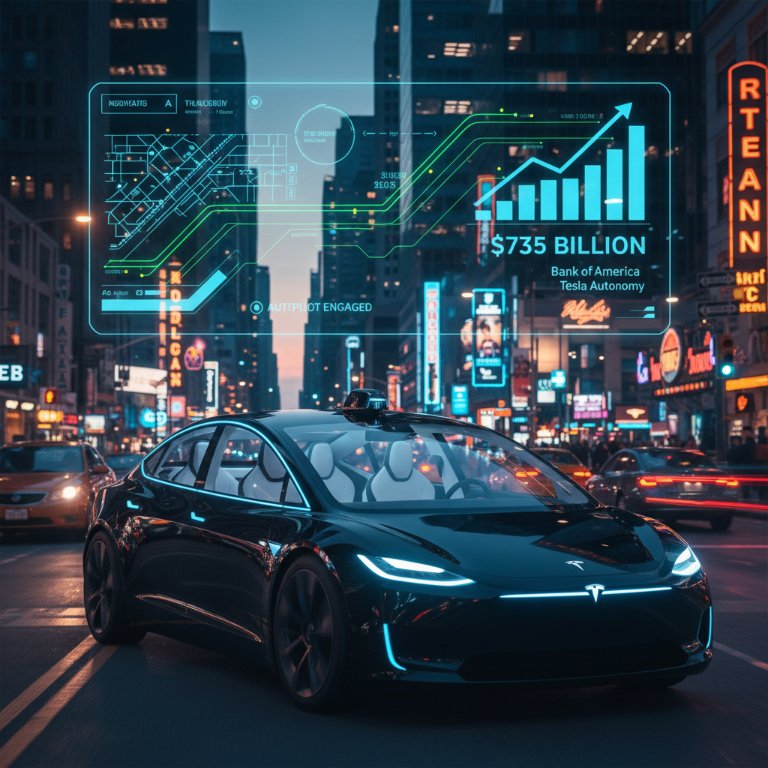
A groundbreaking analysis from Bank of America analyst Alexander Perry reveals a monumental shift in Tesla's perceived value, with its burgeoning autonomous-vehicle and robotaxi divisions now commanding a valuation of up to $735 billion. This staggering figure more than doubles the $345 billion assigned to Tesla's foundational electric vehicle business, signaling a clear strategic pivot by CEO Elon Musk towards a future dominated by self-driving technology and mobility services.
This re-evaluation underscores the market's growing confidence in Tesla's long-term vision, moving beyond merely selling EVs to establishing a dominant presence in the autonomous ride-hailing sector. It also reflects Musk's persistent belief that the true value of Tesla lies in its ability to deploy a vast network of robotaxis, generating significant recurring revenue.
The Strategic Pivot to Autonomy
Perry's valuation places the robotaxi division at an equity value of $422 billion, with the Full Self-Driving (FSD) software contributing another $313 billion to the overall autonomous-vehicle valuation. This allocation highlights how critically the financial markets are beginning to weigh Tesla's software and service potential over its hardware manufacturing prowess. For years, Tesla has been a leader in EV sales, but the company has consistently emphasized its identity as an AI and robotics company. This latest analysis by Bank of America validates that ambitious claim, effectively recasting Tesla's core business in the eyes of a major financial institution.
The Camera-Only Advantage
A key factor underpinning this optimistic valuation is Tesla's distinctive approach to autonomous driving technology. Unlike many rivals who employ a complex array of sensors including LiDAR and radar, Tesla champions a camera-only 'Vision' tech stack. Perry notes that this vision-based solution is inherently cheaper and less power-intensive to implement, offering a significant cost advantage over multi-sensor systems. This strategic choice, while technically challenging, allows for a more scalable and potentially more profitable deployment of robotaxi services, as Tesla can leverage its existing fleet for data collection and software improvement.
Rapid Robotaxi Expansion on the Horizon
Tesla's commitment to accelerating its robotaxi ambitions is further evidenced by its aggressive expansion plans for 2026. The company intends to significantly broaden its ride-hailing service, adding at least seven new cities in the first half of the year. Cities slated for this expansion include Dallas, Houston, Phoenix, Miami, Orlando, Tampa, and Las Vegas. This follows initial operations in Austin, Texas, and the San Francisco Bay Area, with Austin already seeing unsupervised rides in some vehicles. This rapid rollout signals a pivotal year for Tesla's mobility services, bringing its long-promised autonomous future closer to reality for a wider customer base.
Why This Matters:
This valuation shift from Bank of America isn't just a financial footnote; it's a seismic tremor within the automotive and tech industries. For savvy EV enthusiasts and prospective buyers, it signifies a future where your Tesla isn't just a personal vehicle but a potential income-generating asset, contributing to a vast, automated transport network. The transition positions Tesla as far more than an automaker; it's an AI and mobility services platform on the cusp of a potentially massive revenue stream.
- Who Wins? Tesla, undoubtedly, stands to gain immensely if these robotaxi deployments prove successful and scalable, potentially cementing its position as a dominant force in future urban mobility. Consumers in expanded cities stand to gain from new, potentially more affordable, and convenient ride-hailing options. The camera-only approach, if validated at scale, will be a huge win for Tesla's engineering philosophy, proving that massive amounts of real-world data and advanced AI can outperform more hardware-intensive solutions.
- Who Loses? Traditional ride-hailing companies like Uber and Lyft face an existential threat if Tesla's robotaxi network achieves broad, cost-effective deployment. Other autonomous vehicle developers reliant on expensive LiDAR systems may find their technological advantage eroded by Tesla's lean, vision-only approach, potentially impacting their market viability and investor confidence.
- What This Signals: This analysis is a clear market signal that software, AI, and recurring service revenue are increasingly valuable components of the automotive future. It indicates that the industry is rapidly moving towards 'Auto 2.0,' where mobility as a service, rather than just vehicle ownership, drives innovation and valuation. For Tesla, this is a 'do-or-die' moment. The market has placed an enormous bet on its autonomous capabilities, and the success or failure of the 2026 robotaxi expansion will be critical in determining whether Tesla can truly transition from an automotive disruptor to a mobility titan.
The audacious valuation of Tesla's autonomous and robotaxi businesses fundamentally reshapes the narrative around the company. With aggressive expansion plans for 2026 and a cost-effective, camera-only tech stack, Tesla is not just building cars; it's laying the groundwork for a transformative shift in how we experience transportation. The coming year will be crucial in demonstrating the full potential of this robotaxi revolution, solidifying Tesla's place not just in the garage, but at the forefront of the global mobility landscape.