Tesla's Robotaxi Ambitions Confront Regulatory Reality: NHTSA's 2,500-Unit Cap Looms Large for Cybercab
Tesla, a company synonymous with pushing technological boundaries, is actively expanding its intellectual property portfolio for its autonomous vehicl...
Editorial Team
World Of EV
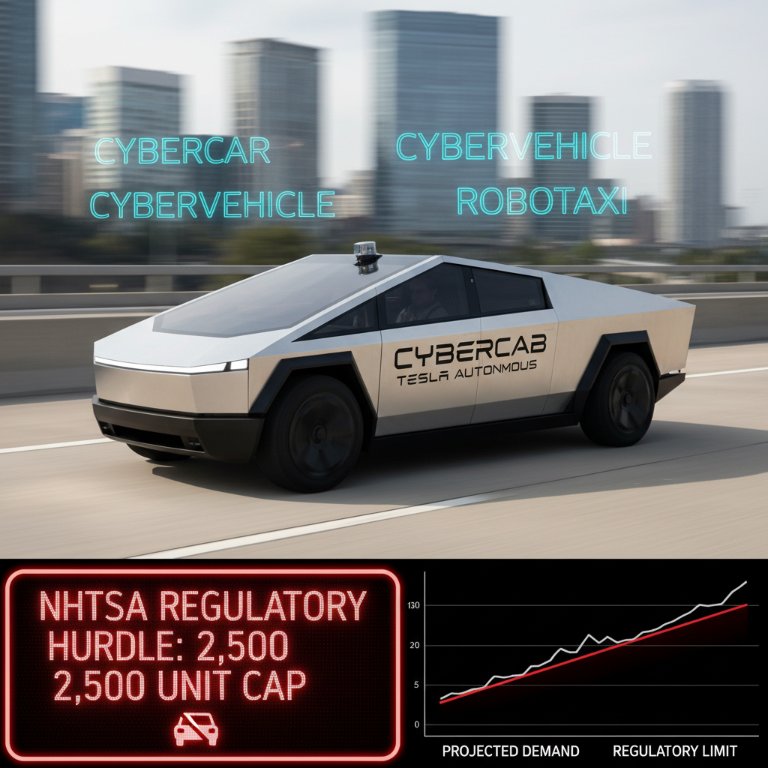
Tesla, a company synonymous with pushing technological boundaries, is actively expanding its intellectual property portfolio for its autonomous vehicle future, including recent trademark filings for 'Cybercar,' 'Cybervehicle,' and the iconic 'Robotaxi.' These filings underscore the company's unwavering commitment to a fully autonomous ride-sharing service, epitomized by its upcoming Cybercab. However, the path to widespread deployment faces a significant regulatory hurdle from the U.S. National Highway Traffic Safety Administration (NHTSA).
Tesla's vision for the Cybercab is a vehicle designed from the ground up for autonomous operation, notably without a traditional steering wheel or pedals. This radical departure from conventional vehicle design, while central to the robotaxi concept, directly challenges existing safety standards. For years, the federal government has sought to streamline the exemption process for vehicles without human controls, aiming to accelerate the deployment of automated vehicles.
Expanding the Autonomous Horizon, One Trademark at a Time
Tesla's proactive move to secure additional trademarks such as 'Cybercar' and 'Cybervehicle' signals a broader strategic play beyond just the 'Cybercab' moniker. This expanded nomenclature could be a response to the complexities of trademarking, as the original 'Robotaxi' application was deemed 'too generic' and the 'Cybercab' trademark faced suspension due to a prior filing by a French beverage company. Furthermore, regulatory nuances in some U.S. states restrict the use of 'cab' or 'taxi' in vehicle names, necessitating these alternative registrations. This multi-faceted approach demonstrates Tesla's intent to establish a comprehensive brand identity for its future autonomous fleet, adapting to both intellectual property challenges and diverse state-level regulations.
The NHTSA's 2,500-Unit Standoff: A Critical Bottleneck
The real challenge for Tesla's Cybercab vision, particularly for a vehicle designed without a steering wheel, lies with the NHTSA's current regulations. While the NHTSA has indeed streamlined the exemption process, allowing automakers to deploy up to 2,500 robotaxis annually, this cap applies to vehicles that do not fully comply with Federal Motor Vehicle Safety Standards (FMVSS), specifically those lacking traditional driver controls like a steering wheel or pedals. This federal limit, while intended to facilitate innovation, presents a substantial bottleneck for any company aspiring to mass-produce and widely deploy a truly driverless vehicle like the Cybercab. Automakers must demonstrate that their non-compliant vehicles offer an equivalent level of safety and that the exemption serves the public interest. For Tesla, which envisions an exponential ramp-up of Cybercab production, this 2,500-unit annual sales ceiling is a significant impediment.
Why This Matters:
For Tesla's Production Timeline: This 2,500-unit annual cap is not merely a bureaucratic formality; it directly constrains Tesla's ability to scale Cybercab production rapidly. Elon Musk has consistently projected ambitious timelines for robotaxi deployment, with expectations of significant rollout in cities as early as 2025-2026. A limited production allowance forces Tesla to either significantly temper its initial deployment aspirations or potentially re-evaluate the Cybercab's design to include traditional controls, which would fundamentally compromise its 'driverless' ethos. This tension between a revolutionary design and existing regulatory frameworks could lead to further delays in achieving mass market penetration.
Industry Precedent and Regulatory Evolution: The NHTSA's stance sets a crucial precedent for the entire autonomous vehicle industry. While companies like Waymo and Cruise have made strides, the widespread deployment of Level 4 and Level 5 autonomous vehicles (those capable of operating without human intervention under specific or all conditions, respectively) hinges on clear, adaptable regulatory frameworks. The current 2,500-unit exemption highlights a gap: regulations designed for human-driven cars are ill-suited for vehicles with no human controls. This situation forces a critical dialogue between innovators and regulators, emphasizing the urgent need for new categories and safety standards tailored specifically for truly autonomous vehicles. The outcome of Tesla's Cybercab rollout will undoubtedly influence future regulatory decisions for all players in the autonomous space.
Consumer Impact and the Pace of Autonomous Adoption: For prospective EV buyers and enthusiasts keenly awaiting the autonomous revolution, this regulatory speed bump signals a more measured, perhaps slower, rollout than anticipated. While Tesla's robotaxi service is already seeing a 'low-key' launch in Austin, Texas, using modified existing vehicles, the purpose-built Cybercab without a steering wheel will face a much more gradual introduction. This could lead to an initial scarcity of Cybercabs and limited geographical availability, postponing the realization of a truly ubiquitous, human-driver-free ride-sharing experience.
Tesla's proactive trademark strategy signals its deep commitment to a fully autonomous future, with a clear intent to dominate the nascent robotaxi market. However, the existing 2,500-unit annual sales limit imposed by the NHTSA for vehicles without traditional controls represents a formidable challenge that could significantly dictate the pace and initial form factor of the Cybercab's rollout. The coming years will reveal whether regulators adapt to innovation or if Tesla is compelled to modify its groundbreaking vision to navigate the current legal landscape.