Tesla's Robotaxi Ambitions Confront Mounting Safety Concerns Amidst Rising Collision Count
Tesla's ambitious push into autonomous ride-hailing faces intensified scrutiny as new collision data emerges, revealing a total of 14 reported inciden...
Editorial Team
World Of EV
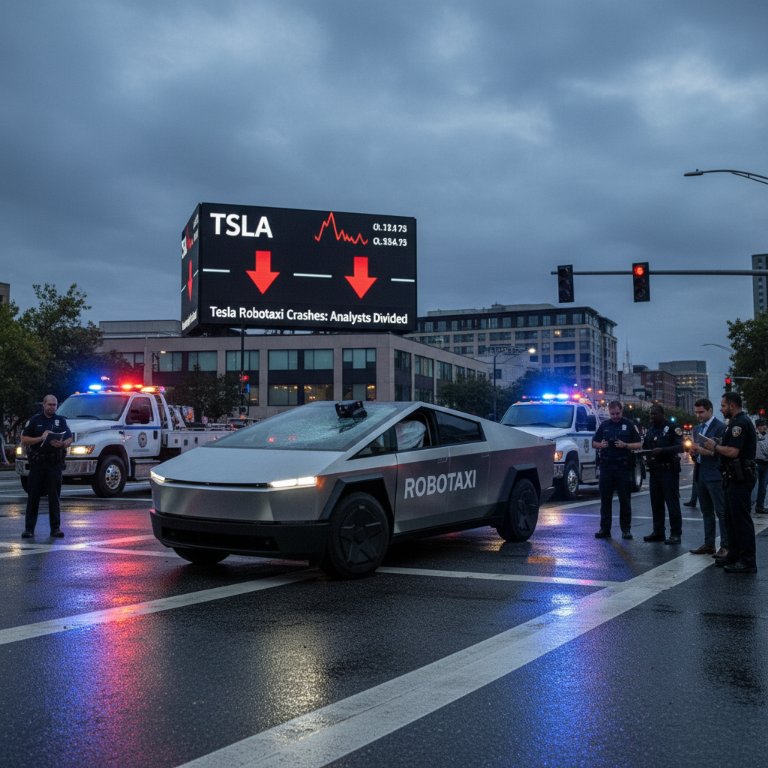
Tesla's ambitious push into autonomous ride-hailing faces intensified scrutiny as new collision data emerges, revealing a total of 14 reported incidents involving its 'Robotaxi' fleet since June 2025. The latest disclosures to the National Highway Traffic Safety Administration (NHTSA) detail five new collisions that occurred in December 2025 and January 2026, stirring mixed sentiment among industry analysts and casting a shadow over the company’s pivotal full self-driving (FSD) strategy. This escalating incident count underscores the profound safety and regulatory hurdles Tesla must overcome to scale its vision of a pervasive robotaxi network.
The Expanding Collision Record
The recently reported incidents push the total number of crashes involving Tesla's autonomous ride-hailing vehicles to 14 within an eight-month span. This concerning trend highlights ongoing challenges in a technology that Tesla CEO Elon Musk has consistently positioned as a cornerstone of the company’s future valuation. Unlike traditional driver-assist systems, a true robotaxi fleet demands near-perfect safety performance to gain public trust and regulatory approval for widespread, unsupervised operation. Each reported collision, irrespective of fault, chips away at this critical foundation.
Tesla's Autonomous Vision on the Line
For years, Tesla has championed its FSD technology as the pathway to a fully autonomous future, promising a revolutionary ride-hailing service that would generate substantial recurring revenue. This vision has been a key driver of investor confidence, differentiating Tesla from traditional automakers and even other EV manufacturers like BYD or Rivian. The company's unique approach, heavily reliant on a camera-only vision system and extensive real-world data collection from its customer vehicles, stands in contrast to competitors such as Waymo, which integrate lidar and radar more extensively. While Tesla's method offers potential scalability advantages, the increasing collision reports raise pointed questions about the robustness and readiness of its autonomous stack for true robotaxi deployment.
Why This Matters:
Investor Confidence Under Threat: A significant portion of Tesla's valuation is tied to the projected future revenue from its FSD and robotaxi services. Continued safety incidents directly undermine this 'autonomy premium,' potentially leading to downward pressure on TSLA stock. Analysts' mixed sentiment reflects this uncertainty, as the market grapples with the gap between Tesla's ambitious timelines and the operational realities.
Intensified Regulatory Scrutiny: The NHTSA's ongoing involvement and the accumulating collision data will inevitably lead to more rigorous oversight. Regulators prioritize public safety above all else, and a growing incident tally could trigger stricter operational restrictions, slower deployment approvals, or even necessitate costly system modifications. This is particularly salient given the industry-wide caution following previous autonomous vehicle incidents involving other players.
Erosion of Public Trust: Every reported collision, regardless of the underlying cause, contributes to public skepticism about autonomous vehicles. For a technology that requires widespread acceptance to thrive, a perceived lack of safety can be a fatal flaw. Tesla, as a high-profile leader in the EV space, bears a disproportionate responsibility in shaping public opinion, and these incidents could inadvertently hamper the broader adoption of AV technology.
Competitive Dynamics Shift: While other autonomous vehicle developers, like Waymo and Cruise, have also faced their own challenges, sustained issues for Tesla could provide a strategic opening. Regulators might view alternative approaches, particularly those with a longer history of slower, more cautious deployments and redundant sensor arrays, more favorably. This could reshape the competitive landscape in the nascent robotaxi market.
A 'Do-or-Die' Moment for Credibility: Tesla's ability to demonstrably improve the safety record of its robotaxi fleet is paramount. Failure to address these concerns definitively, transparently, and rapidly could not only delay its robotaxi ambitions indefinitely but also fundamentally damage the credibility of its entire FSD program. This is less about incremental software updates and more about proving a foundational level of safety that satisfies both regulators and the general public.
The future of Tesla's robotaxi dreams hinges precariously on its ability to demonstrate irrefutable safety and reliability. As the collision count climbs, the pressure intensifies on the EV giant to not only innovate but to execute with an uncompromising focus on public safety. The coming months will be crucial in determining whether Tesla can navigate these regulatory and trust hurdles to realize its autonomous future.