Tesla's Radical Bet: Flagship EVs Axed for an All-In AI, Robotics Future
Tesla, the company that once redefined the automotive landscape with its electric vehicles, has announced a seismic strategic pivot, signaling a profo...
Editorial Team
World Of EV
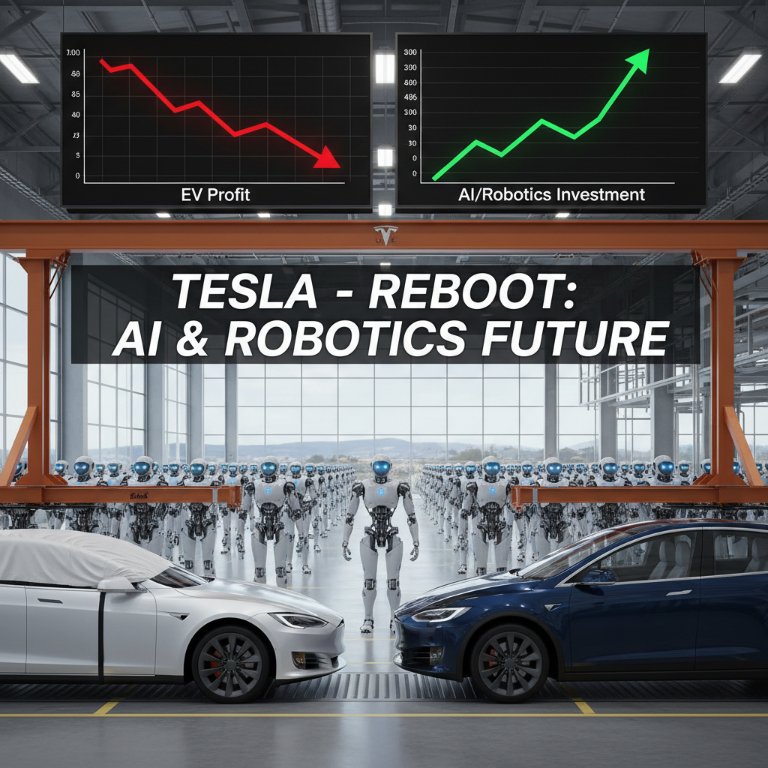
Tesla, the company that once redefined the automotive landscape with its electric vehicles, has announced a seismic strategic pivot, signaling a profound shift away from its EV manufacturing roots. The company reported a startling 46% year-over-year drop in profit and its first-ever annual decline in revenue, a stark indicator of the intensifying competition and maturing EV market. In response, Tesla is committing an unprecedented $20 billion in capital expenditures for 2026, not to new car models, but almost exclusively to artificial intelligence, robotaxis, and its Optimus humanoid robots.
This dramatic reorientation isn't merely a reallocation of resources; it marks the end of an era for two of Tesla’s most iconic vehicles. The company will cease production of its luxury Model S sedan and Model X SUV, models that were once synonymous with Tesla's early premium market dominance. The manufacturing facilities in California previously dedicated to these trailblazing EVs will now be repurposed to churn out Optimus humanoid robots, a clear declaration of Tesla’s intent to fundamentally redefine itself not as a carmaker, but as an AI and robotics powerhouse.
The Financial Imperative and Strategic Shift
Tesla's financial reports paint a challenging picture for its core automotive business. The nearly 50% profit dip and first revenue contraction highlight the increasing pressures from established automakers aggressively entering the EV space and burgeoning competition from Chinese giants like BYD. For years, Tesla enjoyed a relatively unchallenged run in the premium EV segment, but that landscape has irrevocably changed. This financial downturn appears to be the catalyst for a strategic gambit of immense proportions, demonstrating a willingness to abandon a weakening revenue stream in pursuit of potentially exponential, albeit unproven, future markets.
- Significant Capital Reallocation: A staggering $20 billion is earmarked for 2026 capital expenditures.
- New Core Focus: Investments overwhelmingly target AI, robotaxis, and Optimus humanoid robots.
- End of an Era: Production of the Model S and Model X, Tesla’s long-standing premium flagships, will cease.
- Factory Transformation: California facilities previously manufacturing Model S/X will now produce Optimus robots.
- Identity Redefined: Tesla explicitly states its ambition to transition into an AI and robotics company, moving beyond its traditional EV manufacturer label.
Why This Matters:
This isn't merely a product line adjustment; it's a bet-the-company maneuver that will reverberate across multiple industries. For years, industry observers have debated whether Tesla was primarily an automotive company or a tech company leveraging automotive as its initial platform. This move decisively answers that question, shedding the automotive skin to fully embrace a vision centered on advanced AI and robotics. This could be interpreted as a 'do-or-die' moment for Tesla, a high-stakes play to escape the gravitational pull of traditional manufacturing cycles and margins, opting instead for the potentially limitless, yet highly speculative, rewards of nascent AI and robotics markets.
- Impact on EV Buyers: Prospective luxury EV buyers, particularly those considering the Model S or Model X, now face a sudden discontinuation. This could push them towards established luxury brands like Mercedes-Benz, Porsche, Lucid, or burgeoning Chinese players like Nio and XPeng, which are rapidly expanding their high-end offerings. It also signals a potential shift in Tesla's EV product strategy, perhaps towards higher volume, lower-cost models, or a complete exit from certain segments in the future.
- Shifting Industry Dynamics: Tesla's pivot could be a bellwether for other tech-centric automotive companies. It suggests that the future of 'mobility' might diverge significantly from simply building and selling cars, potentially ushering in an era where AI-driven services and robotic applications are the primary value drivers. Traditional automakers, heavily invested in manufacturing infrastructure, must now consider if their long-term strategies are diversified enough to compete with such radical shifts.
- The AI and Robotics Gold Rush: Tesla's substantial investment validates the immense projected growth in AI and robotics. If successful, Tesla could establish early dominance in these fields, potentially creating new revenue streams from autonomous services (robotaxis) and general-purpose humanoid robots (Optimus) that dwarf its current automotive sales. However, the technical and regulatory hurdles are immense, and the path to profitability in these areas is far from clear.
- Who Wins and Who Loses: Competitors in the luxury EV space clearly win in the short term, gaining market share previously held by the Model S/X. Traditional robotics and AI companies will face a well-funded, ambitious new entrant. Tesla’s long-term success hinges entirely on its ability to execute on these incredibly complex technological fronts, something that has historically been a mixed bag with its 'Full Self-Driving' aspirations.
Tesla's decision to effectively divorce itself from its foundational EV business marks one of the most audacious corporate transformations in recent memory. While the company's financial performance in the EV sector has driven this strategic reevaluation, the commitment to an AI and robotics future is a profound leap of faith. The coming years will reveal whether this radical bet solidifies Tesla’s position as a visionary leader across multiple industries or proves to be a misstep that sacrifices its established automotive legacy for an uncertain robotic future.