Tesla's Q1 2026 Stumble: Cybertruck's Reign Can't Mask Broader Market Shifts
Tesla, the undisputed pioneer of the modern EV era, has kicked off 2026 with a notable downturn, reporting a significant 17% drop in U.S. sales for Ja...
Editorial Team
World Of EV
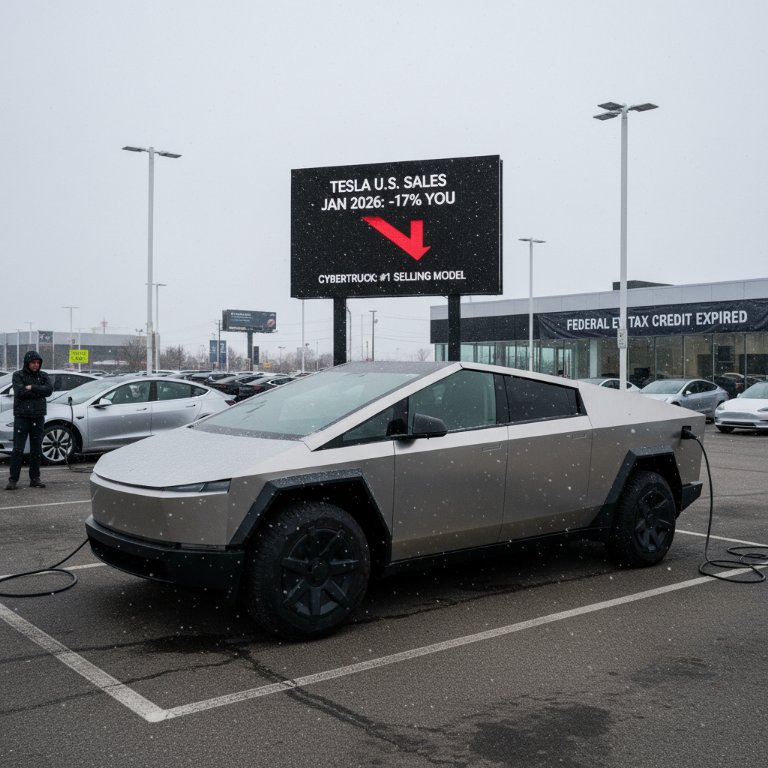
Tesla, the undisputed pioneer of the modern EV era, has kicked off 2026 with a notable downturn, reporting a significant 17% drop in U.S. sales for January compared to the previous year. This marks the fourth consecutive month of year-over-year declines for the automotive giant, signaling a challenging new phase for the company as the EV landscape matures and intensifies.
This isn't merely a blip on the radar; it’s a clear indicator that the dynamics governing EV sales are shifting dramatically. Gone are the days when a Tesla badge alone guaranteed market dominance. The evolving regulatory environment, coupled with a surging tide of formidable competitors, is reshaping consumer choices and forcing even industry leaders to adapt.
The Post-Credit Reality Check
The most immediate and impactful factor contributing to Tesla's January slump is undoubtedly the expiration of the federal EV tax credit. For years, these incentives provided a substantial purchase buffer for many buyers, effectively reducing the barrier to entry for electric vehicles. However, as a more established manufacturer, Tesla had already reached its maximum allocation for these credits on several of its models much earlier than newer entrants. When the updated tax credit system adjusted eligibility, many of Tesla's offerings either no longer qualified or offered reduced benefits, placing them at a significant disadvantage against rivals whose vehicles remained eligible for the full incentive. This sudden withdrawal of financial incentive has clearly impacted consumer willingness to pay the full premium for Tesla's long-standing models.
Cybertruck's Unlikely Ascent Amidst a Dip
In a fascinating twist, Tesla's unconventional Cybertruck emerged as the brand's best-selling model for January 2026. While this highlights significant pent-up demand and the allure of novelty, it simultaneously underscores the challenges facing Tesla's more conventional, higher-volume vehicles like the Model 3 and Model Y. The Cybertruck, with its polarizing design and premium pricing, caters to a specific niche rather than the broad mainstream market where Tesla once reigned supreme. Its success, while a positive for brand visibility, cannot single-handedly offset declining sales across a wider product portfolio.
The Roar of Competition
Moreover, the competitive landscape has never been more vibrant. Legacy automakers, initially slow to embrace electrification, are now aggressively fielding compelling alternatives. Ford's F-150 Lightning and Mustang Mach-E, General Motors with its expanding Ultium-based lineup including the Blazer EV and Equinox EV, and the impressive offerings from Hyundai and Kia (IONIQ 5/6, EV6) are all chipping away at Tesla's market share. These vehicles often come with robust dealer networks, competitive pricing, and in many cases, continued eligibility for federal and state incentives that Tesla’s established models may lack. Newcomers like Rivian also continue to capture segments of the premium EV truck and SUV market, further diversifying consumer options.
Why This Matters:
This early 2026 performance signals a critical juncture for Tesla and the broader EV market.
- For consumers, it means more choice, more competitive pricing, and potentially better value as manufacturers vie for attention. The days of Tesla dictating the market are over; buyers now have a wealth of genuinely attractive options, often with the added benefit of tax credits.
- For competitors, this is a validation of their significant investments in electrification. Companies that have diligently developed compelling EV platforms and built out their charging infrastructure are now poised to capitalize on Tesla's relative vulnerability.
- For Tesla itself, this isn't a do-or-die moment for the company's survival, but it is a wake-up call regarding its growth trajectory and market dominance. The reliance on groundbreaking, but niche, products like the Cybertruck suggests a need for revitalizing its core offerings, accelerating future model introductions, or recalibrating pricing strategies to remain competitive in a landscape that increasingly values choice, value, and readily available incentives. This trend signals that the EV market is finally maturing, moving beyond early adopter enthusiasm to a more competitive, value-driven phase.
Tesla's January 2026 sales figures serve as a potent reminder that even market leaders are not immune to evolving market dynamics. With the federal tax credit no longer providing a consistent tailwind and formidable competition gaining serious traction, Tesla must innovate beyond its current offerings and adapt its strategy to navigate a challenging, yet ultimately more diverse and exciting, electric future.