Tesla's Plummeting Brand Value: A Stark Warning as Market Shifts Underfoot
The automotive world is witnessing a seismic shift, and even the giants are not immune. In a dramatic turn, Tesla, once the undisputed king of electri...
Editorial Team
World Of EV
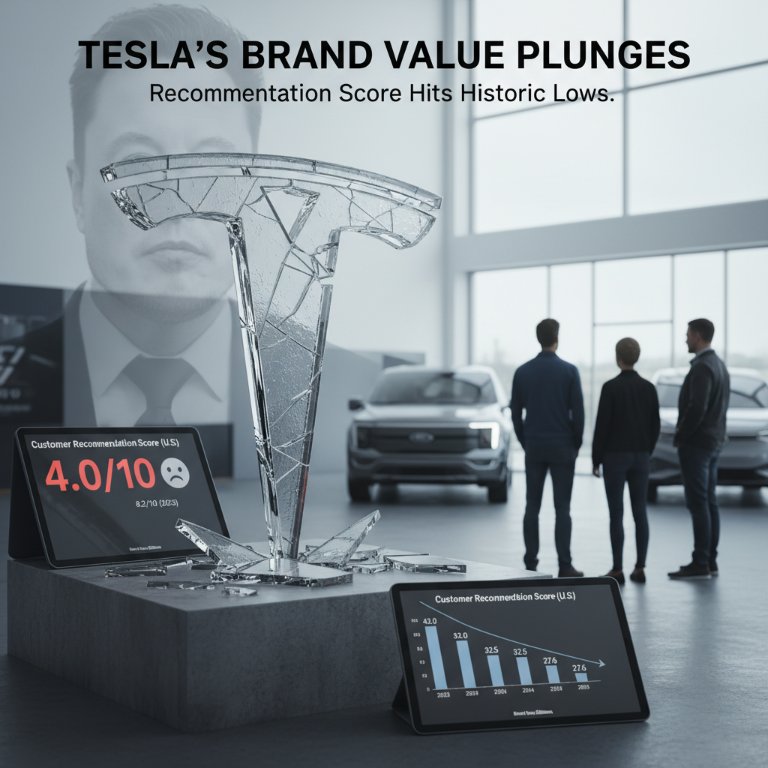
The automotive world is witnessing a seismic shift, and even the giants are not immune. In a dramatic turn, Tesla, once the undisputed king of electric vehicles and a paragon of innovation, saw its brand value tumble by a staggering $15.4 billion (36%) in 2025. This marks the third consecutive annual decline for the Austin-based automaker, as reported by Brand Finance's 'Global 500 2026' report, leaving its brand value at a concerning $27.61 billion. For a company that once commanded unparalleled market attention and investor confidence, this trend signals more than just a momentary dip; it suggests a fundamental recalibration of its position in a rapidly maturing EV landscape.
Once heralded for its disruptive technology and aspirational appeal, Tesla's brand strength is now clearly under pressure. This erosion comes at a critical juncture for the EV industry, where competition intensifies daily, and consumer expectations are evolving beyond mere novelty.
The Shrinking Empire: Tesla's Brand Value in Decline
The raw numbers paint a concerning picture. A $15.4 billion contraction in a single year, representing over a third of its previous valuation, indicates a rapid deterioration of brand equity. This isn't an isolated incident; it's the continuation of a three-year downward trajectory. For a brand whose valuation often outstripped that of legacy automakers selling millions more vehicles, this consistent erosion suggests that the market is beginning to price in factors beyond sheer potential.
Stagnation and Controversy: A Perfect Storm
Brand Finance attributes this significant decline to a confluence of factors, each representing a chink in Tesla's once-impenetrable armor:
- Lack of Breakthrough New Models: For years, Tesla commanded headlines with promises of revolutionary vehicles like the Cybertruck, Semi, and a new Roadster. However, the market has seen a sustained reliance on its established Model 3 and Model Y, with delayed or limited rollouts of new platforms. Meanwhile, competitors like BYD, Hyundai, Kia, and even traditional stalwarts like Mercedes-Benz and BMW have introduced a flurry of compelling, technologically advanced, and often more affordably priced EVs, leaving Tesla's lineup feeling less fresh by comparison.
- High Pricing Relative to Competitors: The EV market is in the throes of intense price wars, particularly in key global markets. As rivals offer increasingly competitive vehicles, often with advanced features and premium interiors at lower price points, Tesla's comparatively higher pricing, coupled with its less diverse product offering, has become a significant hurdle for prospective buyers. The days of Tesla dictating pricing purely on brand cachet are clearly waning.
- CEO Elon Musk's Involvement in Geopolitical Affairs: Elon Musk's public persona, once a significant asset for the brand, appears to be increasingly detrimental. His outspoken and often polarizing involvement in political and geopolitical discussions, amplified by his ownership and management of X (formerly Twitter), has alienated a notable segment of the global consumer base. For a brand that thrives on aspirational appeal, leadership controversies can directly translate into a reluctance among potential buyers to align with the brand's public image.
Loyalty Amidst Disillusionment: A Mixed Signal
Curiously, amidst the plummeting brand value and recommendation scores, Tesla's customer loyalty in the U.S. saw a slight uptick from 90% to 92%. This suggests that existing owners remain highly committed to their vehicles and the Tesla ecosystem. However, this loyalty exists in stark contrast to a dramatic drop in the brand's recommendation score in the U.S., which plummeted to a historic low of 4.0 out of 10, down from a robust 8.2 in 2023. This decline in recommendation was even more pronounced in critical European and Canadian markets. This divergence paints a picture where current owners are satisfied, but the brand's ability to attract new customers through positive word-of-mouth is severely compromised. It indicates a shrinking pool of evangelists and a growing segment of the public hesitant to endorse the brand.
Why This Matters:
This dramatic erosion of Tesla's brand value is far more than just a financial metric; it's a profound signal to the entire automotive industry and, crucially, to potential EV buyers. For years, Tesla's brand was its impenetrable moat, allowing it to command premium pricing and overcome production hurdles. That era is definitively over. This decline signals a maturation of the EV market where product, pricing, and public perception are now paramount. Tesla can no longer rely solely on the cult of personality or its first-mover advantage.
Who wins? Competitors who have meticulously built out diverse EV lineups, focused on quality and competitive pricing, and maintained a less controversial public image stand to gain significantly. Brands like BYD, with its aggressive global expansion and diverse product portfolio, or established automakers like Hyundai-Kia and Mercedes-Benz, which are investing heavily in innovative EV platforms and premium experiences, are well-positioned to capture disillusioned prospective Tesla buyers.
Who loses? Primarily, Tesla and its investors face increased pressure. The reduced brand value directly impacts its ability to attract top talent, secure favorable partnerships, and maintain its premium pricing power. More broadly, if the perception of the leading EV innovator falters, it could subtly impact the overall enthusiasm for EV adoption among a segment of hesitant consumers, even if other brands are excelling.
Is this a "do-or-die" moment? While not an existential threat in the immediate term, this is undoubtedly a critical inflection point for Tesla. The company must diversify its product portfolio with genuinely new and compelling models that address current market demands for affordability and variety. Furthermore, a strategic re-evaluation of its leadership's public-facing persona and its impact on the brand's universal appeal is essential. Without these course corrections, Tesla risks transitioning from an aspirational technology leader to just another automotive manufacturer, albeit an all-electric one, struggling to differentiate itself in a crowded and competitive market.
Tesla's precipitous brand value decline serves as a powerful reminder that even the most dominant brands are not immune to market forces, evolving consumer sentiment, and the consequences of leadership's public actions. To reverse this worrying trend, Tesla must now pivot from solely relying on its past glory and controversial leadership to focusing on product innovation, competitive pricing, and a renewed commitment to its core mission, free from extraneous distractions. The future of its market leadership hinges on how quickly and effectively it responds to these undeniable warning signs.