Tesla's 'Minivan Killer' Tease: A Strategic Shift Towards Family-First EVs
Tesla CEO Elon Musk has once again ignited the automotive world with a tantalizing tease: a new vehicle in development, described only as "something w...
Editorial Team
World Of EV
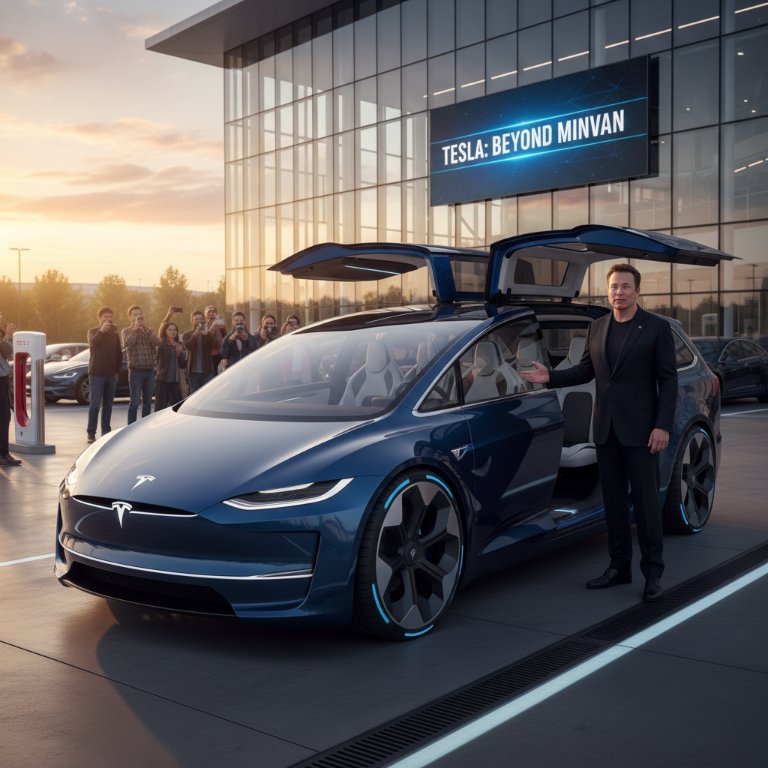
Tesla CEO Elon Musk has once again ignited the automotive world with a tantalizing tease: a new vehicle in development, described only as "something way cooler than a minivan." This provocative statement arrives at a pivotal moment for Tesla, as the company reportedly phases out its flagship Model X, leaving a significant void in its larger passenger vehicle offerings. The hint, extracted from a direct exchange with fans clamoring for more passenger capacity, signals a strategic pivot towards a more family-oriented electric vehicle, a segment Tesla has historically approached with mixed results.
Filling the Family Void: A Long-Awaited Answer to Market Demand
For years, Tesla's lineup, while diverse, has lacked a truly capacious, family-focused EV that blends practicality with an accessible price point. The Model X, with its innovative but complex Falcon Wing doors and premium pricing, served as Tesla's largest offering but often proved too niche for many families seeking straightforward utility. Now, as Tesla officially begins to sunset the Model S and Model X, with a firm cutoff date for orders in markets like South Korea by March 31, 2026, the need for a viable family hauler becomes even more pressing. This move aligns with Musk's broader strategy to focus on higher-volume vehicles and reallocate manufacturing lines for projects like the Optimus humanoid robot.
Musk's recent boast that the Cybertruck, despite its polarizing design, can accommodate three child seats, underscores the current gap in Tesla's portfolio for genuine multi-passenger solutions. The demand for a Tesla minivan or a similar high-capacity EV has been a consistent refrain from the community, with discussions spanning back to Musk's "Master Plan Part 2" where he envisioned "high passenger-density urban transport." While concepts like the Robovan were previewed at the "We, Robot" event in 2024, they leaned more towards utilitarian people-movers rather than dedicated family vehicles.
The 'Minivan Killer' and its Potential Forms
What exactly constitutes "something way cooler than a minivan" remains a subject of intense speculation. It suggests a departure from traditional minivan aesthetics and functionality, likely incorporating Tesla's signature design language and advanced technology. Theories abound, ranging from a potential "CyberSUV" derived from the Cybertruck platform to a more evolved version of the autonomous Robovan concept. Another strong possibility, and one already gaining traction in international markets, is the Model Y L – an extended-wheelbase, six-seat variant of the popular Model Y, featuring a taller roofline and captain's chairs. Already launched in China and now confirmed for markets like South Korea, Australia, and New Zealand, the Model Y L demonstrates Tesla's capability to offer a more spacious, family-friendly configuration without necessarily launching an entirely new ground-up vehicle.
Why This Matters:
This announcement is a critical strategic move for Tesla, with profound implications for its market position and the broader EV landscape.
- Market Expansion and Demographic Shift: By seriously addressing the family vehicle segment, Tesla taps into a massive, underserved market. This could attract a new demographic of buyers who value practicality and passenger capacity above raw performance, significantly boosting Tesla's overall sales volume and market share.
- Challenging Legacy Automakers: A truly innovative, family-focused Tesla could disrupt traditional minivan and large SUV segments, putting immense pressure on legacy automakers like Chrysler (Pacifica), Honda (Odyssey), and even emerging EV players like Volkswagen (ID. Buzz) to accelerate their electric offerings in this crucial category.
- Redefining the Family Vehicle: Musk's promise of "cooler than a minivan" isn't just marketing hype; it signals an intent to redefine what a family vehicle can be in the electric age. Expect advanced infotainment, flexible interior configurations, and perhaps even features leveraging Tesla's AI and autonomous driving ambitions.
- A New Chapter for Tesla: With the Model S and Model X concluding their long and influential runs, this new family-oriented vehicle represents the next generation of Tesla's core automotive business. It signifies a maturation of the brand beyond its luxury and performance roots, towards a more inclusive and utilitarian future.
- Leveraging Manufacturing Innovation: Developing a larger, high-volume vehicle could also be a testbed for Tesla's advanced manufacturing techniques, such as gigacasting, to ensure efficiency and scalability.
The Road Ahead: A New Era of Tesla Utility
Elon Musk's latest tease suggests Tesla is finally ready to fully embrace the family market, moving beyond the Model X's ambitious but ultimately niche appeal. With the Model S and X programs winding down, the stage is set for a new, high-volume, and intensely practical electric vehicle. This strategic evolution not only addresses a long-standing demand from the fanbase but also positions Tesla to expand its reach significantly, challenging competitors and potentially redefining the future of family transportation in the electric era.