Tesla's FSD v14.3: A Make-or-Break Moment for 'Reasoning and Logic' in Autonomous Driving
Tesla CEO Elon Musk has ignited the autonomous driving world once again, confirming that Full Self-Driving (FSD) v14.3 is currently undergoing rigorou...
Editorial Team
World Of EV
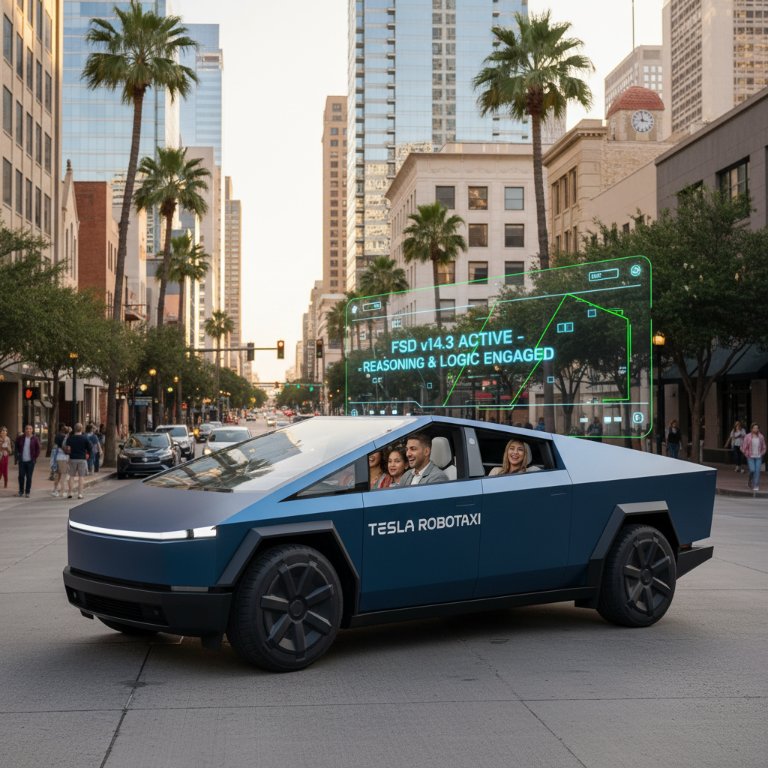
Tesla CEO Elon Musk has ignited the autonomous driving world once again, confirming that Full Self-Driving (FSD) v14.3 is currently undergoing rigorous internal testing. With a public release anticipated 'in a few weeks,' likely by late April 2026, this isn't just another incremental update; Musk himself has touted v14.3 as a "significant update" designed to inject 'reasoning and logic' into FSD's decision-making. For a technology that has faced both fervent praise and intense scrutiny, this release could mark a pivotal turning point, potentially redefining Tesla's trajectory in the race for true autonomy.
This upcoming software iteration arrives at a crucial juncture for Tesla. After years of iterative improvements and ambitious promises, FSD has evolved from basic driver assistance features to a sophisticated, albeit still supervised, system. Previous versions have demonstrated impressive capabilities in navigating complex urban environments but have often been criticized for exhibiting behaviors that, while generally safe, lack the nuanced, predictive intelligence of a human driver. The addition of 'reasoning and logic' suggests a qualitative leap beyond pattern recognition, aiming for a system that can truly understand and anticipate dynamic road conditions, rather than merely react to them.
FSD v14.3: The Promise of Reasoning and Logic
The core of the v14.3 update lies in its purported ability to integrate 'reasoning and logic.' This represents a significant architectural shift from prior iterations, which primarily relied on deep learning and neural networks to predict outcomes based on vast datasets. While powerful, these systems can sometimes struggle with novel situations or subtle social cues on the road – the very scenarios where human drivers apply common sense and foresight. The integration of 'reasoning and logic' implies a more sophisticated decision-making framework, potentially allowing FSD to:
- Anticipate intentions: Better predict the actions of other drivers, pedestrians, and cyclists.
- Handle edge cases: Navigate unusual or unexpected road scenarios with greater consistency and safety.
- Improve human-like driving: Make smoother, more natural decisions that enhance comfort and confidence for occupants.
Robotaxi Integration: Austin's Autonomous Future
Compounding the excitement around v14.3 is the strong speculation that this is the very software version earmarked for Tesla's much-anticipated driverless robotaxi service in Austin, Texas. If true, this ties FSD v14.3 directly to Tesla's audacious vision for a fully autonomous ride-hailing network – a goal that has remained elusive despite years of development. Deploying FSD v14.3 in a commercial robotaxi service would serve as the ultimate real-world test, pushing the boundaries of its capabilities in a live, unsupervised environment. Success here would not only validate Tesla's full-stack approach to autonomy but also provide a massive influx of real-world operational data to further refine the system.
Why This Matters:
This isn't just another software update; it's a make-or-break moment for Tesla's autonomous driving ambitions and a bellwether for the entire industry. If FSD v14.3 truly delivers on the promise of 'reasoning and logic,' it could:
- Elevate Tesla's Leadership: A significant qualitative leap would solidify Tesla's position as a frontrunner in autonomous driving, moving beyond impressive but supervised beta stages. This would directly challenge established autonomous players like Waymo and Cruise, who have taken a more cautious, geo-fenced approach.
- Unlock Robotaxi Revenue: A robust, reliable v14.3 would be the key to finally launching the Austin robotaxi service, opening a colossal new revenue stream and demonstrating the viability of Tesla's long-term business model.
- Reshape Consumer Perception: Persistent skepticism around FSD's capabilities could finally begin to wane, fostering greater consumer trust and accelerating widespread adoption of advanced driver-assistance systems.
- Set New Industry Benchmarks: The successful implementation of 'reasoning and logic' would force competitors to re-evaluate their own development strategies, potentially accelerating the entire industry's pursuit of truly intelligent autonomous systems.
- High Stakes, High Reward: Failure to deliver on this promise, however, would represent a significant setback. It could further erode consumer confidence, attract more regulatory scrutiny, and put immense pressure on Tesla's ambitious timelines for robotaxis and future autonomous vehicles. This moment signals Tesla's willingness to bet big on its unique vision, with either a massive payoff or a painful lesson awaiting.
Tesla's FSD v14.3 update, with its bold claims of integrating 'reasoning and logic,' is poised to be a watershed moment. Whether it ushers in a new era of genuinely intelligent autonomous driving or merely another incremental step remains to be seen, but the implications for Tesla, the EV market, and the future of transportation are undeniably profound. The world will be watching closely as late April approaches, eager to see if Tesla can finally turn its ambitious rhetoric into verifiable reality on the road.