Tesla's FSD (Supervised) v14.2.2.5: Is This the Autonomy Breakthrough We've Been Waiting For?
The Tesla community is buzzing, and for good reason: the latest iteration of Full Self-Driving (Supervised), version 14.2.2.5, is rolling out, prompti...
Editorial Team
World Of EV
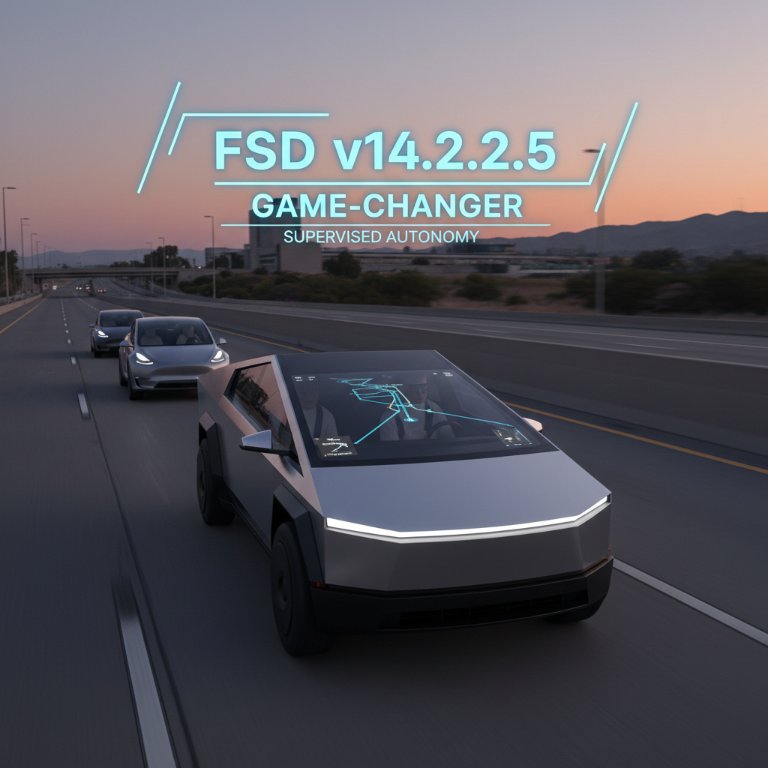
The Tesla community is buzzing, and for good reason: the latest iteration of Full Self-Driving (Supervised), version 14.2.2.5, is rolling out, prompting prominent voices to challenge skeptics to experience what they are calling a pivotal moment for Tesla's ambitious autonomy program. This release, following closely on the heels of the foundational v14 last year, is actively reaching owners of Hardware 4-equipped vehicles, including the Model Y, Model 3, and the highly anticipated Cybertruck.
For years, Tesla's Full Self-Driving capability has been a lightning rod for both fervent praise and intense criticism. Promising a future of truly autonomous vehicles, its development has been a public, often challenging, journey. Previous iterations, while impressive in controlled environments, frequently required significant driver intervention, leading to questions about the "Full Self-Driving" moniker itself. Now, however, there's a palpable shift in tone, suggesting that v14 represents a more mature and robust system.
The 'Second Most Important AI/Autopilot Update'
Elon Musk himself signaled the monumental nature of this particular software branch, referring to v14 as the 'second most important AI/Autopilot update since FSD V12'. This statement alone underscores the internal confidence at Tesla regarding the architectural and functional improvements integrated into this version. While specific technical details often remain proprietary, such a pronouncement from the CEO suggests deep underlying changes, likely related to neural network architecture, data processing, and decision-making logic, pushing FSD closer to its ultimate goal.
Widespread Rollout to Next-Gen Hardware
The current production version, FSD (Supervised) v14.2.2.5, delivered via software update 2025.45.10, is not just a theoretical improvement; it's actively deploying across the fleet. Crucially, this rollout targets vehicles equipped with Tesla's latest Hardware 4. This includes a significant portion of the current Model Y and Model 3 production, alongside the revolutionary Cybertruck. The synergy between optimized software and more powerful, dedicated AI hardware is expected to unlock unprecedented performance and reliability for the system. The focus on Hardware 4 vehicles indicates that Tesla is leveraging its most advanced processing capabilities to deliver the best possible FSD experience right out of the gate.
Why This Matters:
This isn't just another incremental update; FSD (Supervised) v14.2.2.5 could be the breakthrough moment Tesla enthusiasts and the industry at large have been anticipating. For the end-user, this means a potentially smoother, more confident, and less intervention-heavy driving experience, inching closer to the promise of genuine autonomous travel. This could dramatically enhance vehicle convenience and potentially reshape daily commutes, making the investment in FSD a more tangible value proposition.
Who Wins? Tesla and its early adopters, certainly. If v14 lives up to the hype, it solidifies Tesla's position as a leader in automotive AI, potentially attracting new buyers who have been hesitant about FSD's capabilities. It also puts pressure on traditional automakers and rival autonomous driving companies like Waymo and Cruise, demonstrating the power of a vertically integrated software and hardware approach. A more reliable FSD system could also significantly enhance the resale value of Tesla vehicles.
Who Loses? Companies struggling with their own autonomous driving solutions might find themselves further behind. The 'supervised' caveat, while still present, becomes less of a hindrance if the system truly minimizes the need for driver intervention. This could also challenge the narrative that camera-only systems are inherently limited compared to lidar-based approaches, potentially forcing a re-evaluation across the industry.
What This Signals: This release signals Tesla's unwavering commitment to its AI-first strategy and its belief in a camera-centric approach to autonomy. It's a critical moment for public perception; if skeptics are genuinely impressed, it could dramatically shift the narrative around FSD from perpetual beta to a truly advanced driver-assistance system that's pushing the boundaries of what's possible in consumer vehicles. This is a "do-or-die" moment for FSD's reputation and could dictate its broader adoption and regulatory future.
With FSD (Supervised) v14.2.2.5 now actively rolling out, the automotive world is watching closely. This iteration, backed by a powerful new hardware suite and significant internal endorsement, represents a critical juncture for Tesla's autonomous ambitions. If it delivers on its promise, we could truly be witnessing the dawn of a new era in driving, pushing the boundaries of what consumers expect from their electric vehicles and setting new benchmarks for the entire industry.