Tesla's FSD Supervised Unleashed Globally: A Pivotal Shift Towards AI Dominance
Tesla is no longer merely an electric vehicle manufacturer; it is rapidly solidifying its position as a transformative Artificial Intelligence company...
Editorial Team
World Of EV
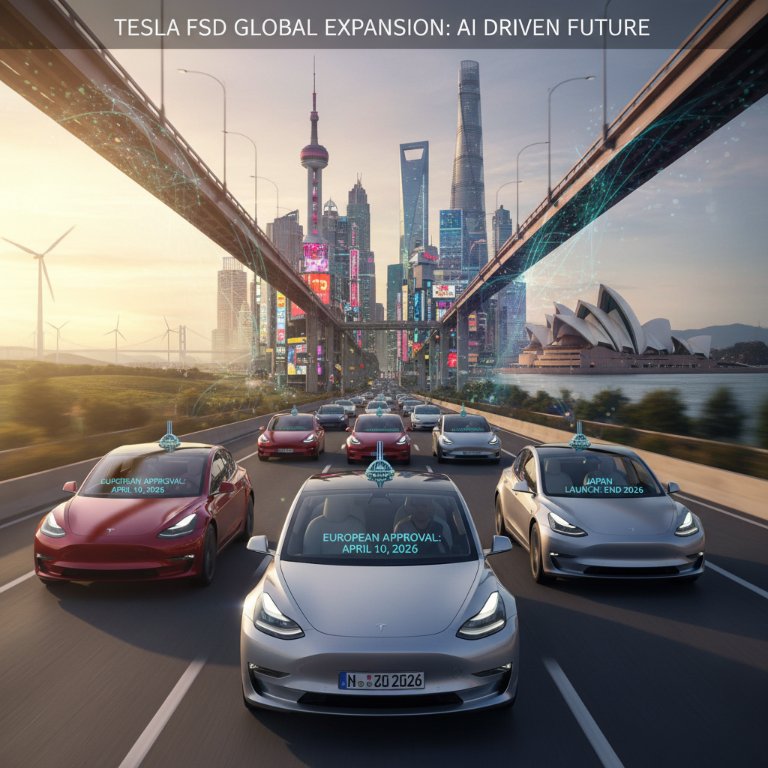
Tesla is no longer merely an electric vehicle manufacturer; it is rapidly solidifying its position as a transformative Artificial Intelligence company. The latest global expansion of its Full Self-Driving (FSD) (Supervised) software, pushing into critical markets across continents, marks a watershed moment not just for Tesla, but for the entire automotive and tech industries. This aggressive worldwide rollout underscores FSD as the primary engine driving Tesla's audacious global ambitions, setting the stage for a dramatic redefinition of personal transportation.
FSD's Global Reach Expands Dramatically
The FSD (Supervised) system, a sophisticated Level 2+ advanced driver-assistance system, is now accessible to a significant portion of the global driving population. Drivers in North America, Australia, New Zealand, and South Korea are already experiencing the system's capabilities, allowing their vehicles to navigate complex urban and highway environments with increasing autonomy. This widespread deployment provides Tesla with an invaluable feedback loop, gathering vast amounts of real-world driving data crucial for further refining and accelerating the development of truly autonomous capabilities.
Navigating Regulatory Labyrinths: Europe and China
While FSD has seen relatively swift adoption in some markets, regulatory complexities have historically presented formidable challenges, particularly in Europe and China. Yet, Tesla is demonstrating remarkable progress in overcoming these hurdles:
- China's Strategic Penetration: Despite stringent local data laws, Tesla's rollout in China is moving forward. The company has proactively established a local data center, ensuring compliance with data residency requirements—a crucial step for operating within one of the world's largest automotive markets. This strategic move is vital for Tesla's long-term growth in a region where local competitors are rapidly advancing their autonomous driving solutions.
- Europe's Landmark Approval Looms: The European market, known for its rigorous safety standards and fragmented regulatory landscape, is on the cusp of a significant breakthrough. Following extensive testing and close collaboration with the Netherlands' vehicle authority (RDW), a landmark formal approval is anticipated around April 10, 2026, through EU Article 39. This approval is not just a win for Tesla; it could establish a critical precedent for autonomous driving technology deployment across the entire European Union, potentially easing the path for future innovations from other players.
Asia's Next Frontier: Japan
Looking further eastward, Tesla intends to launch FSD in Japan by the end of 2026. This move acknowledges the unique complexities of Japan's dense urban environments, intricate road networks, and distinct driving customs. Successfully navigating this market will be a testament to FSD's adaptability and Tesla's engineering prowess, demonstrating its ability to perform reliably across diverse global driving conditions.
Why This Matters:
This global FSD expansion is far more than a software update; it is a profound strategic play with enormous implications for Tesla, its competitors, and the future of transportation. Tesla is not simply selling cars; it is selling access to an evolving AI network. This move fundamentally redefines Tesla's value proposition and sets the stage for exponential revenue growth from software subscriptions and, ultimately, a robotaxi network.
- For Tesla: This rapid expansion validates CEO Elon Musk's long-held vision of Tesla as an AI company. It transforms the automotive sector from a hardware-centric model to a software-driven one, giving Tesla a significant, almost unassailable, lead. The sheer volume of real-world data gathered from millions of miles driven across diverse environments will create an unparalleled feedback loop, making FSD's AI exponentially smarter and more robust than any competitor's system. This is a "do-or-die" moment, where early leadership in autonomous capabilities could secure market dominance for decades. The financial implications are massive, moving Tesla closer to recurring, high-margin software revenue streams.
- For Competitors: Traditional automakers and rival EV companies, many of whom are still struggling to develop comparable Level 2 systems, face an increasingly daunting challenge. While companies like Mercedes-Benz are making strides with Level 3 systems in specific conditions, Tesla's broad, globally integrated Level 2+ approach, coupled with its AI-first philosophy, positions it distinctly ahead in the race for true Level 4/5 autonomy. The gap is widening, and for many, catching up may prove nearly impossible without substantial acquisitions or radical strategic shifts.
- For Consumers and Industry Professionals: The prospect of increasingly capable autonomous driving, even in a supervised capacity, holds immense appeal. For prospective buyers, FSD becomes a powerful differentiator, promising enhanced convenience, safety, and a future-proof investment. For industry professionals, this signals an accelerating shift away from traditional vehicle ownership towards a potential future of mobility-as-a-service, driven by AI-powered fleets. The regulatory breakthroughs in Europe, in particular, signal a potential loosening of the chokehold that bureaucratic processes have had on innovation, which could catalyze a broader acceptance and faster deployment of similar technologies across the continent.
Tesla's accelerated global deployment of FSD (Supervised) is a powerful declaration of intent. It underscores the company's commitment to transforming not just the vehicle, but the very act of driving through artificial intelligence. As FSD continues its global march, Tesla isn't just selling cars; it's laying the groundwork for an autonomous future, poised to capture immense value from an industry on the brink of profound change. The coming months, particularly the European approval, will be critical milestones in this unfolding AI-driven revolution.