Tesla's FSD Supervised Targets Japan: A High-Stakes Bet on Asia's Autonomous Future
Tesla is making an aggressive push to deploy its Full Self-Driving (Supervised) technology in Japan by the close of 2026. This ambitious timeline, con...
Editorial Team
World Of EV
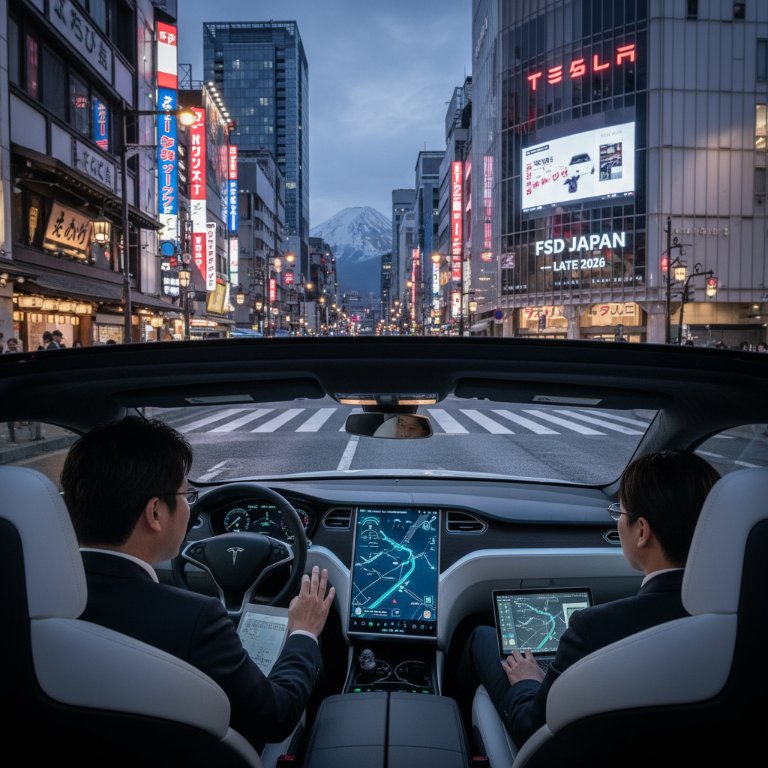
Tesla is making an aggressive push to deploy its Full Self-Driving (Supervised) technology in Japan by the close of 2026. This ambitious timeline, confirmed by Richi Hashimoto, president of Tesla's Japanese subsidiary, signals a pivotal moment for both the automaker's global autonomous driving ambitions and Japan's notoriously complex regulatory environment.
For years, Tesla's FSD program has been a cornerstone of its long-term vision, promising a future of fully autonomous vehicles. While the technology has seen iterative improvements and controversial rollouts in North America, its expansion into new, highly regulated markets like Japan carries significant implications. This move comes after a period of quiet but intensive testing on Japanese public roads since August 2025, now augmented by customer ride-alongs designed to acclimate future users and gather crucial real-world data.
FSD Supervised Arrives in the Land of the Rising Sun
Tesla's strategy to bring FSD (Supervised) to Japan is not merely a technical deployment; it's a strategic maneuver into one of the world's most discerning automotive markets. The 'Supervised' moniker itself is critical, emphasizing that a human driver remains ultimately responsible and must be attentive, a necessary concession in the current regulatory landscape for advanced driver-assistance systems (ADAS).
Key aspects of this rollout include:
- Aggressive Timeline: Deployment by the end of 2026, showcasing Tesla's confidence in its system's maturity and its ability to navigate local compliance.
- Intensive Local Testing: Public road testing since August 2025 has been crucial for adapting the FSD neural networks to Japan's unique road infrastructure, signage, and driving behaviors.
- Customer Ride-Alongs: These experiences serve a dual purpose: gathering user feedback in a controlled environment and building public trust and familiarity with the technology.
- Regulatory Collaboration: President Hashimoto's confirmation underscores active engagement with Japanese authorities to secure the necessary approvals for widespread deployment.
Navigating Japan's Unique Road Ahead
Japan presents a formidable challenge for any autonomous driving system. Its dense urban environments, narrow streets, complex intersections, unique road markings, and distinctive driving culture demand a level of precision and adaptability that surpasses many other markets. Unlike the relatively straightforward highway driving scenarios, navigating Tokyo or Osaka autonomously is a true acid test for FSD's capabilities. Historically, Japanese automakers have adopted a cautious, incremental approach to ADAS, prioritizing safety and reliability above all else. This conservative stance means Tesla's FSD will face intense scrutiny from both regulators and consumers, who are accustomed to extremely high standards of quality and safety.
Why This Matters:
This move by Tesla into Japan with FSD (Supervised) is far more than a routine product launch; it's a strategic gambit with wide-ranging implications across the EV and autonomous driving sectors.
- For Tesla: This represents a crucial validation point for FSD. Success in Japan would significantly bolster confidence in its global scalability, potentially accelerating regulatory approvals in other challenging markets. It also opens a new, potentially lucrative revenue stream through FSD subscriptions or one-time purchases, further differentiating Tesla from competitors who largely offer Level 2 ADAS as standard or via less comprehensive packages.
- For Japanese Consumers: This introduces a new paradigm of ADAS functionality. While Japanese OEMs like Toyota and Honda offer highly capable Level 2 systems, FSD (Supervised) aims for a more extensive domain of operation. This could force local players to accelerate their own autonomous development, ultimately benefiting consumers through more advanced and safer driving aids, though initial skepticism regarding autonomous tech performance is likely to be high.
- For the Autonomous Driving Industry: Japan's approval of FSD (Supervised) could set a global precedent, encouraging other nations to re-evaluate their regulatory frameworks for advanced ADAS. It signals a potential shift from highly conservative deployment strategies to a more open, albeit still cautious, approach, especially for systems that retain strong driver supervision requirements. Conversely, any significant setbacks or public incidents could severely damage public trust and set back autonomous deployment efforts globally.
- Competitive Landscape: This move will undoubtedly put pressure on other international OEMs eyeing the Japanese market for their advanced ADAS offerings. It solidifies Tesla's position as a leader in autonomous software development, forcing competitors to benchmark against FSD's capabilities in one of the most demanding operational design domains.
Tesla's targeted FSD (Supervised) rollout in Japan by late 2026 is a bold declaration of intent, signaling the company's commitment to global autonomous deployment and its belief in the system's maturity. While the regulatory hurdles and the unique challenges of the Japanese market are significant, successful implementation could unlock enormous potential, not just for Tesla, but for the broader evolution of autonomous driving technology worldwide. The eyes of the industry will be firmly fixed on Japan as this high-stakes venture unfolds.