Tesla's FSD (Supervised) Breaches Europe with Swedish Green Light, Signals Continent-Wide Rollout
The autonomous driving landscape in Europe is on the cusp of a seismic shift. Tesla, a long-standing titan in the electric vehicle sector, has just se...
Editorial Team
World Of EV
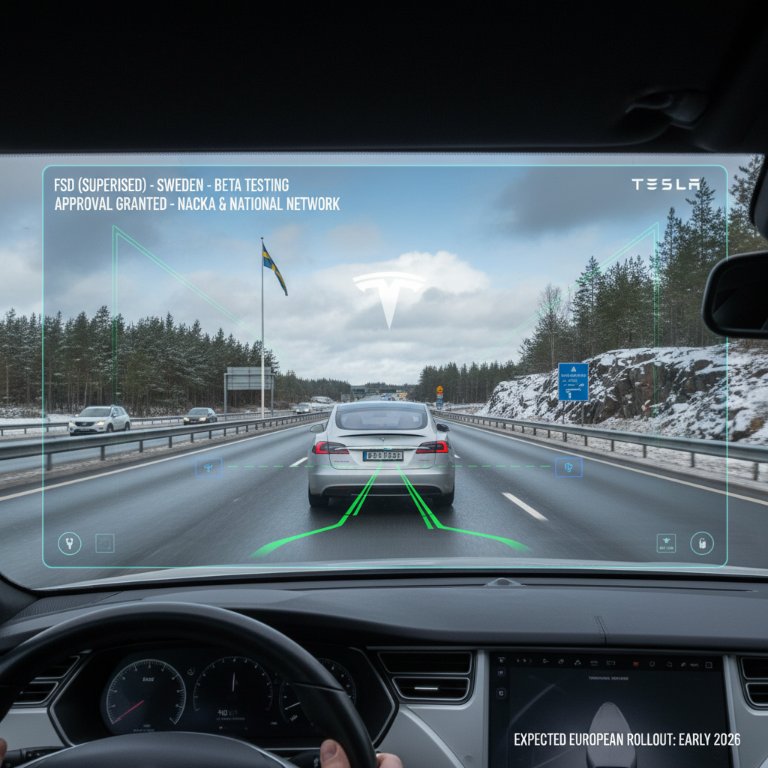
The autonomous driving landscape in Europe is on the cusp of a seismic shift. Tesla, a long-standing titan in the electric vehicle sector, has just secured a landmark regulatory approval in Sweden to commence testing of its Full Self-Driving (Supervised) system on public roads. This isn't merely a limited trial; the approval spans the entire road network governed by the Swedish Transport Administration, alongside urban and highway arteries within the Municipality of Nacka. This critical step marks a decisive move toward widespread FSD deployment across the continent, an endeavor that has historically faced significant regulatory hurdles.
This development comes after years of Tesla meticulously refining its FSD software, primarily within the North American market, navigating a labyrinth of regulatory frameworks and public perception challenges. For European enthusiasts and prospective buyers who have watched from afar, the prospect of FSD (Supervised) arriving on their shores represents a long-anticipated leap forward in vehicle autonomy, promising enhanced safety features and a taste of future mobility.
Sweden: The Nordic Launchpad for European FSD
The scope of the Swedish approval cannot be overstated. By granting Tesla access to its entire public road network and specific, complex urban environments, Sweden has positioned itself as the pioneering European nation for large-scale FSD (Supervised) testing. This comprehensive allowance goes beyond typical localized pilot programs, providing Tesla with invaluable real-world data and experience across diverse driving conditions, from bustling city streets to high-speed motorways.
Tesla CEO Elon Musk has further fueled anticipation, indicating that similar FSD (Supervised) software approvals are imminent in other key European territories. The Netherlands Vehicle Authority, a crucial regulatory body, is reportedly slated to deliver its decision by February 2026. This staggered yet rapid regulatory push underscores Tesla’s strategic intent to expedite FSD (Supervised) access for its European customer base, with the company reiterating its expectation to begin rolling out the system to customers in early 2026, contingent upon these clearances.
For those unfamiliar, FSD (Supervised) represents Tesla’s advanced driver-assistance system, designed to navigate, change lanes, and perform turns with minimal driver intervention, all while requiring an attentive human driver to remain ready to take control at any moment. The 'Supervised' moniker is crucial, distinguishing it from fully autonomous, Level 5 systems. It emphasizes that while the car takes on significant driving tasks, the ultimate responsibility remains with the human behind the wheel.
Why This Matters:
- Regulatory Precedent Setter: Sweden's comprehensive approval could serve as a critical precedent for other European Union member states. A successful, safe deployment and testing phase in Sweden might streamline regulatory processes elsewhere, potentially accelerating FSD adoption across the continent. This is a significant win for Tesla's regulatory teams, who have long sought to navigate Europe's fragmented ADAS rulebooks.
- Competitive Edge for Tesla: While companies like Mercedes-Benz have made strides with Level 3 autonomous driving systems in specific conditions (like their DRIVE PILOT in Germany), Tesla’s FSD (Supervised) offers a broader, more integrated approach to driver assistance across varied driving scenarios. This European entry positions Tesla to outpace rivals in bringing a widely available, advanced ADAS to the market, further solidifying its technology leadership.
- Unlocking New Revenue Streams: The expansion of FSD (Supervised) into Europe opens up a massive new market for Tesla’s lucrative software subscriptions. This is critical for the company’s long-term financial strategy, shifting more toward a recurring revenue model beyond vehicle sales, aligning with Musk's vision of Tesla as an AI and robotics company.
- Empowering European Consumers: For European EV enthusiasts, FSD (Supervised) offers a tangible upgrade in convenience and potential safety, providing a taste of the fully autonomous future. This could significantly boost Tesla’s appeal in a highly competitive market increasingly embracing advanced technological features.
- Challenges and Scrutiny: The European rollout will undoubtedly bring heightened scrutiny from regulators, media, and the public. Tesla will need to demonstrate FSD (Supervised)'s safety and reliability across Europe's diverse road infrastructure, driving cultures, and weather conditions, proactively addressing any concerns that arise.
Tesla’s successful entry into the rigorous European regulatory landscape via Sweden marks a pivotal moment for autonomous driving. It not only validates years of development but also sets the stage for a continent-wide rollout of FSD (Supervised) in early 2026. As the Netherlands and other nations deliberate, the coming months will reveal the true pace of this expansion, but one thing is clear: the future of driving in Europe is accelerating, with Tesla firmly in the driver's seat of this technological evolution.