Tesla's FSD Safety Metrics Plummet as Regulatory Scrutiny Intensifies: A Troubling Downturn in the Race for Autonomy
Tesla's ambition for Full Self-Driving (FSD) has hit a significant roadblock, as critical safety metrics for the system demonstrate a sharp deteriorat...
Editorial Team
World Of EV
Tesla's ambition for Full Self-Driving (FSD) has hit a significant roadblock, as critical safety metrics for the system demonstrate a sharp deterioration. This alarming trend, highlighted by analyst Gordon Johnson of GLJ Research, comes amidst a new federal probe by the National Highway Traffic Safety Administration (NHTSA), casting a long shadow over Tesla's autonomous future and raising serious questions for enthusiasts and industry professionals alike.
For years, Tesla CEO Elon Musk has championed FSD as a revolutionary technology, promising a future of fully autonomous vehicles and robotaxis. However, the latest data presents a stark contrast to these lofty ambitions, indicating a worrying step backward in the system's performance and reliability.
Alarming Drop in Disengagement Metrics
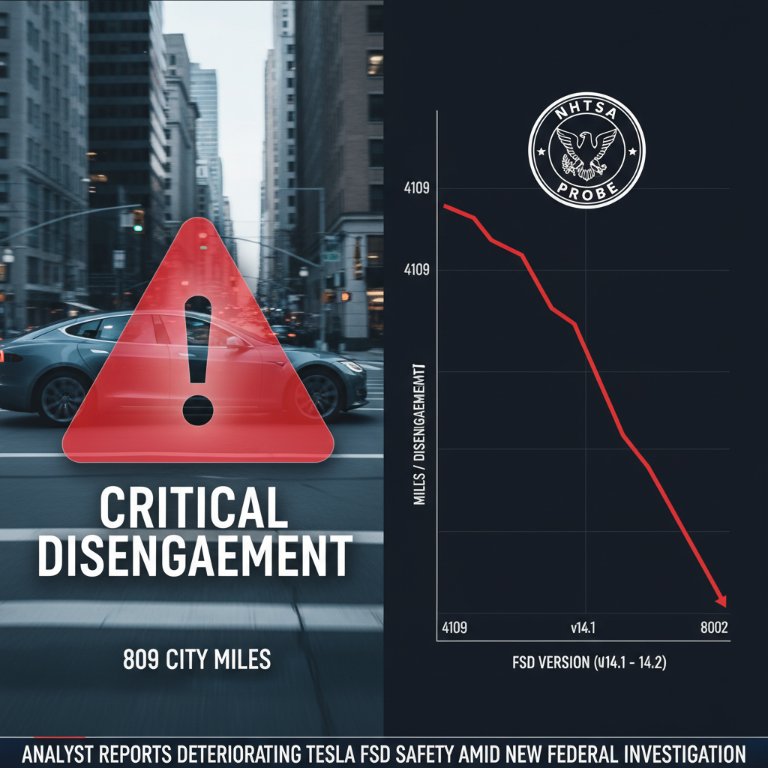
GLJ Research's analysis, utilizing third-party FSD Community Tracker data, reveals a dramatic decline in the 'city miles to critical disengagement' metric for FSD. This crucial benchmark, which measures how many miles the system operates before requiring human intervention due to a critical safety event, has plummeted:
- FSD v14.1 (Peak): Achieved 4,109 city miles per critical disengagement.
- FSD v14.2: Collapsed to a mere 809 city miles per critical disengagement.
To put this into critical context, industry leader Waymo boasts a significantly higher threshold, achieving approximately 30,000 miles before disengagement, a staggering difference of over 37 times compared to Tesla's current FSD v14.2 performance. While Waymo's figures may vary slightly depending on reporting year and methodology, their consistent lead in this critical metric underscores the immense gap in autonomous capability.
Escalating Regulatory Pressure from NHTSA
The deteriorating safety metrics coincide with an intensified federal NHTSA probe into Tesla's FSD system. This investigation adds a layer of significant regulatory risk to the company's autonomous driving aspirations. The NHTSA is scrutinizing traffic violations and crashes linked to FSD (Supervised) and FSD (Beta), including incidents where vehicles ran red lights, made illegal turns, or drove against the proper direction of travel. The probe reportedly involves an estimated 2.88 million Tesla vehicles.
This is not the first time Tesla's FSD and Autopilot systems have faced governmental scrutiny. The ongoing nature of these investigations and the increasing number of reported incidents demonstrate a growing concern among regulators regarding the safety and operational claims of Tesla's advanced driver-assistance systems.
Why This Matters:
This confluence of plummeting safety metrics and escalating regulatory probes represents a pivotal moment for Tesla's Full Self-Driving ambitions. For EV enthusiasts, prospective buyers, and industry professionals, the implications are substantial:
- Eroding Trust and Market Confidence: The sharp decline in FSD safety performance directly undermines consumer trust, a critical factor for the widespread adoption of autonomous technology. Investors, too, will likely view these developments with caution, potentially impacting Tesla's valuation and long-term growth narrative.
- Widening Gap with Competitors: While Tesla has often been perceived as a frontrunner in autonomous driving, these figures clearly illustrate a widening performance gap between FSD and established autonomous leaders like Waymo. This could embolden competitors and force a reevaluation of Tesla's position in the autonomy race.
- Regulatory Roadblocks Ahead: The NHTSA probe is a serious threat. Potential outcomes range from significant fines and mandated software changes to recalls or even restrictions on FSD's deployment. Such measures would undoubtedly delay or even derail Tesla's ambitious robotaxi plans, which are central to its long-term vision.
- Impact on Future Development: A fundamental question arises: is Tesla's current FSD development methodology sustainable? The regression in safety performance suggests that the 'move fast and break things' approach may be reaching its limits when applied to safety-critical autonomous systems. This could necessitate a significant re-think of their strategy, potentially leading to slower development cycles or a shift in technological approach.
Conclusion:
Tesla's FSD system finds itself at a critical juncture. The significant deterioration in safety performance, coupled with intensifying federal scrutiny, demands immediate and transparent action from the automaker. The path forward for FSD will undoubtedly be challenging, requiring not just technological advancement, but a renewed focus on demonstrable safety and regulatory compliance to regain public trust and truly compete in the complex world of autonomous driving.