Tesla's FSD Safety Data Stuns Senate, Company Calls for Unified Federal AV Regulations
In a pivotal appearance before the U.S. Senate Commerce Committee, Lars Moravy, Tesla's Vice President of Vehicle Engineering, delivered a compelling ...
Editorial Team
World Of EV
In a pivotal appearance before the U.S. Senate Commerce Committee, Lars Moravy, Tesla's Vice President of Vehicle Engineering, delivered a compelling case for a standardized federal framework governing autonomous vehicles. Moravy didn't just advocate; he backed Tesla's position with staggering safety statistics from its Full Self-Driving (FSD) system, igniting fresh debate over the future of assisted and autonomous driving in the United States. This testimony arrives at a critical juncture, as the automotive industry grapples with fragmented state-level regulations, stifling the nationwide deployment of advanced driver-assistance systems (ADAS) and true autonomy.
FSD's Unprecedented Safety Record
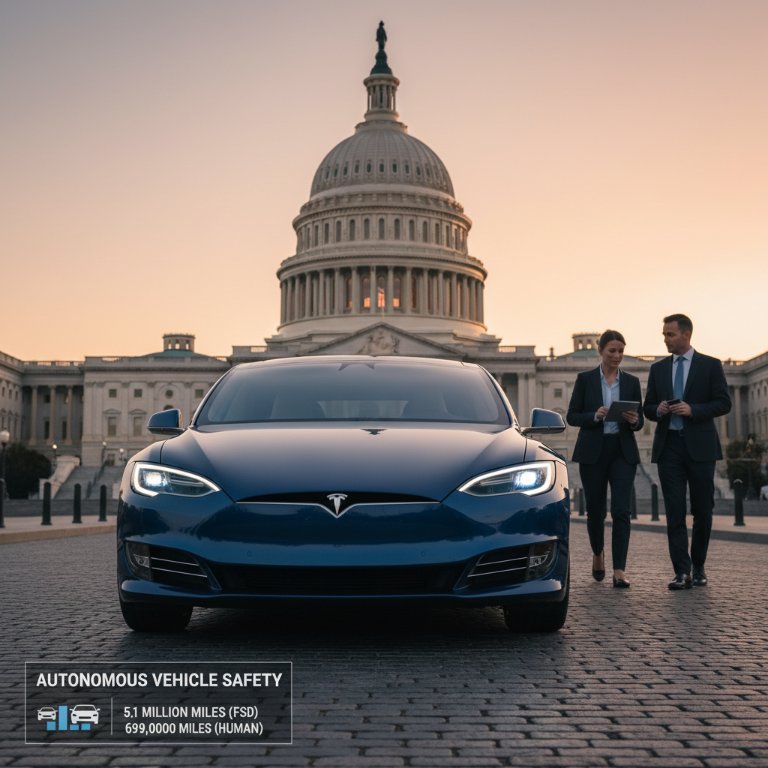
Moravy’s most impactful revelation centered on FSD’s safety performance. He highlighted that Tesla vehicles operating with FSD engaged average an astonishing 5.1 million miles between major collisions. This figure dramatically eclipses the human driver average, which stands at approximately 699,000 miles before a significant incident. While critics often point to the specific use cases and controlled environments where FSD Beta is predominantly utilized, this raw data offers a powerful counter-narrative to concerns about the technology's readiness. It also implicitly challenges the current regulatory environment that, despite these safety improvements, continues to limit broader deployment and public acceptance of these systems.
Fortifying the Digital Frontier: Tesla's Cybersecurity Stance
Addressing a paramount concern for any connected vehicle technology, Moravy robustly defended Tesla’s cybersecurity measures. He asserted that no malicious actor has ever successfully taken control of a Tesla vehicle. This impregnable security, he explained, stems from a securely core-embedded central layer complemented by dual cryptographic signatures. In an era rife with digital threats, Tesla’s proactive architectural approach to vehicle security offers a significant reassurance, differentiating its strategy from many traditional manufacturers who are still playing catch-up in securing their increasingly software-defined vehicles.
The Road Ahead: Robotaxi Ambitions Amidst L2 Reality
Despite the impressive safety metrics and robust security, Moravy confirmed that FSD currently remains classified as an L2-level assisted driving system, necessitating constant driver attention. This distinction is crucial; while FSD's capabilities often appear to border on Level 3 or even Level 4 in specific scenarios, the regulatory and liability frameworks still firmly place the onus on the human driver. Nevertheless, Tesla reiterated its ambitious plans for inclusive mobility and its long-stated vision for Robotaxi services. These services, predicated on achieving higher levels of autonomy, represent a significant revenue stream and a transformative shift in personal transportation, pending regulatory evolution.
The Urgent Call for Federal Clarity
Moravy's core message to the Senate Committee was unequivocal: the U.S. desperately needs a unified federal framework for autonomous vehicles. The current patchwork of state-by-state regulations creates a logistical and legal nightmare for developers and manufacturers, hindering innovation and safe, widespread deployment. A consistent national standard would provide the clarity and predictability necessary to accelerate the development, testing, and eventual commercialization of advanced AV technologies, benefiting both the industry and consumers through enhanced safety and mobility.
Why This Matters:
Moravy’s testimony is far more than a corporate update; it's a strategic maneuver that could redefine the conversation around autonomous vehicles in the U.S. The staggering safety statistics, if widely accepted and validated, present a potent argument against regulatory stagnation. For savvy EV enthusiasts and prospective buyers, this data directly addresses the 'why does this matter to me?' question by suggesting a tangible path to safer roads.
If FSD consistently outperforms human drivers, the societal pressure to accelerate its adoption, under appropriate safeguards, will intensify. This could be a significant win for Tesla, bolstering public confidence and potentially pressure regulators to re-evaluate current L2 limitations in light of real-world performance. Competitors like Waymo and Cruise, while focusing on higher autonomy levels from the outset, operate under different regulatory burdens and public perceptions, but a federal framework would streamline deployment for all.
The biggest loser in this scenario could be the status quo: states clinging to individual regulatory power when a national approach is clearly more efficient for a technology designed to operate across state lines. This isn't just about Tesla; it's about setting a precedent for the entire autonomous vehicle industry, signaling a potential shift from cautious skepticism to proactive enablement. For Tesla, this push for federal oversight isn't just a convenience; it's a do-or-die moment for the widespread realization of its Robotaxi vision, which requires a scalable and legally unambiguous operational environment.
Tesla’s resolute stance, backed by compelling safety data and a robust cybersecurity posture, underscores a critical inflection point for autonomous vehicle technology. The ball is now firmly in the court of federal lawmakers to forge a cohesive regulatory path, potentially unlocking a new era of safer and more efficient transportation for all. The automotive world, and indeed the world at large, awaits their response with bated breath, as the future of mobility hangs in the balance.