Tesla's FSD on the Cusp: Coordinated Messaging Hints at Imminent 'Game-Changer' Upgrade Amidst Critical Deadline
Tesla's Full Self-Driving (FSD) capability, a feature often lauded by CEO Elon Musk yet consistently scrutinized by enthusiasts and regulators, appear...
Editorial Team
World Of EV
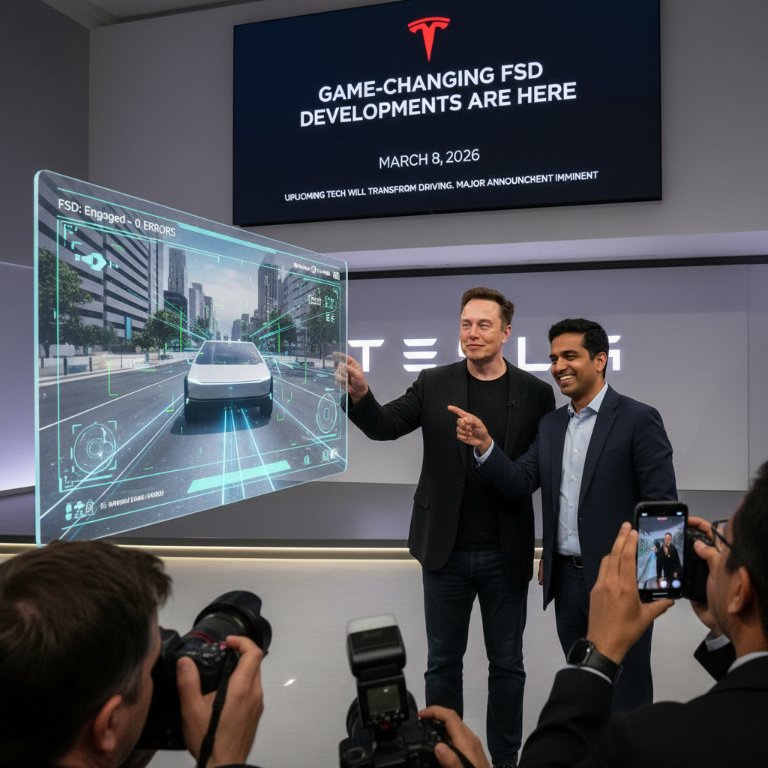
Tesla's Full Self-Driving (FSD) capability, a feature often lauded by CEO Elon Musk yet consistently scrutinized by enthusiasts and regulators, appears poised for a monumental leap. On March 8, 2026, a coordinated series of posts from Musk, the official Tesla account, and Autopilot Director Ashok Elluswamy sent ripples through the automotive world, strongly suggesting a significant FSD announcement or substantial capability upgrade is imminent. This high-level, synchronized communication follows a history of both groundbreaking advancements and unfulfilled promises in the realm of autonomous driving, setting a high bar for what's to come.
The timing of this strategic communication is particularly noteworthy, coinciding with a critical ownership deadline looming for current and prospective FSD users. Tesla's decision to pivot to a subscription-only model for FSD purchases starting April 1, 2026, and the strict March 31, 2026 deadline for FSD transfers to new vehicles, adds immense pressure and anticipation to any impending technological breakthrough.
The Coordinated Drumbeat of Change
The messaging was unequivocal and orchestrated. The official Tesla account initiated the flurry with a video promoting FSD (Supervised), highlighting its potential to grant owners unprecedented freedom. This was swiftly followed by Autopilot Director Ashok Elluswamy, the engineering architect behind Tesla's autonomous systems, teasing that while the current system is impressive, "the upcoming tech will make it even more so." Just minutes later, Elon Musk himself concluded the sequence, boldly declaring Tesla's self-driving a "game-changer" without qualification.
- Elon Musk: Declared FSD a "game-changer."
- Ashok Elluswamy: Teased "upcoming tech" to make FSD "even more transformative."
- Official Tesla Account: Promoted FSD (Supervised) as a freedom-granting feature.
- Timing: All posts occurred within an hour on March 8, 2026, signaling a deliberate and impactful campaign.
This concerted effort from the highest echelons of Tesla signals a shift beyond incremental updates. It suggests a foundational improvement that Tesla believes will fundamentally alter the user experience and potentially reshape the industry's perception of FSD. The mention of "upcoming tech" from Elluswamy, an engineer known for his precise language, typically indicates a release within weeks, not quarters, further fueling expectations.
FSD's Trajectory: From Vision to 'Supervised' Reality
To fully appreciate the weight of these new pronouncements, it’s crucial to recall FSD's journey. Tesla introduced Autopilot years ago, progressively evolving it into the Full Self-Driving Beta program, which has since been rebranded as FSD (Supervised). This system has steadily improved, allowing vehicles to navigate complex urban environments, handle traffic lights, and execute turns. However, despite its ambitious name, FSD (Supervised) still requires active driver attention and intervention, falling short of true Level 4 or Level 5 autonomous driving.
Past iterations have seen incremental gains, but also moments of controversy and a persistent gap between Musk's bold predictions and the on-road reality. The sheer volume of cumulative FSD miles – now approaching 8.4 billion – provides an unparalleled dataset for training Tesla's neural networks. However, the public's perception of FSD remains tied to its ability to reliably and safely operate without human intervention.
Anticipating the 'Upcoming Tech'
What could this "upcoming tech" entail that prompts such confident declarations? Given past statements and ongoing development, it likely points to significant advancements in Tesla's core AI models and reasoning capabilities. Elluswamy himself previously indicated that "more and more reasoning" would ship in Q1 2026, suggesting a deeper integration of logical decision-making into the FSD stack.
- Enhanced Reasoning & Reinforcement Learning: Expect FSD to exhibit more human-like decision-making, particularly in ambiguous or complex scenarios, potentially utilizing an "order of magnitude larger" neural network model. This could involve better prediction of other road users' intentions and more sophisticated path planning.
- Improved Edge Case Handling: A key hurdle for autonomous systems is reliably navigating unexpected or rare events. The new tech might significantly reduce the need for driver interventions in these challenging "edge cases."
- Broader Geofencing & Unsupervised Capability: While a full rollout of unsupervised FSD is likely gradual and regulatory-dependent, this update could pave the way for expanded geofenced areas where Level 4 operation becomes feasible, moving towards the long-teased Robotaxi vision.
- FSD v14 Expansion: With FSD v14 already live on HW4 vehicles utilizing a neural network 10 times larger than its predecessor, the new tech could be an expansion of these capabilities to a wider range of vehicles or further refinements of this advanced architecture.
Why This Matters:
- Credibility on the Line: Tesla has consistently positioned itself as a leader in AI and autonomous driving. A truly transformative FSD upgrade could silence skeptics and validate years of development, bolstering the company's long-term vision and stock valuation. Conversely, if the "game-changer" falls short, it could further erode trust among a segment of its customer base.
- Driving FSD Adoption and Revenue: The March 31 deadline for FSD transfers and the transition to a subscription-only model are direct drivers for a sales push. A compelling, demonstrably superior FSD could motivate fence-sitters to purchase the feature outright or subscribe before the terms change, directly impacting Tesla's bottom line.
- Competitive Pressure: A significant leap from Tesla would intensify pressure on rival autonomous driving companies like Waymo, Cruise, and Mobileye. While these competitors often operate within different business models (e.g., geofenced robotaxi services), Tesla's progress influences public perception and the broader investment landscape for self-driving technology.
- Regulatory Scrutiny: As FSD capabilities advance, so too will the scrutiny from regulatory bodies worldwide. A system verging on true autonomy will demand even more rigorous safety validation and clearer operational guidelines, potentially accelerating or delaying wider deployment.
- Future of Mobility: If Tesla truly unlocks a "game-changer," it brings the vision of widespread autonomous vehicles closer to reality, potentially reshaping urban infrastructure, logistics, and how we interact with personal transportation. This isn't just about Tesla; it's about setting a new benchmark for what's possible in automotive AI.
Conclusion:
Tesla's synchronized declarations regarding FSD signify more than just an impending update; they herald a potential inflection point for the company's most ambitious technology. With a critical ownership deadline rapidly approaching, the pressure is immense for Tesla to deliver on its "game-changer" promise. The industry, investors, and enthusiastic owners will be watching closely to see if this is the moment FSD truly transitions from an advanced driver-assistance system to a revolutionary step towards full autonomy, reshaping the future of electric mobility.