Tesla's FSD Navigates a Dual Reality: Global Expansion Meets Heightened Regulatory Scrutiny
Tesla's Full Self-Driving (Supervised) system finds itself at a critical juncture, simultaneously expanding its global reach and facing an intensified...
Editorial Team
World Of EV
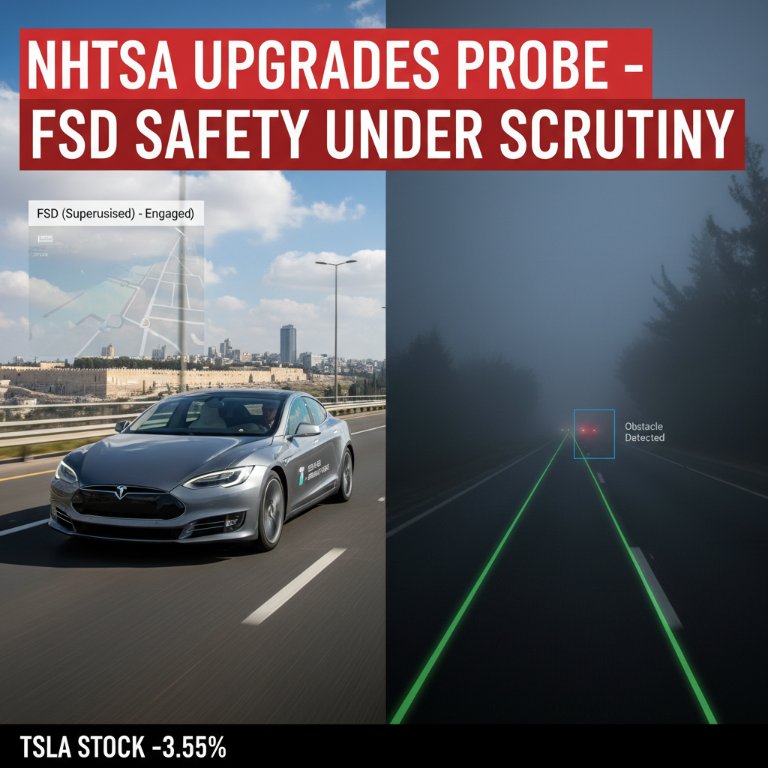
Tesla's Full Self-Driving (Supervised) system finds itself at a critical juncture, simultaneously expanding its global reach and facing an intensified regulatory spotlight. Just as Israel prepares for the imminent consumer launch of FSD, following public road trials that began on February 1, 2026, marking a significant expansion into a new market, the US National Highway Traffic Safety Administration (NHTSA) has escalated its investigation into the system, now encompassing a staggering 3.2 million vehicles. This dichotomy underscores the immense promise and persistent challenges inherent in the quest for true autonomous driving.
FSD Expands Its Global Footprint with Israel Launch
Tesla’s strategic push for global FSD adoption is gaining traction, with Israel being the latest territory to welcome the advanced driver-assistance system. The Israeli Ministry of Transport publicly teased the imminent consumer launch, a move that follows dedicated public road trials initiated on February 1, 2026. This expansion is not merely about market penetration; it's about broadening FSD's operational dataset and gathering real-world performance metrics across diverse road conditions, traffic patterns, and regulatory environments outside of its primary markets like North America.
Overcoming Adversity: FSD's Progress in Challenging Conditions
Amidst the regulatory storm, new evidence suggests FSD is making strides in tackling some of the most formidable challenges for autonomous systems. A recent video, shared by prominent Tesla observer Whole Mars Catalog, showcased the Full Self-Driving system confidently navigating dense fog. The footage demonstrates FSD maintaining lane position, managing speed effectively, and exhibiting robust obstacle awareness, all without any reported driver intervention. This particular demonstration highlights an important step forward in FSD's ability to handle low-visibility conditions, an area where all autonomous technologies have historically struggled.
NHTSA Intensifies Scrutiny: A Cloud on the Horizon
Despite these advancements, the regulatory environment for FSD in the United States is becoming increasingly challenging. The US National Highway Traffic Safety Administration (NHTSA) has significantly escalated its ongoing investigation into Tesla's Full Self-Driving system, upgrading it to an 'engineering analysis.' This deeper probe targets 3.2 million vehicles and is specifically focused on evaluating FSD's capacity to detect degradation in performance and provide timely, adequate alerts to drivers when operating in poor visibility conditions, such as glare, fog, or dust. This escalation follows a series of reported crashes where the system allegedly failed to adequately warn drivers, contributing to a 3.55% drop in Tesla Inc. stock on March 26.
Why This Matters:
This evolving narrative represents a crucial moment for Tesla's ambitious autonomous driving program and the broader EV industry. For savvy EV enthusiasts and prospective buyers, the Israel launch signifies that FSD, despite its 'supervised' designation, is maturing and expanding its capabilities into more diverse global contexts, potentially leading to a richer, more robust system globally. The demonstrated improvement in handling dense fog is a tangible win, directly addressing a common fear factor for autonomous driving: adverse weather conditions. If FSD can reliably navigate such scenarios, it significantly boosts confidence in its underlying technology.
However, the intensified NHTSA investigation looms large. This isn't simply a continuation of existing concerns; an 'engineering analysis' is a serious escalation, indicating that regulators are looking for systemic issues that could lead to recalls or mandatory design changes. This scrutiny could slow FSD's deployment in key markets, potentially impacting Tesla's revenue streams and reputation. The market's immediate reaction, with Tesla's stock dip, signals investor apprehension about the potential financial and operational costs associated with regulatory demands. This signals to the entire autonomous vehicle market that robust safety mechanisms, clear driver warnings, and flawless performance in edge cases like poor visibility are not just technical goals but regulatory imperatives. Who wins? Drivers in Israel gain access to advanced tech. Who loses? Tesla, potentially, if this investigation results in significant setbacks or mandates that slow innovation or increase costs. Ultimately, the biggest winner could be the public, as this regulatory pressure will undoubtedly push Tesla and others to prioritize safety and transparency in the development of increasingly capable, yet still 'supervised,' autonomous systems.
Tesla's journey with Full Self-Driving remains a compelling saga of pioneering technology battling complex real-world variables and formidable regulatory oversight. As FSD rolls out to new territories and demonstrates improved capabilities, the intensified scrutiny from regulatory bodies like NHTSA ensures that the path to full autonomy, even supervised, will be paved with rigorous safety assessments and an unwavering focus on driver accountability and system reliability.