Tesla's FSD Fleet Surpasses 8.4 Billion Miles, Paving the Way for Unsupervised Autonomy; Cybertruck Refinements Enhance Drivability
Tesla's Full Self-Driving (FSD) system continues its relentless march towards autonomous driving, with its global supervised fleet exceeding an astoni...
Editorial Team
World Of EV
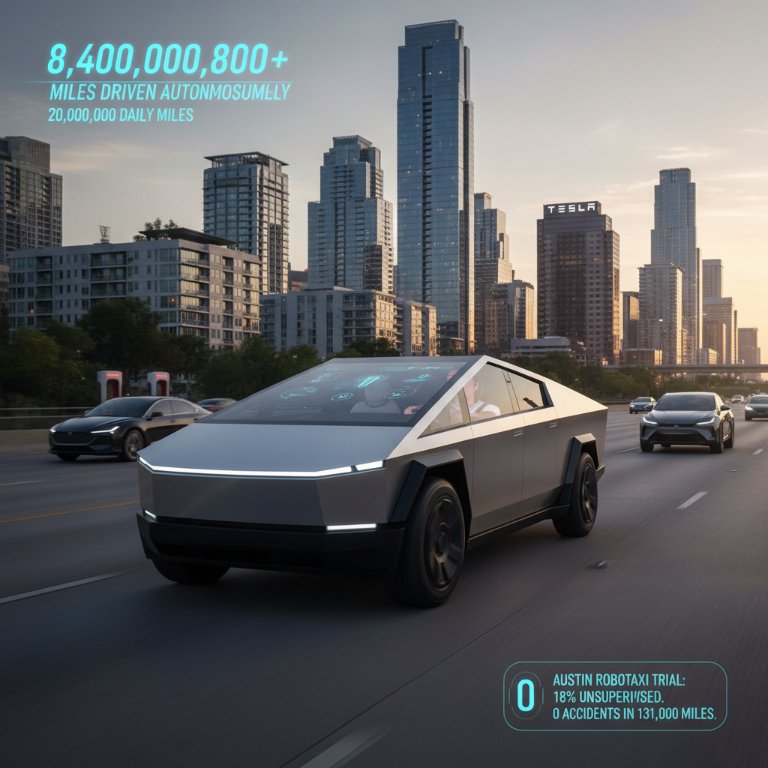
Tesla's Full Self-Driving (FSD) system continues its relentless march towards autonomous driving, with its global supervised fleet exceeding an astonishing 8.4 billion accumulated miles as of February 28, 2026. This monumental data collection, accelerating with over 20 million FSD miles driven daily in the first quarter of 2026, positions Tesla uniquely in the race for true self-driving capabilities. Simultaneously, the 2026 Tesla Cybertruck receives crucial refinements, enhancing its software and overall drivability, signaling Tesla's ongoing commitment to evolving its product line.
Tesla's approach to autonomy has always hinged on real-world data, a strategy that sets it apart from competitors relying more heavily on simulation or smaller, geofenced fleets. The sheer scale of 8.4 billion miles, with a remarkable 1 billion miles added in just the first 50 days of 2026, provides an unparalleled training ground for its neural networks. This rapid data accumulation is crucial for addressing the 'long tail' of rare driving scenarios that CEO Elon Musk believes will require roughly 10 billion miles to achieve safe, unsupervised self-driving at scale.
Austin Robotaxi Trial: A Glimpse into Unsupervised Operation
The real-world application of this data is becoming increasingly evident in Tesla's Austin robotaxi trial. A significant 18% of trips in this program are now fully unsupervised, a notable increase from the previous 13%. Critically, the program reports no accidents in the last 131,000 miles as of March 1, 2026, a testament to the system's improving real-world performance. This progress occurs even as previous reports indicate 14 crash incidents since the service launched in June 2025, some involving minor injuries, with Tesla redacting accident narratives—a point of contention for some regulators and safety advocates. Nevertheless, the recent accident-free streak in unsupervised operation highlights the rapid learning curve and refinement of Tesla's FSD software in a commercial setting. Tesla's published safety statistics also assert that FSD (supervised) cars experience a major accident only once every 5.3 million miles, significantly outperforming manual driving.
Cybertruck Refinements Enhance User Experience
The polarizing 2026 Tesla Cybertruck also sees continuous improvement. Beyond mere aesthetic tweaks, recent enhancements focus on software optimizations and improved drivability. Early adopters often face initial product quirks, and Tesla's over-the-air update capabilities allow for agile responses to user feedback. These refinements likely encompass:
- Software Enhancements: Improving the user interface, vehicle controls, and integration with FSD.
- Drivability Improvements: Refinements to suspension tuning, steering response, and overall vehicle dynamics for a smoother, more intuitive driving experience.
- Efficiency Optimizations: Potentially including new variants of the 4680 battery and improved battery management software, contributing to the Cybertruck's impressive 400-500 mile range and 600-845 horsepower.
- Interior Upgrades: The introduction of new textile seat options for certain trims, enhanced interior materials, better sound insulation, and updated software animations contribute to a more premium cabin experience.
Why This Matters:
This confluence of advancements signals a critical juncture for Tesla and the broader EV industry. The sheer volume of FSD data offers an undeniable advantage, creating a virtuous cycle where more miles lead to more data, leading to better AI, and ultimately, safer and more capable autonomous systems. This data moat makes it incredibly challenging for competitors to catch up, particularly those without a massive installed customer fleet actively contributing driving data. The increasing percentage of unsupervised robotaxi trips in Austin is not just a technical milestone; it’s a tangible step towards a scalable, profitable robotaxi network that could fundamentally reshape urban transportation and unlock a massive new revenue stream for Tesla. If Tesla can effectively scale this model, it could dramatically undercut traditional ride-sharing services and even public transport on a per-mile cost basis, as suggested by some analyses.
For Cybertruck owners and prospective buyers, the continuous refinements demonstrate Tesla's commitment to perfecting its ambitious, if controversial, electric pickup. Addressing early drivability concerns and rolling out software enhancements will bolster confidence and expand its appeal beyond the initial enthusiast base. This iterative improvement process is crucial for a vehicle that aims to redefine a segment traditionally dominated by internal combustion engines. Tesla's ability to refine its products post-launch, leveraging OTA updates, is a key competitive differentiator, ensuring its vehicles remain at the cutting edge throughout their lifecycle.
Looking ahead, Tesla's trajectory suggests a future where autonomous driving moves from a theoretical concept to a widespread reality, propelled by unprecedented data collection and continuous software evolution. The ongoing progress in FSD and the concurrent maturation of vehicles like the Cybertruck underscore Tesla's dual strategy: pushing the boundaries of autonomous technology while simultaneously refining its innovative EV lineup. The next few years will undoubtedly reveal the full economic and societal impact of these advancements.